
Are you a robot?

The question posed as the title of this piece might appear to be one that is easy to answer or might seem rhetorical but it is a question we will soon have to take seriously with regards to our future and humanity’s trajectory moving forward.
I do not have a crystal ball but I suspect we will be forced to make a tough decision in the coming years where we will have to choose either to be upgraded aka microchipped to be a cyborg or to take the tough road of remaining natural and organically human as we have always known humans to be.
Might seem like a forgone conclusion but when our means of livelihoods is threatened, personal and social friendships are threatened and the media has successfully propagandized millions to go along with the “current thing”, will you be able to withstand the onslaught, name calling and being ostracized by family or friends?
We are slowly getting to this point so prepare yourselves for what is to come. Of course, with no fanfare or public discourse on the ethics, safety and risks of the Brain Computer Interface (BCI).

Like I have mentioned in the article above with reference to Elon Musk’s Neuralink company and the development of brain implants, another competing company called Synchron has begun human trials of its brain implant that lets the wearer control a computer using thought alone.
Synchron appears to be advancing at a much faster pace than Elon’s Neuralink with their development of the Stentrode brain implant, about the size of a paperclip and are already undergoing human trails.
The Stentrode brain implant will let patients control digital devices just by thinking and give them back the ability to perform daily tasks, including texting, emailing and shopping online.
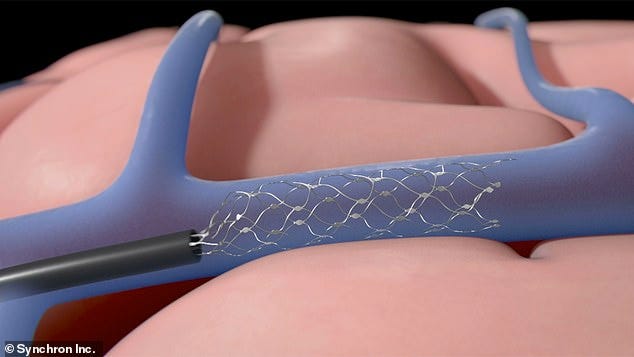
Synchron’s BCI consists of a scaffold made from a flexible alloy called nitinol. This scaffold is dotted with electrodes, which can record neural signals in the brain.
The device can be implanted into the blood vessel and implantation will be carried out through “a small keyhole” incision in the neck. Once in place it expands to press the electrodes against the vessel wall close to the brain where it can record neural signals. This signal is then transmitted out of the brain directly to targeted areas into a unit implanted under the skin in the chest area.
According to Synchron:
“This [chest] unit is programmed to pick up brain signals continuously and when connected to an external receiver can send them to a computer.
Ultimately, this means the patient can control what's on the computer screen, such as a cursor or an on-screen keyboard.
The command center of the brain is now directly connected to software and the patient would attempt to train their brain for direct operating system control.”
This is not far from what many have been alarmed about (rightly so) with respect to data and privacy rights. Attempts to call other people’s attention to the ominous and far reaching technology seem to be falling on deaf ears as many are so distracted looking down at their phones.
Similar ideas are out there that aim to connect thoughts with the virtual world is taking shape. One of particular concern is the Japanese Moonshot program, that is aiming to achieve its objectives by the year 2050, where people will have “cybernetic avatars” that will provide a hyper virtual reality experience that shifts seamlessly between cyberspace and physical space.”
If this technology like the one mentioned above is perfected and the BCI controls a computer by thought alone, then how easy will it be to reverse the process so that computer can control a brain, or millions of brains?
Not to mention the blatant military, defense and national security applications that it reeks of and the complete disregard of human nature all together!
How do we square the circle when or if there is a hack or internet shut down?
Something similar happened yesterday (16th of May 2022), where bank cards, ATMs and all 120 000 to 130 000 payment terminals in all of Norway were down for several hours. Do people run around in circles without access to their thoughts and minds if the internet is down? Will be able to use their minds once again?
We are slowly getting there with thousands of Swedes already using a microchip (RFID- Radio Frequency Identification) implant in their hands to use for cashless payments and Norway also in lockstep as it was announced only a few weeks ago that they are getting a new system for digital ID where people can use facial recognition or fingerprint scanning to verify their identity online.
I wonder if the outage of yesterday displayed the weakness of a cashless/technological society to many of Norwegians. The lesson here is: if the system goes down, it causes chaos and disruption to everyday life.
Hopefully, this will give one person a moment of clarity to reconsider the trajectory of travel of the so called cashless society that is heralding the Transhumanist and Singularity movement.
See you tomorrow!
- Ope