
Constitutions to Smart Contracts

Two weeks ago, America celebrated 250 years of independence. Fireworks. Flags. Barbecues. Speeches about freedom.
Three months from now, Nigeria will celebrate 66 years of its own. Parades. Presidential addresses. The green-white-green. Speeches about sovereignty.
Neither country is asking the right question: independent from what?
Because here is the pattern, and it runs deeper than any flag ceremony on either continent. Power doesn’t disappear. It migrates to a deeper abstraction layer. And every time it migrates, it wraps itself in the language of liberation: “independence,” “stability,” “innovation,” “democratization,” “decentralization” so that the people whose sovereignty is being relocated applaud the move instead of resisting it.
Track it.
Kings claimed divine right. “God” ordained the Crown. When that claim became too expensive: too many wars, too many famines, too much distance between throne and taxed, sovereignty migrated. The Declaration of Independence relocated it to the individual. “All men are created equal.” No inherited titles. No divine proxy. The people are sovereign.
It worked. For a time.
Then the function of the Crown migrated again. December 23, 1913. Woodrow Wilson signed the Federal Reserve Act. The power to create money, arguably the most sovereign power there is, because it determines the purchasing power of every hour of every person’s labor, moved from elected legislatures to a quasi-private institution. Twelve regional banks, a Board of Governors, and a structure specifically designed to operate at arm’s length from democratic accountability. The earlier attempts had been cruder (First Bank of the United States, 1791; Second Bank, 1816, Andrew Jackson killed it). But the function kept looking for a new body, and in 1913 it found one.
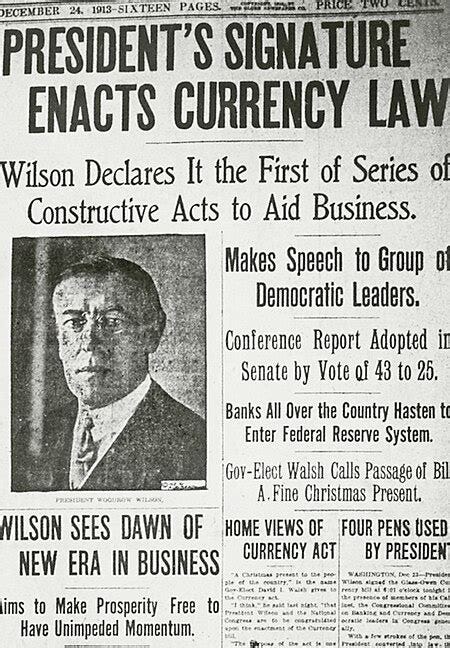
People still voted. They still felt free. They just no longer voted on the thing that mattered most: how much their money was worth.
Now. The next migration.
Larry Fink is the CEO of BlackRock, over $14 trillion in assets under management, the world’s largest investment firm. He is also, since August 2025, the Interim Co-Chair of the World Economic Forum, replacing Klaus Schwab, who founded the organization in 1971 and stepped back after an internal investigation. The man who manages more money than anyone on earth now also co-chairs the institution that convenes the regulators who govern the financial system.
Hmmm.
From that position, here is what he says: “We’re not spending enough time talking about how quickly we’re going to tokenize every financial asset.” He called tokenization “probably one of the most exciting potential markets for BlackRock.” He said his firm needs to “move rapidly, not just financial assets, but we need to be tokenizing all assets, especially assets that have multiple levels of intermediaries.” He compared it to the internet in 1996. He described it as “changing the technology around the plumbing of finance.”
“Plumbing.” We’ll come back to that.
BlackRock’s BUIDL fund, a tokenized money market fund launched in March 2024 now holds $2.85 billion. Minimum investment: $5 million. Qualified institutional investors only. The firm has nearly $150 billion in AUM connected to digital assets, $65 billion in stablecoin reserves, roughly $80 billion in digital asset exchange-traded products.
But BlackRock is not building alone. The settlement infrastructure race of 2026 has three lanes, and over a billion dollars has been poured into them in six months:
Canton Network: Digital Asset’s permissioned blockchain for institutional finance. Raised $355 million in June 2026, led by a16z crypto. Investors: HSBC, BNP Paribas, Citadel Securities, CME Ventures, Apollo Funds, Abu Dhabi Investment Authority, Goldman Sachs, DTCC, S&P Global, Broadridge, Tradeweb. Valuation: $2 billion. Seven hundred ecosystem participants. Claims $4 trillion in monthly transaction activity. Consortium-governed. “Need-to-know” privacy model: data shared only with authorized parties.
Tempo: Stripe and Paradigm’s payments blockchain. Raised $500 million at a $5 billion valuation. Mainnet launched March 2026. Design partners: Visa, Mastercard, Deutsche Bank, Standard Chartered, Revolut, Nubank, Shopify, OpenAI. Launched the Machine Payments Protocol, an open standard that lets AI agents make autonomous payments without human approval at each step. Matt Huang, Paradigm’s co-founder, serves as CEO.
Circle Arc: Circle’s institutional Layer 1 blockchain. Raised $222 million in a presale at a $3 billion fully diluted valuation in May 2026. Backers: BlackRock, Apollo, a16z crypto, ARK Invest, Intercontinental Exchange (parent of the New York Stock Exchange). Over 100 institutional participants on the public testnet, including Visa and Goldman Sachs. USDC as the native gas token. Designed for settlement, tokenized assets, and regulated financial systems.
Three networks. Different architectures. Different branding. Same investor class. Same direction.
BlackRock appears on multiple cap tables. Apollo appears on multiple cap tables. a16z crypto appears on multiple cap tables. Goldman Sachs appears on multiple cap tables. Visa appears on multiple cap tables. The same institutions hedging across all three lanes of the race to own the settlement layer. It doesn’t matter which network wins. What matters is that the same consortium of actors controls whichever one does.
Cui bono?
Here is the infrastructure, and I want it to land clean.
A currency can be spent. You hold a dollar. You spend a dollar. The dollar does not check your identity, verify your income, screen your jurisdiction, expire on a schedule, restrict where it can be redeemed, or report your transaction to a consortium governance board.
A token can do all of that. And the ones being built right now do.
BlackRock’s BUIDL enforces a wallet whitelist through smart contracts. If your wallet isn’t approved, verified through identity checks, income verification, jurisdiction screening, the token physically cannot transfer to you. The accreditation gates (Regulation D: $200,000 annual income or $1 million net worth) are not policy on top of the technology. They are encoded in the token itself. Canton’s consortium determines validator eligibility and protocol upgrades. Tempo’s Machine Payments Protocol lets AI agents transact autonomously, which means the decision about whether a payment clears can be made by software, not by a person.
The monetary architecture and the digital infrastructure are not parallel systems. They are fused inside the token. The token carries the value and the conditions under which that value can be accessed, transferred, or revoked. The platform operator controls issuance, access, settlement, dispute resolution, and revocation.
That is not money. That is permission.
Now here is the escalation that nobody in the tokenization space seems willing to say out loud.
LFG.
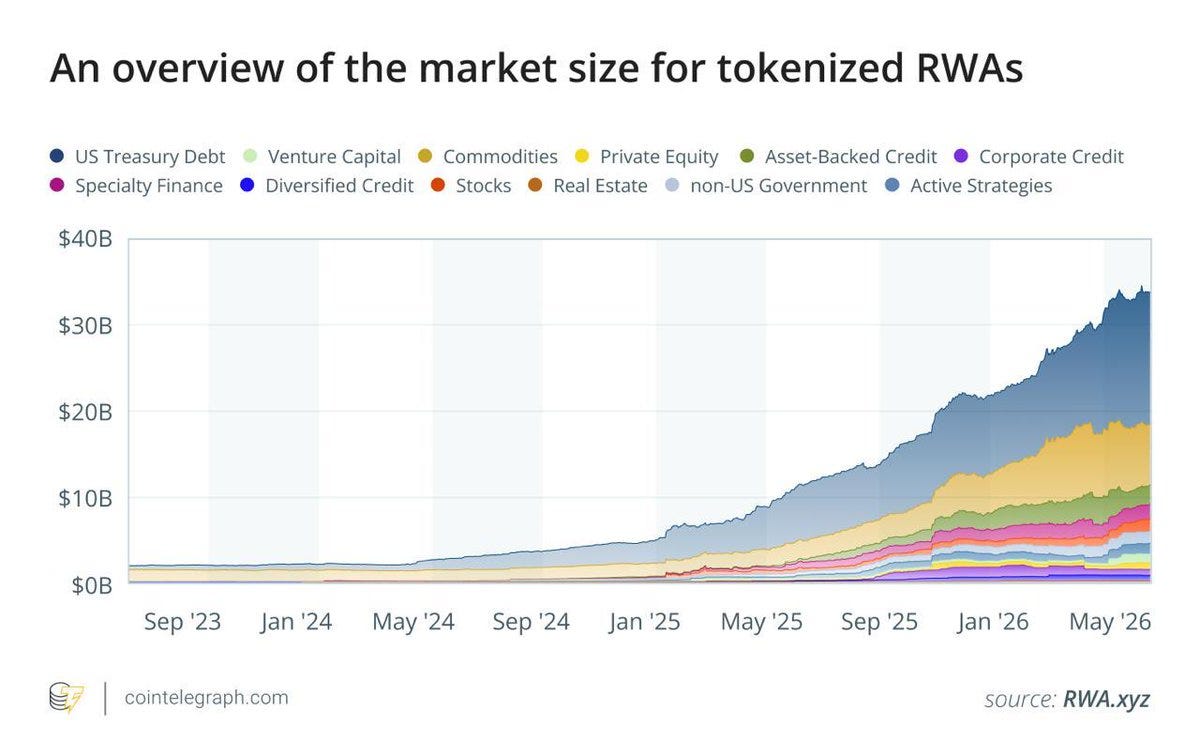
Fink said “all assets.” Not financial instruments. All assets. The scope: grains, precious metals, farmland, art, forests, energy, nature itself. The tokenized real-world asset market just hit an ATH of $33 billion in on-chain value. But the RWA acronym hides the stakes. When you tokenize a forest, whoever governs the token governs the forest. When you tokenize farmland, whoever controls the settlement layer controls the food supply. When you tokenize “all assets,” you are migrating reality itself onto digital rails whose operator becomes the new sovereign.
We have gone from Kings to Sovereign State to Central Bank to Tokenized Platform.
Same game. Four costumes. Each one a deeper abstraction layer. Each one harder to see, harder to resist, harder to hold accountable.
And now, the absence that should be screaming.
The founders of the American republic understood something most people celebrating July 4th have forgotten: centralization is the default tendency of power. Left unchecked, it consolidates. Always has. So they built firewalls. Separation of powers: executive, legislative, judicial. Bill of Rights, protections the sovereign cannot override. Habeas corpus. Jury trial. Due process. Imperfect firewalls (they excluded enslaved people, indigenous populations etc) but the structural idea was embedded in the design: sovereign power must be checked, distributed, and held accountable.
The tokenized system has none of this.
Canton’s consortium governs itself. Tempo’s protocol lets machines pay machines without human oversight. Arc’s validator infrastructure is run by Circle itself (25% of token supply allocated to its own validator operations). No separation of powers within any of these networks. No bill of rights for token holders. No judicial review of smart contract enforcement. No habeas corpus for a revoked token. No due process for a wallet kicked off the whitelist.
The governance framework that the founders built to check sovereign power does not extend to the layer where sovereign power has migrated. The constitution governs the state. It does not govern BlackRock’s smart contracts. It does not govern Canton’s consortium. It does not govern Tempo’s Machine Payments Protocol.
The firewalls stopped at the old perimeter. The power moved past them.
And here is where the Nigerian parallel illuminates the pattern more clearly than the American one does.
October 1, 1960. Lagos Race Course. Midnight. The Union Jack came down. The green-white-green went up. Princess Alexandra represented the Queen. Prime Minister Abubakar Tafawa Balewa declared: “This is the day we have been waiting for.”
Nigeria was technically independent. Sovereign. Free.
Except.
Shell-BP kept the oil concessions. Sterling zone monetary policy kept governing the currency. Commodity pricing stayed in London. The Northern and Southern Protectorates that Lord Lugard had amalgamated in 1914, for British administrative convenience, not Nigerian self-determination remained the geographic template for the “independent” federation. The borders were Britain’s. The economic architecture was Britain’s. The extractive infrastructure was Britain’s. What Nigeria received on October 1, 1960 was the ceremony of sovereignty without the machinery of it.
Sixty-six years later, the same pattern is being digitized.
Nigeria passed the Investment and Securities Act 2025 formally classifying digital assets as securities under SEC Nigeria oversight. VASP licensing mandatory. KYC, AML compliance operational. The regulatory framework exists. But the settlement infrastructure that tokenized securities run on is being built by consortiums headquartered in New York (Canton, Digital Asset), San Francisco (Tempo, Stripe/Paradigm), and Delaware (Arc, Circle). The validators are theirs. The governance is theirs. The protocol upgrades are theirs.
Nigeria can regulate the tokens. It cannot govern the rails they run on.
Same operation. Different century. Same continent on the receiving end.
In 1776, the American revolutionaries understood that political independence without monetary sovereignty was incomplete, which is why the debates over the First Bank of the United States were so vicious and why Andrew Jackson killed the Second one. In 1960, the Nigerian nationalists understood it too, which is why the CFA franc zone and the sterling area were battlegrounds for real sovereignty, not just the flag ceremony. In 2026, the question is the same: if the settlement layer is someone else’s, what exactly are you independent of?
And about that “plumbing” metaphor.
SWIFT was “plumbing” too. Neutral. Technical. Boring. Just pipes. Until Washington needed to punish Russia in 2022, and the neutral pipes became a weapon overnight. No army. No UN vote. Just a call to the pipe operator.
When Fink calls tokenization a “plumbing upgrade,” he is performing a rhetorical operation. He is recategorizing a political reorganization of sovereign power as a technical renovation. The metaphor makes sovereignty sound like a bathroom remodel. “We’re just fixing the pipes.” The pipes determine who can access the financial system, under what conditions, with whose permission, and who captures the margin. Those are not pipes. Those are power lines.
Over $1 billion in settlement infrastructure funding in the first half of 2026. Canton: $355 million. Tempo: $500 million. Arc: $222 million. BlackRock, Apollo, Goldman, a16z, Visa, Mastercard, HSBC, Citadel, the same names appearing across all three. The concrete is being poured. Not in one trench, but in three simultaneously so that whichever network becomes the settlement standard, the same consortium of actors controls the substrate.
The structural answer to sovereign migration hasn’t changed in 250 years, or 66. Decentralization. Distribution of power. Public infrastructure that cannot be captured by the consortium that built it. Open protocols. Self-custody. Parallel systems. The founders in Philadelphia knew it. The nationalists in Lagos knew it. The question is whether this generation knows it, or whether the celebrations of independence have become so ritualized that nobody checks whether the thing being celebrated still exists.
Tafawa Balewa said on October 1, 1960: “This is the day we have been waiting for.”
Ben Franklin said (reportedly) in 1787: “A republic, if you can keep it.”
Both were warnings dressed as celebrations.
The settlement layer is being poured. $1 billion in six months. The throne has migrated to the server room, wearing a fresh costume labeled “plumbing upgrade,” while two countries, and a hundred others celebrate an independence that was relocated two abstraction layers ago.
Is there still time to build the firewalls?
That depends on whether anyone still knows what a firewall is for.
Khaki & leather tracks the migration of power in real time, from the only vantage point that has watched sovereignty ceremonies end in extraction for sixty-six years running.
"Power doesn’t disappear. It migrates to a deeper abstraction layer." Wow. So profound. That captures the entire playbook of hierarchy. It happened with the transfer from the Torah, where violence was blatant, to the gospels, where the Jesus story was subtle propaganda for the empire. He was positioned as a rebel, crucified by the Romans except they bear no blame--only the true rebels--the Judeo-Samaritans. And the new Roman Empire is Holy. What a slick trick!
The same thing happened in the world wars. Adolf is presented as the rebel against global domination by the money system. But he's really working for Rothschild. He makes monetary sovereignty forever conflated with genocide. And the people who actually did it and the ones who were its victims are reversed. As I titled my culminating article on my research: Coins over kings. There's no longer a figurehead to depose. It's all abstracted.
And here's the great benefit of abstractions ... for them. They can only be communicated in symbols. If they can control the symbols--the words and stories--that abstraction is too slippery to be communicated. It becomes a maze no one has the diligence to follow the trail out of.
Before the WWs, linguists talked about Aryan-root languages instead of the nonsensical PIE. That got too close to them figuring out they were imposed from above by a tiny dynasty with a winning formula for colonization, not a vast migration escaping the ice age. So Adolf was sent to scramble that word, among other agendas like turning the oldest Goddess symbol of the suvastika into his logo. Now, we can only use abstractions like 'rulers' or 'globalists', not the Ayro/ Hiero who were the originators of hierarchy and the hieroglyphs that erased and overwrote all previous language like a palimpsest.
For instance, you use the word sovereign. What does it mean? It's the closest word we have for people ruling over themselves. Yet it also means someone who has the power to rule over everyone else. Very confusing, intentionally so. We have no language to talk about self-rule. Anarchy, meaning without rulers, has been turned into chaos and no rules. Conveniently.
Also, it's as important for you to learn the true history of the US from me as it is for me to learn the true history of Nigeria from you. Monetary self-rule started in the British colonies, was exemplified by Franklin's system in the Commonwealth of Pennsylvania, and was ended by the British. The American Revolution was in reaction to that but they never got it back because it was usurped by those 'founders' who were just like your imperial lackies behind the Nigerian ruler. Instead of being paid for their service, their farms were repossessed for back taxes, leading to Shay's Rebellion for sovereign money. Hamilton worked for the bankers, of course. He drafted the Constitution to make sure no state could ever issue their own money for internal trade. The states wouldn't ratify it without the promise of a Bill of Rights, which he called his 'nauseous project' when he put in pablum that couldn't be enforced or enacted. You'll see the relevant chapters on this in the summary of my book.
Last, money has always been tokenized. I call the currencies 'empire chips.' They give the holder the ability to take a share of the pillaged loot from the slave and resource colonies, aka Nigeria. We trade these empire chips around between ourselves but the value that backs them is you. In the end, they have to be worth more than our labor can produce. Otherwise, we'd figure out that we could trade between ourselves directly. But there's no way to compete with slave labor. And that's why the Constitution also enshrined slavery and made everything but the money and slavery open to amendment. Those were the only things that mattered.
Thanks for the education and thought provocation, Ope!