
DO INTERNATIONAL ORGANIZATIONS REINFORCE THE POWER OF THE STRONG OR REINFROCE THE POSITION OF THE WEAKER ACTORS?

Referring to Intergovernmental Organizations as IO’s in this case and to answer the question above: Yes and Yes. This is a double question and I would give reason to answering in the affirmative; Of course, most IO’s reinforce the power of the strong e.g., WTO, World Bank, IMF and also with the help of other IO’s like the Non Governmental Organization’s (NGO) that purport to help the “needy”, they are also reinforcing the position of the weaker actors as the victim while emphasizing the strong actors as the savior. Lets start by focusing on the former that most IO’s reinforce the power of the strong;
Firstly, it was the strong powers that validated and implemented IO’s and the same strong powers that allocate high amount of funds for their operations (See image below). They still continue to do so as a means of soft power projection of their reach and capabilities.
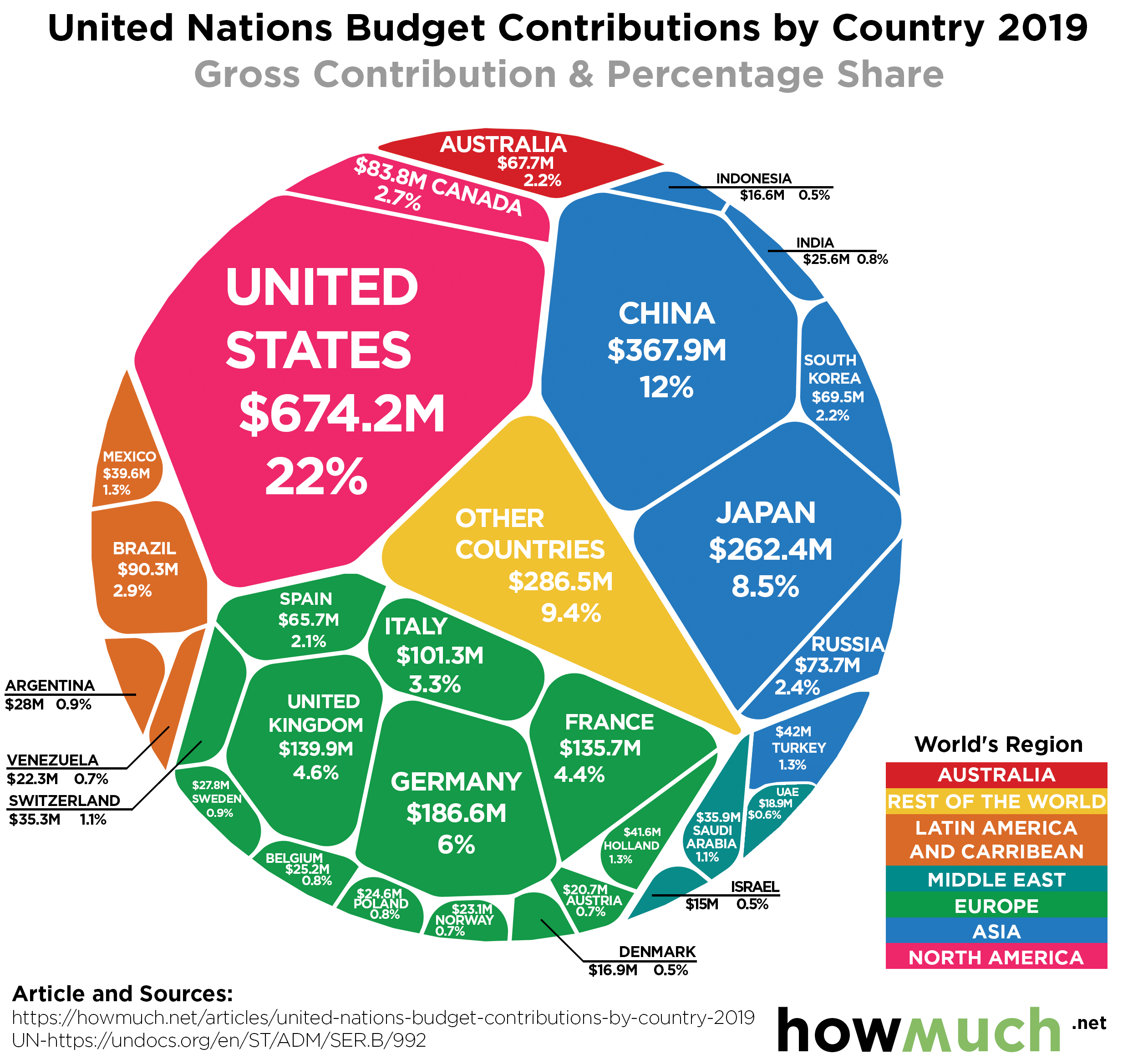
Looking at the location of many IO’s, most of them reside in strong powers states that make it easier for them to influence those institutions. The strong used the opportunity of setting up the structures of the international system to their benefit. This is merely a case of the “He who pays the piper dictates the tune” as IO’s have to be faithful servants to their mandates and masters. Having been legitimized by the strong states, they possess the moral authority to represent the so called “international community”, they can claim to be an expert authority and legal authority to fulfil given mandates that will benefit their paymasters.
As the UN (IO’s) attempts to coordinate the actions of States and harmonize the world community and striving to model a ‘utopian’ collective structure, even as it faces mounting challenges to rally its member states to follow its general principles and vision. One could argue that the United Nations has been vital in entrenching the further colonization, loss of human rights, striping of environmental protection and its protection of the strong against the weak in international law. Neo-liberal institutionalism stresses the importance of the UN’s work with regional organizations, as they become indispensable in the international diplomatic process as vassal states predicting, “the international community will increasingly direct itself towards combined action of the universal Organization with regional bodies.” (Cassese: 2005). This is observed in links between the UN and regional organizations such as the Organization of American States (OAS), the African Union (AU), the European Union (EU), the Arab League, and the Association of South East Asian Nations (ASEAN). It is widely regarded by theorists in International Relations that the failure of neo-realism resides in its ontology of institutions, as many believe it has the capacity to redefine the behavior of weaker states. This is further expressed in their reasoning as to how institutions influence weak state conduct by both creating strong incentives for cooperation whilst at the same time implementing disincentives, like trade sanctions and embargos. All these highlight is the overarching power strong states have through IO’s.
IO’s reinforcing the power of the strong has led to the development of state strategies and coalitions against the strong, such that weaker states would be forum shopping as other means of reinforcing their positions in coalition building such as the NAM (Non-Alignment Movement) in 1955, the Group of 77 (G77), the Organization for the Islamic conference and not forgetting Ad-hoc multilateralism such as the BRICS groupings (Brazil, Russia, India, China and South Africa) and other transnational networks.
In the international system, the model employed is usually the “US vs THEM” model, where the US or G7 or NATO or using a general term “THE WEST”, is the Northern rich, developed countries versus the THEM, global south countries (developing/poor and begging). This drives a dependency model as humanitarian aid, sovereign debt and FDI (Foreign Direct Investment) is trickled down through IO’s to the developing countries that come with conditions that favors the benefactor.
According to Herbert Jauch;
Debt repayments drain about US$ 160 billion each year from ‘developing’ countries. This is about 2.5 times the total development aid that these countries receive!
Since the 1980s, debt repayments are a major mechanism of transferring wealth from the South to the North. The former French President Francois Mitterand admitted this when he said in 1994: ‘Despite the considerable sums spent on bilateral and multilateral aid, the flow of capital from Africa toward the industrial countries is greater than the flow of capital from the industrial countries to the developing countries’ (see Touissaint and Comanne 1995: 10-12).
Weaker powers most of which are in the global south have always been at the loosing end of this spectrum because, in effect they are weak. In order to be a reinforcing power in the world system, a state has to go through economic successes and to be developed as we have seen through the emerging economies (BRICS) although this might not actually make the emerging states reinforce their power through current existing IO’s.
A dependency theorist would argue that the current international order has failed the many and is marked with rapidly widening inequality gaps where weaker states are seen as easy markets and resource exploitation for the strong powers while the IO’s serve to ensure and enforce the policies of strong powers.
Contrary to what many perceive that we exist in a “liberal international order” with its numerous self serving and virtue signaling platitudes of “open markets”, “international institutions”, “cooperative security”, “democratic community”, “progressive change”, “collective problem solving”, “shared sovereignty” and the most hypocritical “rule of law” which is of course “rule of the strong”, we actually live in a world where might is always right.
“Hierarchy in its extreme form is Empire”
See you tomorrow!
- Ope