
Liberté, Égalité, Shut Up
The mask slipped and they still clapped

He couldn’t hold it for five minutes.
That is what you need to understand about what happened in Nairobi on May 11, 2026. Not the deals. Not the speeches. Not the thirty-plus heads of state seated in a room that France called “Africa Forward.” What you need to understand is the five minutes.
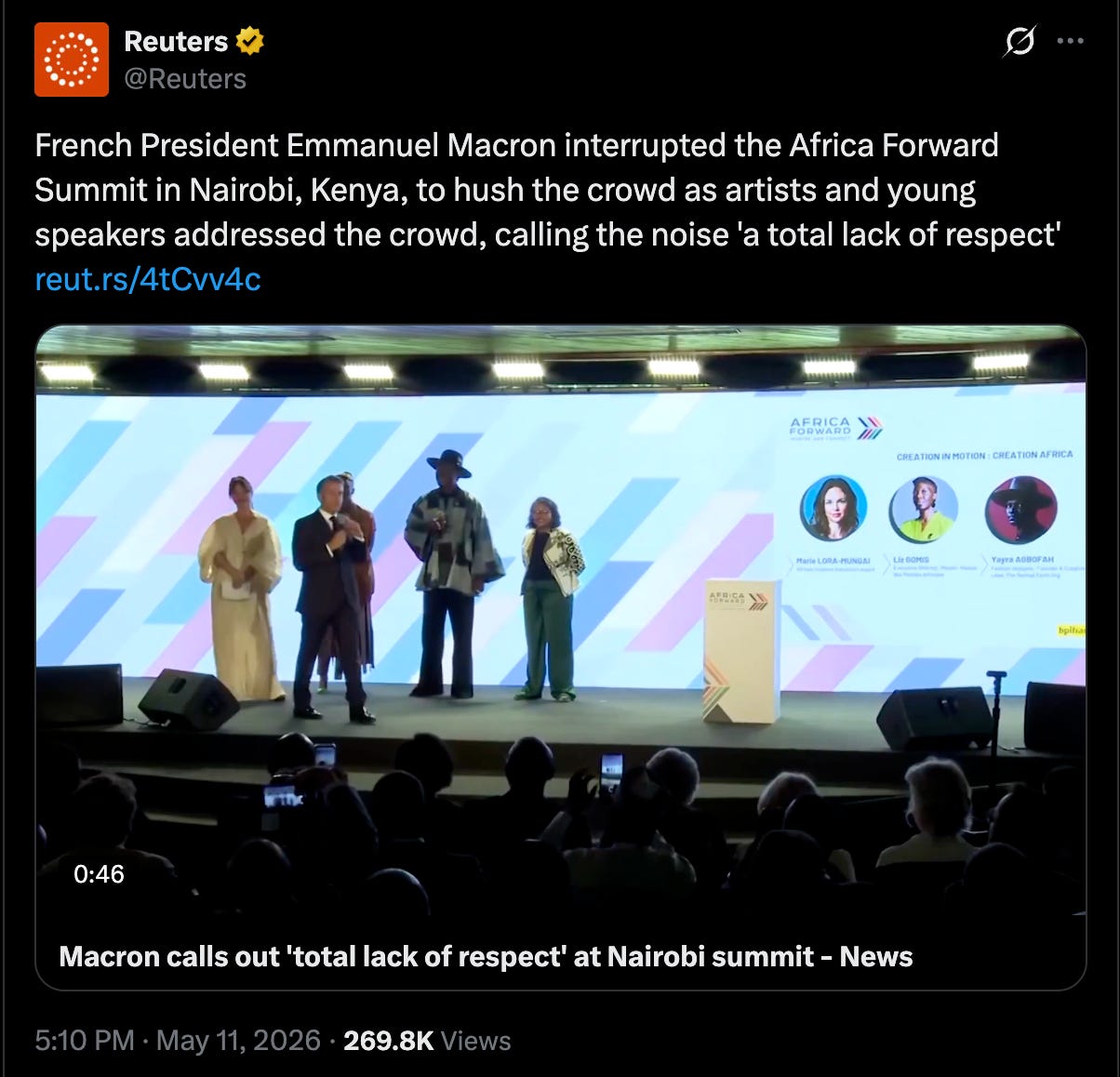
Emmanuel Macron took the stage before it was his turn. The crowd was lively: artists, young people, Africans making noise on African soil. He walked up, interrupted the proceedings, and said:
“Excuse me! Hey! Hey! I’m sorry guys, but it’s impossible to speak about culture with people like that.”
Then he lectured them into silence.
Then they were silent.
Then William Ruto mounted the podium and said that Kenya looks forward to relating with France “as equals.”
Let me be precise about what this was and what it was not.
It was not a gaffe. Strip that word from your vocabulary when you apply it to powerful people doing powerful things. A gaffe is an accident: a slip, a mistaken word, a joke that lands wrong. A gaffe implies the speaker holds a better value and temporarily lost grip of it. What Macron revealed in that moment is not a deviation from his actual beliefs. It is his actual beliefs, surfacing because the charm offensive requires sustained performance, and sustained performance is exhausting, and eventually the muscle holding the mask gets tired.
Five minutes. That is how long the performance of equality lasted before the reflex took over.
The reflex is: I am in charge here. The reflex is: you are making noise when I want to speak, and that is not permitted. The reflex fires without a cost-benefit calculation, without a thought for the summit’s optics, the cameras, the thirty heads of state watching, the footage that would circle the continent within hours. He does not think before doing it because for him it does not require thought. It is instinct. Deeply settled instinct.
David Hundeyin, Nigerian investigative journalist watched that footage and described it with precision: “Even in this process of trying to pivot this charm offensive and trying to present France as this friendly cosmopolitan entity... that colonial arrogance just has to rear its head. It can’t hide it. Doesn’t matter how many Nigerian celebrities they pay. Doesn’t matter how many Ghanaian social media influencers they fly out to Paris... just pinch it just an inch beneath the surface and that colonial arrogance just has to rear its head.”
Pinch it an inch beneath the surface. The surface broke in under five minutes.
I want to talk about three words France has been exporting since 1789.
Liberté. Égalité. Fraternité.
These words are on French government buildings. They are in French school curricula. They are the premise on which France constructs its self-presentation to the world, that France is not merely a nation-state pursuing its interests, but the carrier of a universal civilizational value. Freedom. Equality. Brotherhood.
Now. The same French state that prints these words on its currency ran a legal system called the indigénat across its African colonies, a body of law that applied specifically to sujets (subjects) as opposed to citoyens (citizens), under which Africans could be imprisoned without trial, subjected to forced labor called corvée, fined without court process, and denied the civil rights the French constitution guaranteed to actual citizens. The indigénat, introduced in Algeria in 1881 and extended to other colonies, was formally abolished in 1946 and the Lamine Guèye Law of that year proclaimed French citizenship for all inhabitants of overseas territories, but many of its hierarchies and techniques of control persisted in practice. The indigénat ran alongside the declaration of universal equality. Both were French state products. They were not contradictions. They were a system.
The motto is for outside consumption. The indigénat is for the colonies.
And when the colonies look closely enough at the gap between the two, the response, historically consistent, has been: be quiet.
Macron said it out loud in Nairobi. In front of thirty heads of state. On camera. He said what the system has always said, except this time he said it without the paperwork.
There is a specific Fanonian diagnosis for what happened in that room.
Frantz Fanon published Peau noire, masques blancs (Black Skin, White Masks) in 1952. The core argument: the colonized person who has deeply internalized colonial values does not perform subservience purely from fear. They perform it from a genuine internalized belief that the colonizer’s approval is the measure of the colonized person’s worth. That what Europe thinks of Africa is the actual metric by which Africa should measure itself. The colonized who have been most thoroughly shaped by this internalization do not need to be threatened into silence. They will volunteer it, and be grateful for the opportunity.
Seventy-three years after Fanon published that diagnosis, a room full of African heads of state sat on African soil and were told to be quiet by a French president. And they were quiet. And then some of them applauded.
Fanon is not dated. Fanon is a live clinical report.
David Hundeyin on the Kenyan ruling class, and I want to quote this carefully because the anatomy is precise:
“There’s something uniquely disconcerting about watching a room full of Africans sit down and listen to a French man stand in front of them and insult their intelligence for thirty minutes. He’s telling you two plus two is nine. Just playing in your face. And for whatever reason there’s just nothing you can do about it.”
The “for whatever reason”, that is where the analysis lives. Because there are reasons, and they are specific.
For some leaders in that room, the silence is transactional. Their political survival depends on French diplomatic cover: France’s silence about their rigged elections, France’s debt renegotiation forbearance, France’s informal network that keeps certain presidents in power long after their citizens want them gone. The closest allies of imperial powers have always been leaders who rule through repression rather than consent. A leader loved by his people negotiates with confidence. A leader who rules through fear needs external protection. That dependency produces a specific kind of silence: the silence of a man who knows exactly what he is doing and has calculated that his personal survival requires it.
For others, and this is the more disturbing category, the silence is ideological. The Kenyan ruling class has been offered a specific deal over several decades: position Kenya as the regional hub for international capital, NGO infrastructure, multinational corporate headquarters, and in exchange, Nairobi gets the veneer of prosperity. Skyscrapers. International conferences. The prestige of being chosen. Being selected to host the Africa Forward Summit is experienced, in the minds of this class, not as being selected as France’s new extraction zone, but as being endorsed. Validated. Seen as sophisticated enough to deserve the table.
Hundeyin calls this the “new negro” dynamic, invoking Malcolm X precisely: “Those who came before us they suffered and they went through all of this but somehow we are special. So all the things that they went through we will not go through it because somehow things are different now... It’s a very old and very flawed idea that has been found repeatedly over and over again to be false.”
We are special. We are different. What happened to the Malians, the Burkinabè, the Nigeriens: that was their own fault, their anti-Westernism, their failure to engage diplomatically. We engage differently. We will be treated differently.
This idea has failed every single time someone has staked their country on it. Every single time. And it will fail here too. The question is only how much it costs before the failure is undeniable.
Ruto said Kenya and France will relate as equals.
PLO Lumumba said, before the summit had even ended, “it is the partnership between a horse and the rider. That is not partnership. That is not a symbiotic relationship. That is a parasitic relationship.”
France’s GDP is a little over three trillion dollars. Kenya’s is in the low hundreds of billions, on the order of one hundred and thirty. When you hear “partnership” in this context, ask the basic question: partnership between what? A horse and its rider are not equal because you call the arrangement collaborative.
William Ruto knows this arithmetic. He is not naive about how the world works. He is making a calculation, that the veneer of partnership buys something for Kenya that he values more than the substance of sovereignty. The question is what he is spending to buy it. And who has authorized him to spend it.
I want to put one image next to another, and I want you to sit with the contrast.
December 20, 2025. Bamako, Mali. General Assimi Goïta presides over the AES Unified Force flag ceremony. Brigadier General Daouda Traoré installed as commander. Three days later, Ibrahim Traoré and Abdourahamane Tiani are in the same city inaugurating the BCID-AES bank. Then AES Television launches. Then the biometric ID rolls out in Niamey. African leaders building things, on their own soil, accountable to their own people, without asking anyone’s permission.
May 11, 2026. Nairobi. Macron walks on stage before his turn and shushes the room.
Both images are Africa in 2026. They are not describing the same Africa.
One group of leaders will be in the history books as the people who built something when the entire machinery of French power was trying to prevent them from building it. The other group will be in the history books as the people who clapped.
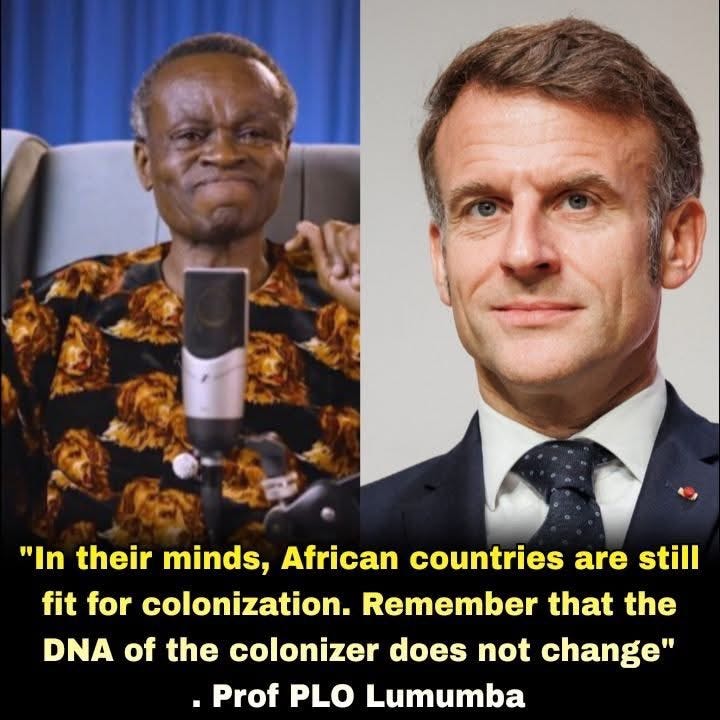
PLO Lumumba closed with a question that has been sitting in my chest since I heard it: “Are we prepared?”
Not a rhetorical question. A genuine one. He says: France has defined what it wants. France knows exactly what it is extracting and what it is leaving behind. The question is whether Africa has defined what it wants in return. Whether the thirty heads of state in that room walked in with a collective agenda, a collective set of conditions, a collective line beneath which they would not go. Or whether they walked in to be photographed with a European head of state and count the national anthems.
“Feel good effect without being good.”
He could not hold the pose for five minutes. Five minutes is all it took for the mask to fall and the colonial reflex to surface in public, on camera, before the entire continent.
The more important question is not what Macron revealed about France.
It is what the silence afterward revealed about everyone else in that room.
The footage exists. The cameras were running. Share this with one person who still calls that room a partnership.