
One Big, Beautiful Database

Chat Control is bad. Yes. New? No.
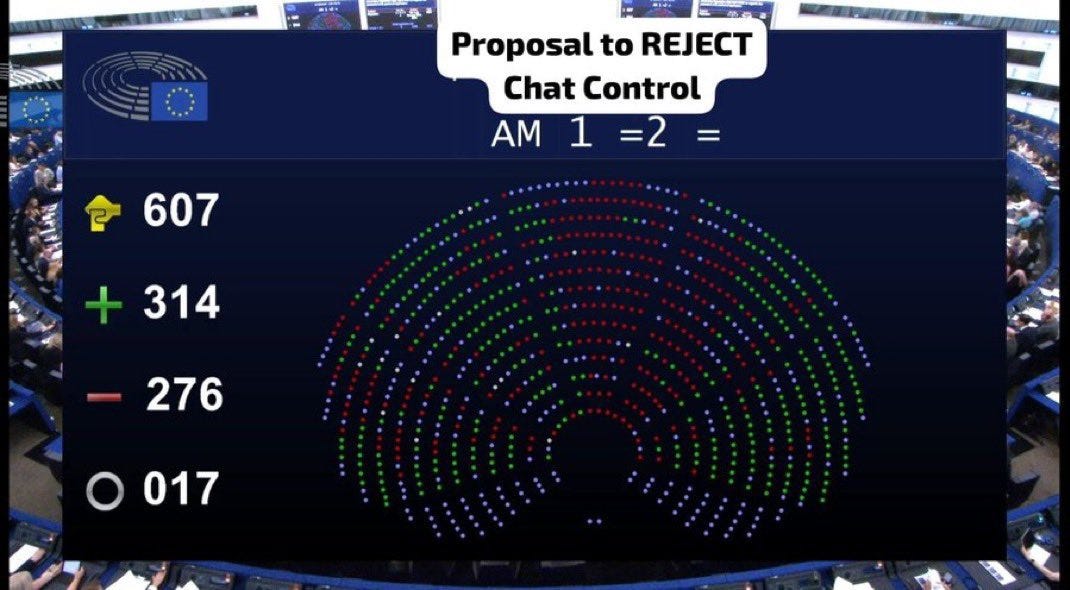
The European timeline spent this week performing shock. 314 MEPs voted against gutting their own citizens’ encrypted lives, the measure passed anyway on a technicality nobody explained to them in school, and everyone with a blue-check opinion suddenly discovered that platforms can read your messages. Where were all these people last month? Last year? The whole time, feeding every waking thought into American servers: no warrant required, no vote needed, because a Terms of Service agreement already did the job Brussels just needed an “urgent procedure” to fake.
(Sorry chiefs, but the irony here is not subtle.)
Some of the loudest Chat Control critics have a Gmail account and a ChatGPT tab open right now. That’s not a gotcha. That’s the whole argument.
Let’s define terms before we go further, because “surveillance” and “voluntary data collection” get used interchangeably and they’re not the same animal. Surveillance implies a target: someone decided to watch you, specifically, for a reason. What Silicon Valley runs is closer to agriculture: no watcher, no target, just a field planted with users and harvested on a schedule. Both end with someone else holding your private life. Only one of them makes the news in Europe this week.
Here’s what “voluntary” actually built while Europe was busy being surprised.
In April 2026, Meta pushed a program called the Model Capability Initiative onto every US employee’s work laptop: keystrokes, mouse movements, screenshots, no opt-out, capturing what staff typed into Gmail, Google Chat, and Meta’s own internal tools, all to teach an AI model how a human hand moves across a keyboard. Sixteen hundred employees signed a petition against it. Didn’t matter. CTO Andrew Bosworth confirmed there was no way to say no, before rescinding and halting the initiative. Then in June the whole trove: prompts, transcripts, private conversations, HR performance data, turned up exposed across internal company tables, accessible to anyone with a login. Meta’s own staff called it “dystopian.” That’s not my word. That’s theirs, in their own internal messages.
Google isn’t innocent either. Gemini got switched on by default across Gmail, Chat, and Meet starting late 2025: no meaningful consent screen, just an assumption you wouldn’t notice your inbox had a new reader. Google says it doesn’t train its core models on your personal email. Fine. It still processes it for “smart features.” There’s a difference between we don’t train on it and we don’t touch it, and Google is very careful to only ever promise you the first one.
Then there’s OpenAI, ordered by a federal judge in January to hand over twenty million, twenty million anonymized ChatGPT logs to lawyers in a copyright case, over its own privacy objections. The court’s reasoning: you typed it into a box voluntarily, so your privacy interest is weaker than someone whose phone got wiretapped without consent. Sit with that reasoning for a second. The company promised your chats were private. A federal judge in the Southern District of New York just explained, on the record, why that promise carries less weight than you assumed.
Cui bono?
Every one of these systems: Meta’s, Google’s, OpenAI’s runs on a business model where behavioral data isn’t a side effect. It’s the product.
This is the beast nobody wants to name out loud: the reason Big Tech trades at valuations that make no sense against actual earnings is that markets are pricing your data, my data, everyone’s data, as if it were a mineral reserve sitting under the balance sheet. It isn’t innovation stacked on innovation. A meaningful share of it is extraction stacked on extraction, dressed in a hoodie, IPO’d, and rebranded “platform economics” so nobody has to use the word harvest.
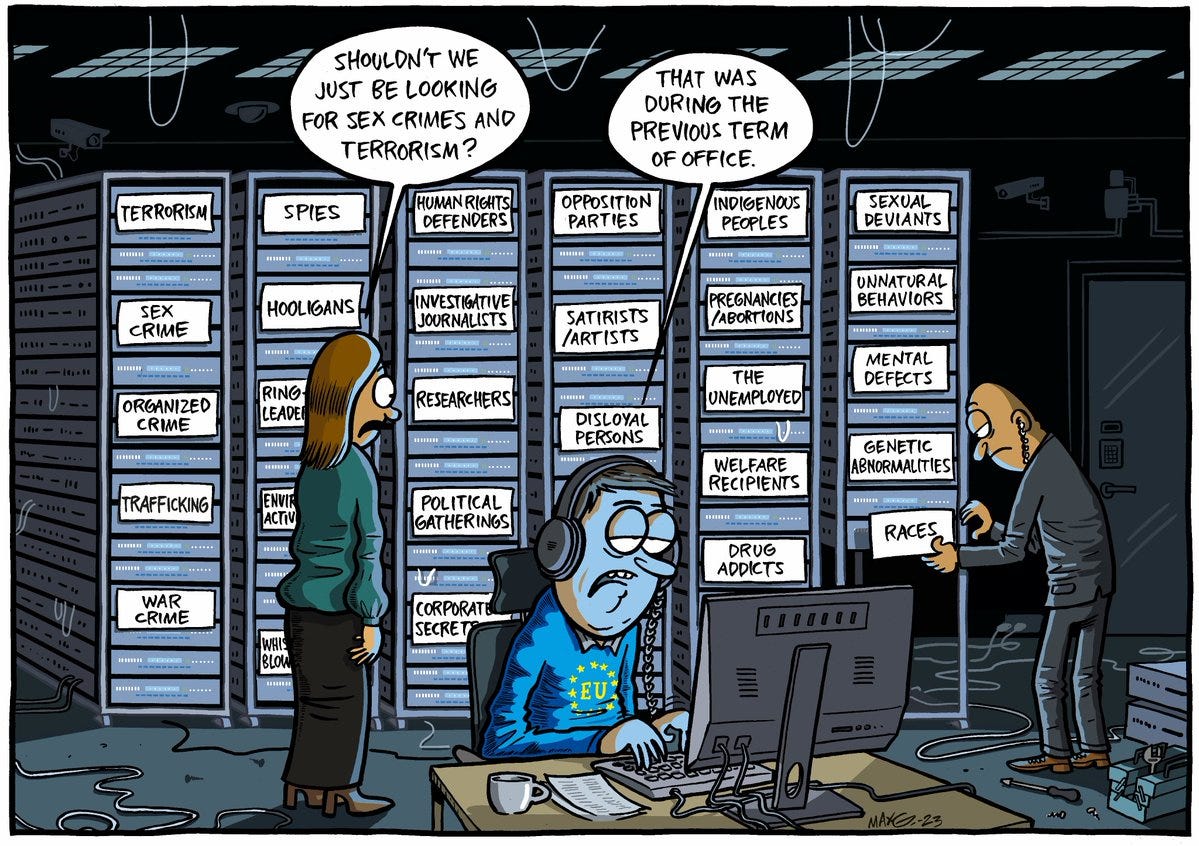
Now walk it to the state side, because the corporate layer and the government layer aren’t actually separate machines. They’re the same pipes wearing different uniforms.
A March 2025 executive order titled, I am not making this up, “Stopping Waste, Fraud, and Abuse by Eliminating Information Silos”, told federal agencies to start pooling data across departments (remember DOGE?) Under Elon, DOGE was seeking to create a centralized government database. Brookings called the result exactly what it is: “one big, beautiful database” of American life. The people building it weren’t anonymous bureaucrats. Several came straight from Palantir, under the surveillance villain Peter Thiel, with others arriving from Thiel-funded firms. In June 2025 the Supreme Court let that project into Social Security’s most sensitive records over the dissent of three justices. One staffer got edit access, not read access, to live Treasury payment systems. Another authorized copying NUMIDENT, the master file behind every Social Security number ever issued, reasoning in writing that “the business need is higher than the security risk.” A federal filing in January 2026 admitted the operation had shared that data on an outside server in violation of a standing court order, and the agency still can’t fully say what left the building. A federal appeals judge reviewing the case in April called the whole pattern “even more alarming”, and ruled for the operation to continue anyway.
(Somewhere in that pile of access, a staffer at Social Security signed a “Voter Data Agreement” with an outside political advocacy group hunting 2026-midterm “voter fraud” evidence. Government data. Private political actor. No public vote authorized any of it.)
This is the part that should scare you more than a scanning mandate in Brussels: the infrastructure built to sell you targeted ads and the infrastructure built to audit your immigration status and your voter roll are, increasingly, the same pipes, run by an overlapping circle of people, justified by the same word: efficiency.
The 2001 PATRIOT Act is the legal ancestor of all of it: the document that first taught American law to treat private communication as intelligence material by default, civil liberty a distant second. Everything after it: corporate, federal, doesn’t matter is a descendant, not a rupture.
So no. I won’t pretend the outrage should have started in Strasbourg. Chat Control deserves every bit of criticism headed its way, dressing message scanning up as “voluntary” doesn’t dissolve the surveillance logic underneath it just because nobody’s compelled to opt in yet. But treating Brussels like the origin story, while an American data-extraction machine has spent years cross-referencing your bank records with your keystrokes with your ChatGPT confessions, that’s not concern. That’s a very selective memory.
Different flags. Same load-bearing wall. And this wall isn’t hiding.
The "voluntary," architecture is built to be invisible until it isn't. Khaki & Leather will keep pointing at the wall.