
Six Faces, One Engine

Six prime ministers in ten years. Cameron, May, Johnson, Truss, Sunak, Starmer. Not one of them completed a full parliamentary term. Not one of them altered the trajectory.
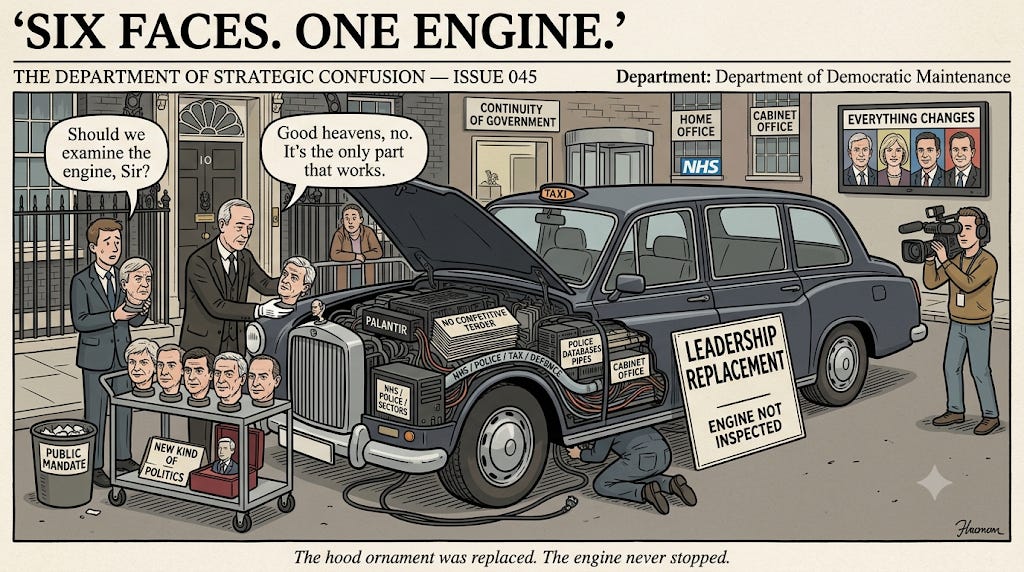
At what point do you stop blaming the driver and start examining the car?
Keir Starmer resigned yesterday 22 June 2026, less than two years after winning 412 seats on a third of the popular vote. His foundation, as Toby Buckle noted in Liberal Currents, was “a mile wide and an inch deep.” The commentariat is performing its ritual autopsy. He was too boring. He couldn’t communicate. He didn’t deliver. Burnham is the remedy, apparently. Northern accent. No knighthood. “A new kind of politics.”
Hmmm.
Kit Knightly, writing at Off-Guardian, offered a more useful frame. Politicians, he said, are “hood ornaments and hubcaps. Good for brand recognition and covering up the messy bits, but they go where the engine goes, turn in the direction the wheels point, and the car runs just fine without them.”
I want to stay with that image. Because if Starmer was a hood ornament, the interesting question isn’t why he fell off. It’s what the engine was doing while everyone stared at the chrome.

Before Starmer was Prime Minister, he was Director of Public Prosecutions. 2008 to 2013. The Crown Prosecution Service under his leadership handled the proposed extradition of Julian Assange to Sweden.
Assange, for anyone who has conveniently forgotten, exposed war crimes. He published classified files showing US helicopter crews laughing while killing civilians in Iraq. He released diplomatic cables documenting how Western powers managed African governance behind closed doors, including cables detailing Shell’s infiltration of Nigerian government ministries. He embarrassed the military-industrial apparatus in a way that no amount of parliamentary inquiry or journalistic “access” ever had.
And Keir Starmer’s CPS made sure the legal machinery kept grinding.
Italian journalist Stefania Maurizi’s FOIA investigation revealed that the CPS advised Swedish authorities not to interview Assange in London, the one legal strategy that could have resolved the case quickly. A CPS email to Swedish DPP Marianne Ny in August 2012 reportedly read: “Don’t you dare get cold feet!!!” When Sweden considered dropping the case, the CPS pushed back. When costs became a concern, the CPS replied that they “do not consider costs are a relevant factor in this matter.”
During this period, Starmer made four trips to Washington, his most frequent foreign destination as DPP. In November 2011, he led a five-person delegation to meet US Attorney General Eric Holder, whose department had “personally authorised a number of things” against WikiLeaks. The delegation included the UK liaison prosecutor who dealt with extradition.
The CPS has since destroyed all records of these Washington trips. Declassified UK’s FOIA requests confirmed the destruction. The CPS internal review called them “administrative records.” Maurice Frankel of the Campaign for Freedom of Information called the destruction “inconceivable” for records of a case with “major domestic and international implications.”
The function was clear. Prosecute the man who exposed the engine.
Fast forward. Starmer is now PM.
In February 2025, he visited Palantir Technologies’ Washington headquarters. His newly appointed ambassador to the United States was Peter Mandelson, whose lobbying firm Global Counsel had Palantir as a paying client. No minutes were taken. No transcript was kept.

Seven months later, the Ministry of Defence awarded Palantir a £240 million contract for data analytics across “strategic, tactical and live operational decision making.” No competitive tender. Defence Secretary John Healey followed with a £1.5 billion investment partnership. Palantir announced the UK as its European defence headquarters.
Na so we see am.
This was not Palantir’s introduction to the UK. That began in 2020, a £1 NHS contract during COVID to build a data store. By 2023, the £1 had become £330 million for the NHS Federated Data Platform. Patient records. Hospital data. Service planning. The contract was published with 417 of 586 pages completely redacted.
By 2026, Palantir’s UK public sector contracts exceeded £900 million. NHS. MoD. Eleven police forces. The FCA (fraud, money laundering, insider trading data). The Home Office. The Cabinet Office, where Palantir was given permission to combine data from HMRC, Defra, Department of Transport, and other agencies. Liberty Investigates revealed a contract with police in the East of England to develop a surveillance network incorporating data about citizens’ political opinions.
On 3 June 2026, the House of Commons Science, Innovation and Technology Committee called for termination of the NHS Palantir contract because the company supports “highly controversial policies and activities.”
Three weeks later, Starmer resigned.
Here is the architecture.
Starmer’s career is not two phases. It is one function, performed in sequence.
Phase one: prosecute the journalist who exposed military and intelligence operations. Ensure that the legal architecture for punishing disclosure is established, tested, and normalised.
Phase two: install the surveillance infrastructure that makes future disclosure either technically impossible or immediately traceable. Ensure that the contracts are locked in, the data pipelines are built, and the institutional dependencies are deep enough to survive any leadership change.
The DPP prosecuted the last major leak. The PM procured the system that prevents the next one. This is not a career arc. This is a job description.
And look at where it lands.
Nigeria. Africa’s most populous country. 232 million people. The World Bank’s ID4D project: $430 million, launched February 2020, extended to December 2026 is installing biometric identity infrastructure targeted at 180 million Nigerians. Co-financed by the French Development Agency and European Investment Bank. The eNaira CBDC, launched October 2021, requires bank verification numbers linked to National Identity Numbers. Zero anonymity, even for lower-tier wallets.
The same architecture. Same vendor ecosystem. Same convergence of digital identity, programmable money, and surveillance infrastructure.
Palantir processes NHS data for 65 million Britons and provides intelligence analytics for military operations that include African theatres. The World Bank installs the digital identity framework on 180 million Nigerians. The programmable money requires the identity verification. The identity verification feeds the surveillance architecture. The surveillance architecture protects the military operations that the original prosecution of Assange was designed to shield from public scrutiny.
Sorry chiefs. This is one system with different postcodes.
Now the “Succession”..
Andy Burnham called for “a new kind of politics” in his victory speech after the Makerfield by-election. Jeremy Corbyn used the same phrase when he won the Labour leadership in 2015.
The difference, as Knightly noted, is that Corbyn meant it. Which is why he’s in the political wilderness, and every person he humiliated in leadership contests is either in the cabinet or about to become Prime Minister.
Burnham hasn’t mentioned Palantir. He hasn’t mentioned the £900 million in surveillance contracts. He hasn’t mentioned the Online Safety Act. He hasn’t mentioned the Assange prosecution. His statement talked about “economic growth, cost of living, public services, housing and opportunities for the next generation.”
Hood ornament language. Brand management.
Yanis Varoufakis called Starmer “a mendacious figure of ethical decrepitude... who has taken the historic Labour Party and transformed it into a vessel for the very oligarchy it was elected to restrain.” Accurate. But incomplete. Because the oligarchy doesn’t need the Labour Party specifically. It needs a party. Whichever one happens to be in power when the next contract is due.
Having said that, Buckle wrote something remarkable in his Liberal Currents piece. He observed that the entire British media is analysing Starmer’s fall “without mentioning the main things he did with it.” Not the immigration enforcement. Not the surveillance contracts. Not the Palantir expansion. Not the prosecution-to-procurement pipeline. None of it.
The Economist’s Stanley Pignal posted on Bluesky: “It’s hard to make sense of what happened to Starmer… Political scientists will have their work cut out on this one.”
They won’t. The only mystery is why the media can’t see what’s sitting in the public procurement records.
But cui bono from the mystery?
Who benefits from a public that believes PM changes are meaningful events rather than scheduled maintenance?
Watch Burnham’s first MoD briefing. Watch whether any Palantir contract is reviewed, renegotiated, or terminated. Watch whether the £240 million award without competitive tender draws a single parliamentary question. Watch whether the £330 million NHS contract with 417 redacted pages gets a single redaction lifted.
The hood ornament is being swapped.
The engine hasn’t missed a stroke...
This is not a British story. This is a procurement story that happens to rotate British politicians through the frame. If you see the same architecture operating where you are: Nigeria, Kenya, Ghana, anywhere the infrastructure lands, forward this to someone who needs the receipts.
Here in the USA, the Land of the Free and the Home of the Brave, our politicians are also hood ornaments.