
Someone Is Always Mining Where the Bodies Were
The Governor's Signature: How Nigeria's Middle Belt Is Being Emptied for Lithium

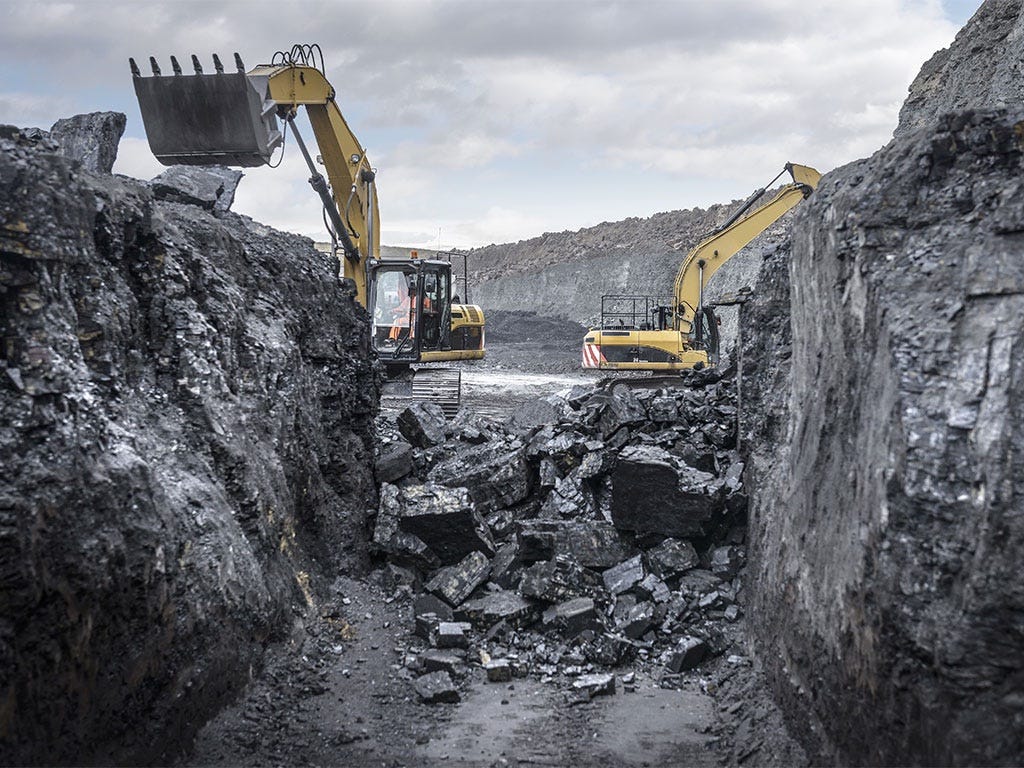
In Zamfara State, there is no Christian-Muslim conflict. The population is predominantly Muslim on every side. The violence is narrated as banditry, criminality, armed groups, and yet: 80% of Northwestern mining is illegal, per ENACT Africa. Bandit leaders: Halilu Sububu, Sani Black, Kachalla Mati control specific mine sites using captured villagers as forced labour. “Nigerians in high positions of authority” collaborate with Chinese corporations on illegal gold extraction. Mati earns an estimated ₦300 million ($222,078.62) weekly. The gold goes to Dubai. Dubai sends weapons back. Communities are displaced. The mining continues.
No evangelical briefings in Washington about Zamfara. No UN resolutions about the Zamfara genocide. No congressional testimony framing Zamfara as a faith-based atrocity requiring international intervention.
This is the controlled case. Zamfara runs the same mechanism as Plateau and Benue and Nasarawa: armed groups, community displacement, extraction of mineral-rich land, elite protection of the network without the religious framing that would attract a foreign policy response. The absence of the framing makes the mechanism visible. The presence of the framing in the Middle Belt makes the mechanism invisible. That is the entire argument.
Let’s be precise about what we mean.
“Farmer-herder conflict” is a description. It describes who is fighting. It does not explain why they are fighting there, why they are fighting now, what happens to the land after they have finished, or who benefits from the sequence. “Displacement as extraction architecture” is a mechanism. It says: violence produces displacement, displacement vacates land, vacated land enters the commodity pipeline. These are not the same thing. The first forecloses investigation. The second opens it.
Former Plateau State House of Representatives member Dachung Musa Bagos said it plainly, on camera, Arise TV, January 2024: “All the communities wiped out on the Plateau, go back to those communities, you will see that some people are mining there.” He named the resources: tin, cassiterite, columbite, fertile agricultural land, water access. He named the pattern: the targeted areas correlate with documented mineral deposits. He said the facts and proofs exist. He is an elected official, on the record, in a broadcast. He is not an anonymous source or an advocacy pamphlet.
Since 2001, over 60 communities in Plateau State have been “wiped out,” per Bagos. A joint report by five tribal associations: Atakar, Berom, Irigwe, Mwagavwul, Ron documented 151 hamlets and villages “totally annexed or under effective occupation” across Barkin Ladi, Bassa, Bokkos, Mangu, and Riyom LGAs as of 2024. Six years earlier, that number was approximately 50. That is a 200% increase. The same report notes that the affected areas in Gashish District are “richly endowed with natural and mineral resources like fertile soils, water bodies, cassiterite, and columbite.” Nobody in the coalition was required to invent this. It is there. Go look.
Here is what it looks like at ground level.
Ilyasu Umar lives in Adudu Village, Obi LGA, Nasarawa State. In 2021, 30 hectares of farmland his family had worked across multiple generations were acquired by Adudu Prospective Mining Ltd. He received no compensation. Multiple villagers corroborated the account. The community chief, they allege, was induced by the mining operator to authorise the transfer. The Business & Human Rights Resource Centre documented this in 2023, with named sources.
How is this legally possible? Section 28(2)(c) of Nigeria’s Land Use Act, 1978. All land in every state “is hereby vested in the Governor.” A customary right of occupancy may be revoked for land that “is the subject of any laws relating to minerals.” Compensation is payable, but only for “unexhausted improvements” to the land, not for the land itself. Your grandmother’s farm is worth the cassava she planted last season. The ground beneath it belongs to the state and, by extension, to whoever the governor decides to give it to.
This law was promulgated by a military government. It has not been amended in forty-eight years. Every governor since 1978 has held the legal power to dispossess any community in their state for mineral purposes at will, with minimal compensation, using a stroke of executive pen.
Abdullahi Sule, Governor of Nasarawa State, has found it useful.
In May 2021, Flour Mills of Nigeria, publicly listed on the Nigerian Stock Exchange received 20,450 hectares of Nasarawa land in a formal handover ceremony in Abuja. The land was in the Toto LGA area previously vacated by Bassa communities displaced by a conflict that began in 1986. AZMA, another agro-conglomerate, acquired the balance. Total: 40,800 hectares of Bassa community land transferred to private companies after displacement. The Bassa communities wrote to the State Government and to the companies asking them to stop. The IFIT commission documented this in 2022.
Nobody was charged. Nobody went to prison. The ceremony was held in Abuja.
Governor Sule is not hiding this. That is important to understand.
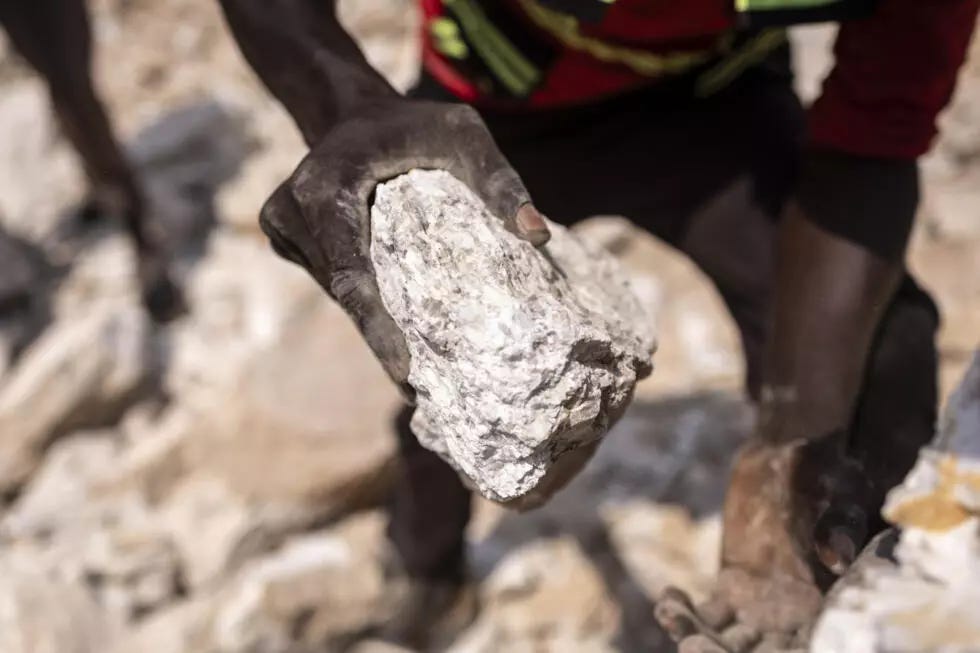
In November 2025, he told Arise TV: “Lithium is the gold of today.” He confirmed that Nasarawa had attracted $850 million in lithium investment from four major processing plants. He said: “The two major lithium sites used to be bandit zones. Today, there’s not one bandit there.” He credited military super-camp establishment.
Parse that sentence. He acknowledged that the lithium sites were previously bandit-controlled. He confirmed that military presence followed. He did not describe the communities that lived there before the bandits or before the military. In the grammar of the statement, the communities do not exist. The land moves from bandit zone to investment opportunity, with the military as the transition mechanism and the governor as the facilitator.
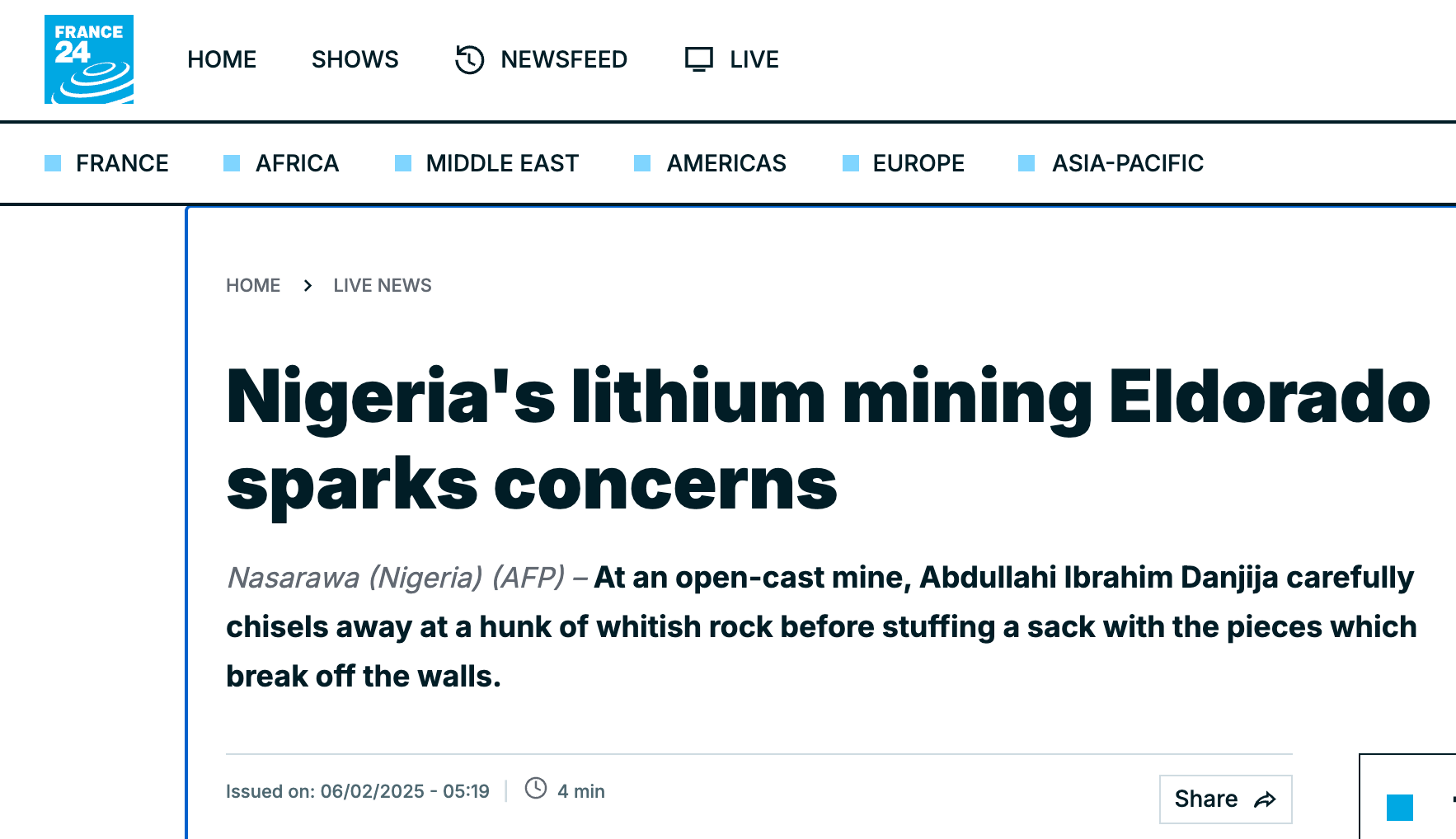
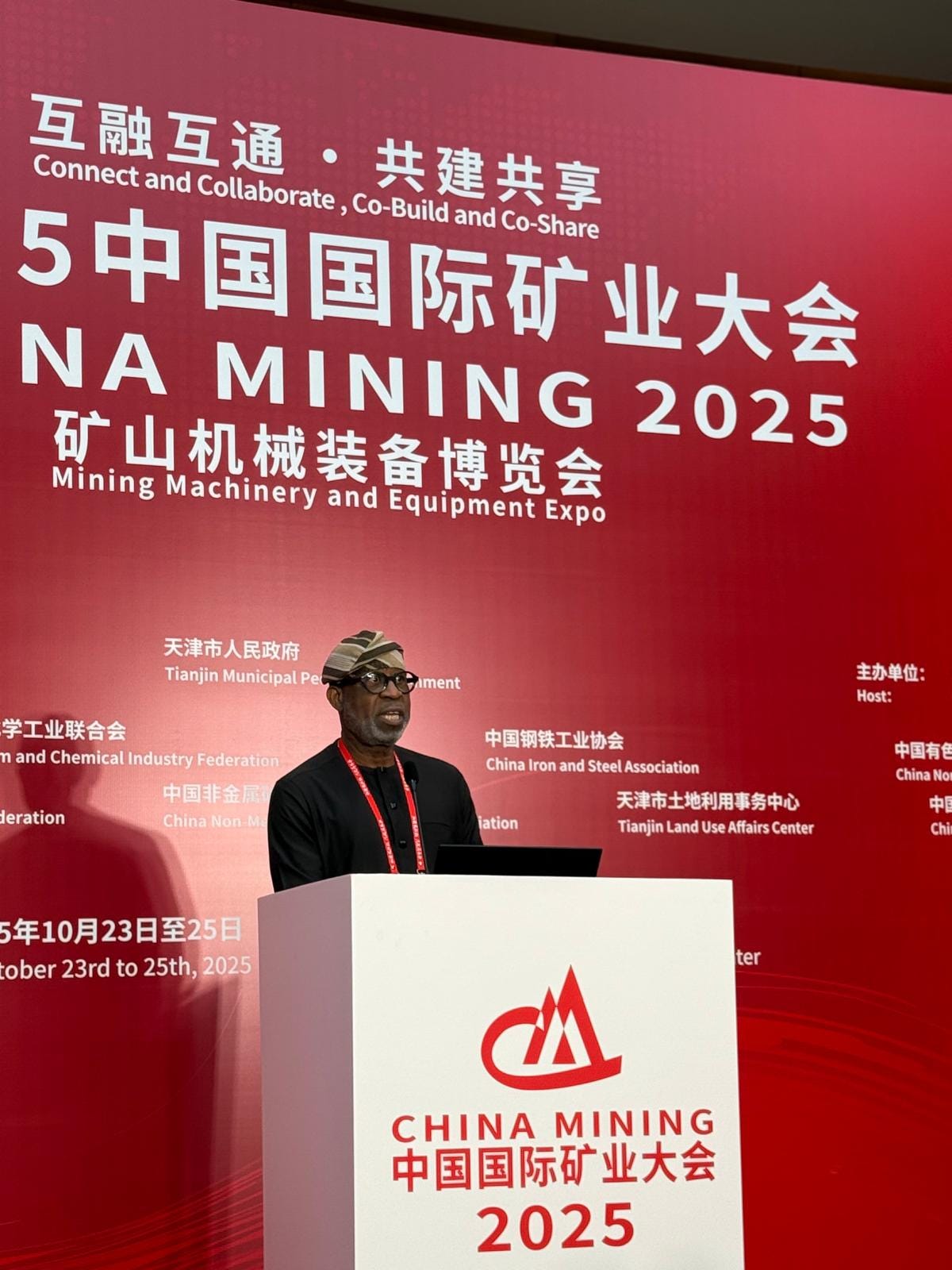
At the same time: Avatar New Energy Materials, a Chinese company, is operating a 4,000 metric ton per day lithium processing plant commissioned at Nasarawa Local Government Area on May 10, 2024. Canmax Technologies, responsible for more than 30% of global battery material production committed an additional $200 million for a second plant. Hasetins Commodities Ltd broke ground in December 2025 on a $400 million rare earth and critical metals plant in Uke Development Area, Karu LGA. Target metals: platinum, uranium, chromium. Governor Sule performed the groundbreaking. Minister Dele Alake, at the China Mining Conference in Tianjin in 2025, confirmed total Chinese investment in Nigeria’s lithium processing sector had exceeded $1.3 billion since 2023, led by Canmax, Jiuling Lithium, Avatar New Energy, and Asba.
Community representatives were not invited to the May 2024 presidential-level meeting in Abuja where President Tinubu, Governor Sule, Avatar chairman Hi Yongwei, and Canmax chairman Zhenhua Pei discussed lithium strategy. Renevlyn Development Initiative and Neighbourhood Environment Watch formally protested the exclusion, noting it was “repeating the Niger Delta oil exploration disaster.”
That parallel is precise.
November 1990, Umuechem, Rivers State. Shell Petroleum Development Company in partnership with the Nigerian government, which held a 55% stake in the joint venture, requested Nigerian military intervention against a community that had been peacefully petitioning Shell about environmental damage from its operations. The military complied. The Umuechem massacre followed. Shell’s formal records did not show operational involvement. The enforcement was deniable. Thirty-one years later, Shell divested its Nigerian subsidiary in March 2025, forming Renaissance Africa Energy Company Limited, having extracted an estimated $30 billion from Ogoniland while communities remained in poverty. The clean-up of the 2008 Bodo spills was still unresolved at time of divestment.
The mechanism in Umuechem and the mechanism in Nasarawa are the same: resource interest, community in the way, deniable enforcement clears the community, extraction proceeds, accountability apparatus fails to function. The commodity is different. The foreign capital is different. The dress code has changed. The architecture has not.
There is a deeper layer, and it starts in 1900, not 1978.
Moses Ochonu’s Colonialism by Proxy (Indiana University Press, 2014) documents how British colonial administration deployed Hausa-Fulani personnel as “native alien” administrators over Middle Belt communities the British deemed “too backward” for direct administration. The British extended the Hausa-Caliphate administrative model over indigenous farming communities, creating a land-tenure hierarchy in which settler Hausa-Fulani claims were recognised above “indigene” communities. This was not accidental. It was policy.
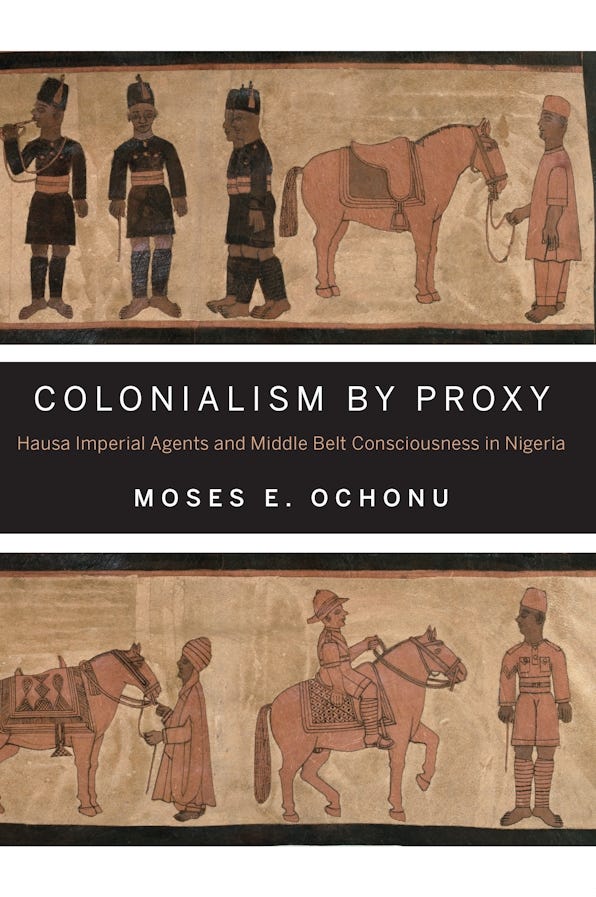
Post-colonial Nigeria inherited these hierarchies. The indigene/settler legal distinction that today governs who has standing in land disputes in Plateau and Nasarawa derives directly from colonial administrative categories. The Land Use Act of 1978 did not create this hierarchy; it formalized and sharpened it, giving governors: inheritors of the colonial administrative apparatus, unilateral authority over customary land. What the Ogboni society in Yoruba territories, the Tiv communal tenure councils, and the Idoma land institutions previously governed with sacred obligation to the earth and accountability to community, was replaced by a Governor’s signature on a certificate.
It was not modernity replacing tradition. It was the deliberate removal of a land-protection institution without creating a replacement. The result is not a gap in governance. It is a frictionless pipeline.
Tiv communities in Nasarawa State are currently fighting this pipeline in court.
In July 2025, they obtained Suit No. NSD/LF/44/2025, a court order restraining the Nasarawa State Government from encroaching on their ancestral lands in Doma, Obi, Awe, Keana, and parts of Lafia LGAs. On July 1, 2025, Governor Sule proceeded with a rice-farming project on the disputed Tiv territory despite the subsisting court order. A Tiv man was murdered the following day. No arrests were made.
In a separate suit, the Nasarawa High Court granted a preservation order in May 2025 against the Governor’s Executive Order No. 3 of 2023, which had authorised land acquisition from 21 Tiv communities in Awe and Obi LGAs. The Nigerian Army is listed as a co-defendant.
The army is defending the governor’s land policy in court. This is on the record.
The IFRC confirmed 615,000 people displaced in Benue State as of July 2025. Amnesty International documented 510,182 IDPs in Benue as of December 2024. Amnesty confirmed 10,217 people killed across the North Central zone in the two years of the Tinubu government. These are field-verified figures with named LGAs.
Someone is always mining where the bodies were. That is not a metaphor. It is the sequence. Document it or argue it’s coincidence. But bring receipts either way.
Watch:
Whether Suit No. NSD/LF/44/2025 survives.
Whether the court order against the Governor’s Executive Order No. 3 holds.
Whether any mining licence in Nasarawa is ever conditioned on resolving an open IDP situation.
Whether the Nigerian Army remains a co-defendant or whether the case is quietly settled.
If you've been explaining the Nigeria Middle Belt as a religious conflict and you've never looked at a mining concession map, this essay is not an accusation. It's an invitation to update the model. The receipts should be shared..
Thank you for this. I've been completely ignorant about Nigeria, but I'm learning now.
I'm embarrassed to admit I didn't even know about the Nigeria Middle Belt conflict. But I'm seeing all 'religious' conflicts as a cover. You lay out the formula very clearly, Ope.
I expand on our earlier conversation about bloodlines vs systems in my latest: https://thirdparadigm.substack.com/p/coins-over-kings. I quote from The Forest Doesn't Kill You and then your observation about Bretton Woods (before the war was even over!) and the CFA franc. While researching these, I found the cosmetic language changes to confirm your theory:
"They also set up the CFA franc, which first stood for Colonies françaises d'Afrique ("French colonies of Africa"); then for Communauté française d'Afrique ("French Community of Africa") … Since independence, CFA is taken to mean Communauté Financière Africaine (African Financial Community)"
And you may find this quote amusing, in a gallows humor kind of way:
"The CFA franc was created on 26 December 1945, along with the CFP franc. The reason for their creation was the weakness of the French franc immediately after World War II. When France ratified the Bretton Woods Agreement in December 1945, the French franc was devalued in order to set a fixed exchange rate with the US dollar. New currencies were created in the French colonies to spare them the strong devaluation, thereby making it easier for them to import goods from France (and simultaneously making it harder for them to export goods to France). French officials presented the decision as an act of generosity. René Pleven, the French Minister of Finance, was quoted as saying: 'In a show of her generosity and selflessness, metropolitan France, wishing not to impose on her far-away daughters the consequences of her own poverty, is setting different exchange rates for their currency.'" Currently .0014 Swiss franc.