
The Architecture Lost the Race

“I think it’s over.”
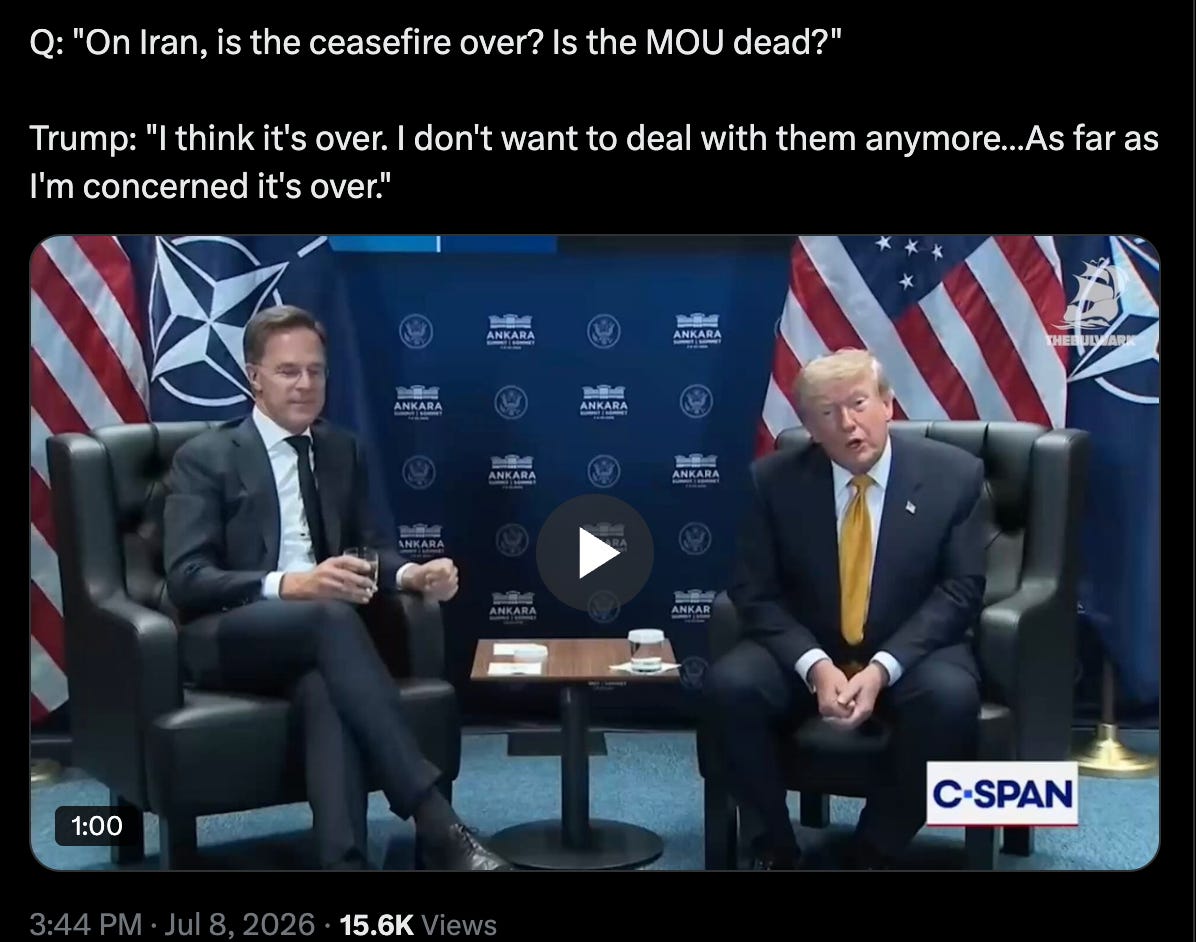
Five words, July 8, and the memorandum Switzerland brokered between Washington and Tehran, the one everyone had been calling fragile for weeks, the one with a $300 billion reconstruction fund attached to it, was dead. No signing ceremony to mark its death. No summit. Just a president telling reporters he doesn’t want to deal with Iran anymore, and the attacks resumed days later like nothing had ever been signed.
Here’s what actually killed it, and it’s smaller and stupider than a war deserves to be.

The memorandum committed both sides to “arrangements using its best efforts for the safe passage of commercial vessels with no charge, for 60 days only,” with Iran and Oman jointly defining the strait’s future administration alongside other Gulf littoral states. Tehran read that as conditional, time-limited, and shared. Washington read the same sentence as unconditional free passage, on American terms, indefinitely. Two governments signed one document and walked away with two different agreements in their heads. That’s not a negotiating gap. That’s a contract built to be misread: deliberately or not, and honestly, at this point, who benefits more tells you the answer.
I’ve been tracking a fork in the road across two drafts sitting unpublished on my desk.
One thread: an emerging regional order of Gulf states pursuing economic interdependence with the very Iran that just bombed them, the same coal-and-steel doctrine that built the EU, quietly assembling itself out of a Helsinki-model non-aggression pact and a Riyadh summit and a Quincy Institute playbook running the same script on two continents at once.
Second thread: a spoiler dynamic, Israeli battlefield censorship hiding how the last war actually went, Netanyahu’s corruption trial and immunity tied to staying in office past October.
Both threads were racing toward the same finish line: would the architecture harden before the spoiler could break it?
We now have the result. The spoiler won this round.
Here’s the confirmation, and I want to be careful about how I say this, because I don’t believe victory laps serves any material purpose, I rather leave room for my fine, capable collaborators reading this to do it.
M. Javad Zarif, Iran’s former foreign minister, writes in Foreign Affairs that Israel has “consistently opposed” every de-escalation effort on the table, the 2015 deal and this memorandum alike, and that its conduct sows regional chaos irrespective of what it costs anyone, including Israel. That’s not my inference anymore. That’s a former Iranian FM stating it plainly, in one of the most establishment publications in the field, three weeks after the war he’s describing resumed.
And here’s where the two threads actually touch not thematically, mechanically.
Trump and JD Vance signed paragraph one of that same memorandum committing to Lebanon’s “territorial integrity and sovereignty.” Zarif says Secretary of State Marco Rubio then ran an active campaign, weeks later, to coerce the Lebanese government into a lopsided arrangement favoring Israel, while Israeli forces kept the ground they’d already taken.
One administration. One signed document. One cabinet member working against the exact paragraph his own president put his name on.
That’s not incompetence. Incompetence doesn’t require an active campaign. Somebody decided the sovereignty clause was negotiable the moment it became inconvenient, and nobody in Washington had to answer for it, because there’s no mechanism that makes them.
Now watch what almost got built instead, because it’s the part that should actually make you angry, not the collapse.
Zarif lays out the architecture in real terms this time: no longer rumor, no longer a Helsinki analogy floating in Western press summaries. An institutionalized regional dialogue built on nonintervention and eventual nonaggression. A regional nuclear enrichment consortium: the sole enrichment facility for all of West Asia with China, Russia, and the United States helping stand it up. A West Asia development fund for reconstruction, healthcare, education, infrastructure. Cross-border rail, pipelines, digital infrastructure, shipping lanes, all designed so that no single state’s stability depends on an outside guarantor showing up when called.
Sit with what that actually is. It’s the coal-and-steel doctrine, the same one Quincy’s Episkopos is selling for NATO’s European drawdown except this version wasn’t written by a Washington think tank asking the region to grow up. It was written by Tehran, and it doesn’t put the United States at the center of the guarantor list. China and Russia are named right alongside it. Washington gets to help build the consortium or watch someone else build it without them. That’s the actual stakes of the collapse not just a dead memorandum, a missed invitation to author the very architecture Quincy’s been arguing the region should have all along.
I’ll give the fair read, because Zarif does too, and I’m not interested in a cleaner story than the facts support: Iran’s leverage over Hormuz is genuinely fragile. Close it too long or too often, and the world routes around it: new pipelines, new corridors, new ports, and Tehran loses the only card that made anyone listen. Zarif admits this outright. Restraint isn’t just posture for him; it’s the only way the leverage survives its own use.
But fragile leverage still worked well enough to sink a $300 billion deal over a sentence nobody bothered to write clearly.
Chiefs. You had one job to write the strait clause so both governments agreed on what it meant, and instead you built the exit ramp into the contract itself!
Cui bono from West Asia never finishing that consortium?
I’ll let you make the list.
Arms exporters are on it, aka Military Industrial Complex. So is anyone whose regional relevance depends on the neighborhood staying too suspicious of itself to build anything shared. And structurally, anyone who needs the Strait of Hormuz to stay a flashpoint rather than a jointly administered waterway nobody has to fight over.
The fund still has a number attached to it. Three hundred billion dollars, sitting in the text of a memorandum that’s already dead, waiting for someone to either revive it or formally cancel it.
Nobody’s cancelled the number yet.
Two drafts died on my desk before this essay, because this story keeps evolving faster than i can research and observe moving parts. Subscribe if you want it as it happens, not after it's settled.
As said in my last comment, Ope, there are no greener intellectual pastures than yours. Definitely no greener geopolitical meadows. There's so much that I'd miss without your analysis, even when I'm catching up on it two weeks later--which seems like a long time for you.
Let me restate what happened naively, because I don't have these nuances down like you. Trump's signature committing to Lebanon’s “territorial integrity and sovereignty” was a trick to lure Lebanon into a lopsided deal where Israel keeps Lebanese territory and Lebanon stops fighting back? The pressure that Lebanon was putting on Israel had made the Zarif architecture into a deal that 'USrael' would have to consider or be left out when it went ahead anyway. That's now been scuttled for the time being. Is that right?
It seems like the negotiations that bring leaders somewhere they can be assassinated. No accountability.
Substack is wrong when it calls this a 5-minute read. It needs to calculate the time to read it four times and ponder it.