
The Ceiling Is the Question That Gets the Gag Order
The third essay in the Babalawo series: on whom to name, why the architecture manages what you call it, and why Arendt and Tereza are both right

When you want to hold power accountable: do you name the system or do you name the person? The choice between these is not merely analytical. The architecture has opinions about what you call it.
Two essays built the case. The first proved the architecture is global: five elements, one technology, every continent, the costumes changing while the commitment device stays identical. The second proved it is operational and running right now: from Nebraska to the Knesset to a family home in northern Israel with a court-issued gag order attached. This essay has the hardest task of all three.


Answer the question.
Not which family sits at the apex. Not whether the theology is real or performed. The prior question: when you want to hold power accountable: do you name the system or do you name the person? The choice between these is not merely analytical. It is strategic, political, and, as this essay will argue, itself a site of active management by the architecture we have been documenting. The choice of what to name is something the five-element system has opinions about.
This is why the question matters. Not because naming is satisfying. Because naming incorrectly protects the thing you are trying to expose.
Three thinkers arrive at this question with different answers. All three are right. All three are incomplete. Let me state each one clearly before breaking them.
Hannah Arendt attended the 1961 trial of Adolf Eichmann, the Nazi official responsible for the logistics of the Holocaust, expecting to encounter a monster. What she found was, in her documented account, a shallow bureaucrat who had never made up his mind to be either good or evil. A man who followed procedure, used office language, and had replaced moral thinking with administrative function so completely that he could not, even at his own trial, speak in anything but clichés. Her conclusion: the banality of evil, was not a defense. She supported his execution explicitly. It was an analytical claim: the system produces the act, the individual is the instrument, and holding only the instrument accountable while leaving the system intact changes nothing. The system finds another instrument. Another Eichmann. The next week.
Christopher Lasch and the managerial-class literature that followed him sit very close to Arendt’s insight, but give it a sociological face. The “Original Man”: the manager, the professional, the technocrat is no longer the owner of capital or the feudal lord. He administers systems he did not build and does not truly control, but from which he derives status, income, and identity. He is Eichmann in a business suit or an NGO lanyard: not the architect of the camp, but the one who makes the trains run on time because that is what his job description and promotion ladder require. The managerial class is the social stratum Arendt was watching in that courtroom: people trained to see their complicity as just procedure, their participation as professional obligation, their moral disengagement as maturity.
Michel Foucault, in Discipline and Punish, offers the Panopticon: Bentham’s prison design in which a single central tower could theoretically observe every prisoner simultaneously. The prisoner, knowing they might be watched at any moment, begins to watch themselves. Power operates most efficiently when it requires no one to actively exercise it. The surveillance architecture disciplines through the permanent possibility of exposure, not its constant exercise. Applied to what this series has documented: the camera on Epstein’s island did not need anyone watching it in real time to function as a constraint. The knowledge that footage existed, and was held somewhere, was sufficient to produce the behavior. That is Foucault’s Panopticon made flesh: the surveillance architecture that disciplines through the permanent possibility of exposure, not through its constant exercise.
Tereza Coraggio’s case for naming the dynasty runs as follows. First: ascribing atrocities to faceless institutions strips culpability. Someone gave the order to wire the walkie-talkies. Someone authorized the massacre. Someone negotiated the Balfour Declaration. When we say “the empire” or “the system” we erase the agency of the person who made the decision and grant them the cover of structural inevitability. Second: the bloodline is not a supernatural claim. It is a documented operational practice. Dynasties that practice strategic intermarriage: the Rothschilds explicitly excluded daughters from the business and married within the family to keep capital consolidated, documented in their own archive, are not expressing metaphysical beliefs. They are building a trust network whose reliability is guaranteed by shared genetic interest. The bloodline is the loyalty mechanism made biological. Third: cross-national loyalty above state loyalty is only coherent if the unit of analysis is the dynasty rather than the nation.
These are rigorous arguments. The nation-state framework cannot explain a family that funds both sides of a European war and coordinates privately between the capitals. The dynasty framework can.
The Rothschild Case
Before the analytical synthesis: the receipts. The standard record is already damning enough.
Mayer Amschel Rothschild, beginning as a coin dealer in Frankfurt’s Jewish ghetto in the late eighteenth century, built the early family fortune by becoming court financial agent to Prince William of Hanau. By 1810 he had deployed five sons to the five financial capitals of post-Napoleonic Europe: Nathan to London, James to Paris, Salomon to Vienna, Carl to Naples, Amschel Junior remaining in Frankfurt. Five brothers, five cities, five banks, one family coordinating across borders using private couriers before international banking infrastructure existed. Encyclopædia Britannica confirms the result: contemporaries described the Rothschilds by 1850 as the “sixth great power of Europe.” Nathan Rothschild could supply enough coin to the Bank of England in 1825–26 to avert a market liquidity crisis. Documented.
They financed multiple sides in the Austro-Prussian War of 1866 and the Franco-Prussian War of 1870–71. Financial historians describe this as business strategy: whoever won could repay. Britannica confirms one family member “could boast that his influence had maintained the chief of the French government in power.”
The Balfour Declaration: the document that created the legal foundation for the State of Israel, was formally addressed to Lord Walter Rothschild on November 2, 1917, by British Foreign Secretary Arthur Balfour. The Rothschild Archive documents: Walter Rothschild was the “unofficial leader of the British Jewish community” and the primary conduit between the British Foreign Office and the Zionist movement. The National Library of Israel’s analysis of the unpublished drafts confirms the declaration went through multiple rewrites with the Zionist Organization’s input incorporated at the War Office level before finalization. This is not conspiracy theory. This is the Rothschild Archive, the National Library of Israel, and Encyclopædia Britannica.
A private banking dynasty coordinating across five national capitals, financing opposing sides in major European conflicts, receiving formal correspondence from a foreign government about the creation of a new state. All documented. All in the standard record.
This is what Tereza means when she says names matter. The Balfour Declaration was not addressed to “the financial system.” It was addressed to a specific man at a specific address on a specific date.
Where Each Framework Fails
Arendt’s framework fails at the founding moment. Foucault’s disciplinary power presupposes that subjects already operate within a shared normative framework, that the Panopticon is already built. Before that framework exists, you need a founding group that trusts each other enough to construct it. The family: the five sons in five capitals, is the oldest and most reliable trust technology available. You do not defect against your brother. The Panopticon requires architects before it can run itself. Arendt cannot explain the architects.
Foucault’s framework fails at the theological layer. He can explain the self-policing prisoner. He cannot explain the Cremation of Care. Structural power is not sufficient to explain why the most powerful people in the world gather annually in the California redwoods to burn an effigy before a forty-foot concrete owl. Rational structural interest cannot produce that behavior. Something beyond structural interest is operating, something that requires a framework to carry it across generations. That framework is the dynasty.
Tereza’s framework fails at persistence. If the dynasty is removed, the system finds new operators. The Rothschilds themselves displaced earlier banking dynasties. The Medici Bank preceded them by three centuries. The Torlonia family took over Papal State finances when the Napoleonic turbulence disrupted existing arrangements. The architecture is older than every family that has operated it. Naming and removing the dynasty solves nothing if the architecture remains functional.
Here is what I think: dynasty and system are not competing explanations. They are consecutive layers. And between them sits a third layer that all three frameworks have been gesturing toward without naming directly.
The Managerial Class: Original Men of a Borrowed Architecture
The architecture we have been mapping does not run on aristocrats and dynasts alone. It runs on a broad layer of semi-autonomous functionaries whose role is to operate the machinery without ever fully seeing, or wanting to see, who owns it.
The managerial class lives by operating systems it did not build and does not own, but whose survival it is professionally obliged to ensure. Their job is not to ask whether the machine should exist, but to keep it calibrated, compliant, and productive. They experience themselves not as rulers but as professionals: experts, administrators, responsible adults doing what the situation “requires.” The moral horror is diffused into spreadsheets, memos, protocols, and best practices, the evil is administered rather than chosen.
Central bankers, supranational bureaucrats, corporate compliance officers, national security lawyers, IMF and World Bank staff, ESG committees, Silicon Valley trust-and-safety teams: these are the contemporary Original Men. They do not decide the theology. They do not select the dynasty. They translate those decisions into policy, protocol, budget, and algorithm. Their status, income, and identity depend on the continuity of structures they did not design but now cannot imagine living outside. To question the architecture would be to question their own life’s work; so they question only its parameters, never its right to exist.
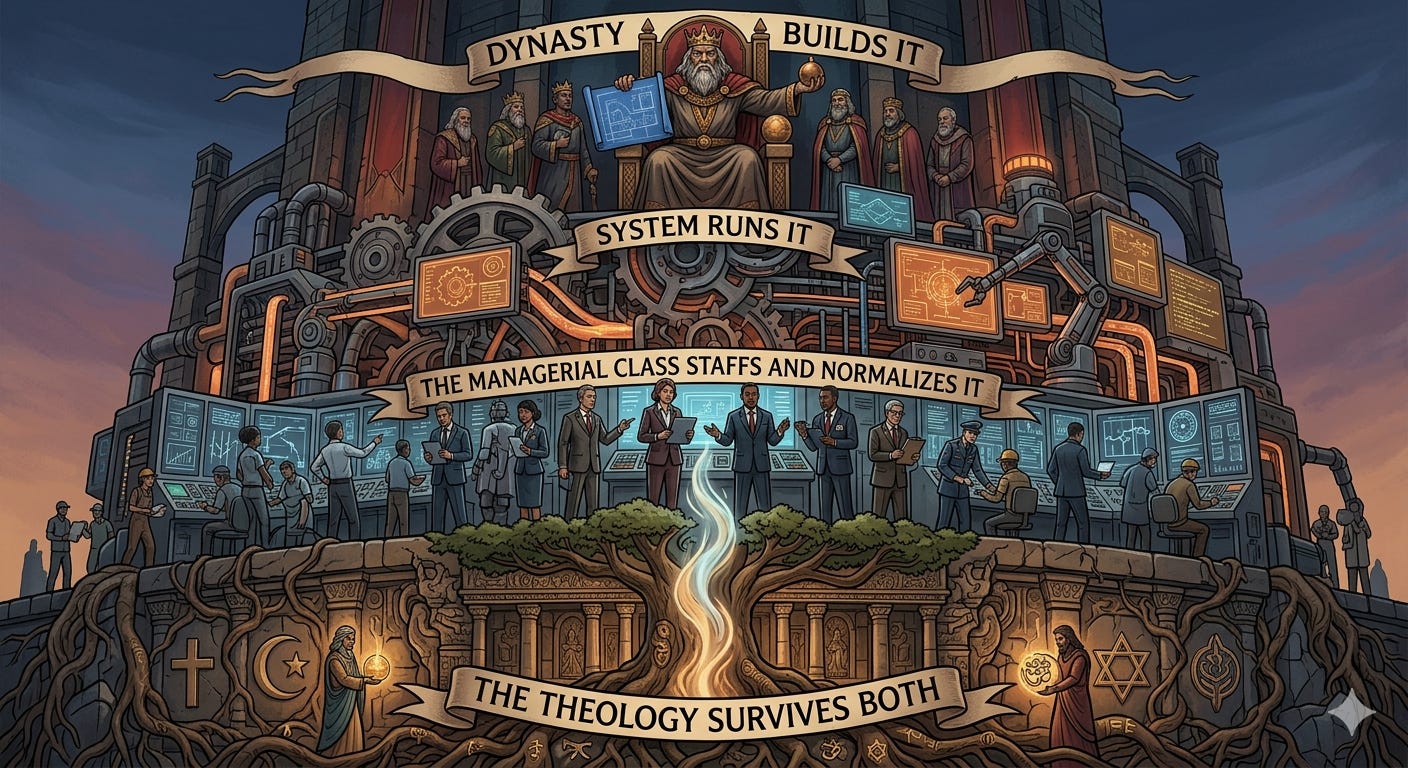
If dynasties are the engineers and theology is the operating system, the managerial class are the technicians: swapping parts, updating firmware, and insisting the machine is neutral. This is the layer that makes the architecture feel inevitable. Without them, the dynasty’s schemes would remain fantasies; with them, they become policy and protocol.
Arendt supplies the psychological template: the bureaucrat who never makes up his mind to be good or evil. Foucault supplies the structural context: institutions designed so that compliance appears natural and resistance appears deviant. The managerial class literature supplies the class position: people whose livelihood and self-concept depend on not seeing what their work enables. Together they describe the middle layer that dynasty and system both rely on: the people who sign the forms, write the memos, draft the legal opinions, and push the updates that make the Panopticon hum.
This is the group most of us actually encounter. Not the Rothschild, not the Orsini, but the deputy director, the senior associate, the program officer, the judge, the colonel. The managerial class is where Arendt’s Eichmann, Foucault’s self-policing prisoner, and the Original Man all meet. It is also, notably, the layer most resistant to both naming and accountability, because its members are genuinely not the architects, which makes them genuinely believable when they say so.
What the Dynasty Provides That the System Cannot
The documented five-element architecture requires a dynasty to initialize it, a managerial class to staff and normalize it, and a system to sustain it. The dynasty provides three things neither the managerial layer nor the system can provide without it.
One. The initial trust layer. You cannot build a coordinated multi-continental network without a founding group whose loyalty is pre-established. The biological family is the oldest and most reliable version of pre-established loyalty available. You do not defect against your brother. The five sons in five capitals is not mysticism. It is rational trust architecture.
Two. The cross-national information advantage. Moving intelligence faster than states across national borders before telecommunications, before international banking infrastructure, was only achievable by a loyalty network whose commitment was not dependent on any single state. The dynasty is that unit. The state cannot be.
Three. The theological glue. The Book of the Dead’s apotheosis promise runs through priestly families and schools, not through states. The Kabbalistic transmission documented in the previous essay runs through rabbinical families across centuries. The Bohemian Grove is not a state institution. The theology requires a carrier, and the carrier is the dynasty.
The dynasty builds the architecture. The managerial class staffs and normalizes it. The architecture eventually runs itself. New dynasties capture and operate it. The architecture persists through dynasties as an independent variable. Arendt is right about the instrument. Foucault is right about the structure. Tereza is right about the dynasty. The managerial class literature is right about the layer in between. These are not competing claims. They are a description of four consecutive components of the same operation.
The Question Above the Rothschilds
Frances Leader’s Black Nobility framing: that there is a tier above the Rothschilds, the old Roman and Venetian aristocratic houses, Orsini and Colonna and Farnese and Chigi, predating the Rothschild family by five centuries is, at the level of the specific ordering, currently in the alternative literature tier. I do not have clean receipts for the precise hierarchy.
However, the structural argument is not in the alternative literature tier. Every network examined in this series has a visible layer and a less-visible layer above it. P2 had Licio Gelli, but Gelli’s “Plan of Democratic Rebirth” required external financing never fully sourced. The Broederbond ran apartheid South Africa, but the gold and diamond interests that benefited: De Beers, Anglo American operated through separate corporate infrastructure that outlasted it and predated it. Mossad had Epstein, but whoever held the footage from Little St. James held the real power. The entity that held and used what the surveillance infrastructure produced has never been identified, charged, or named in any court proceeding.
The visible operator is never the ceiling. The ceiling is the entity that holds the leverage on the operator. Five separate documented cases across three essays confirm the same structural pattern.
Here is the move the entire series has been building toward.
The choice of what to name as the locus of power is itself managed by the architecture. This is the observation that ties the colonial epistemology confession from the first essay to this one. My confession: I applied differential evidentiary standards based on the continent of the practitioner. The architecture also manages what evidentiary standard gets applied, and to whom.
Naming the system: “capitalism,” “the empire,” “the deep state,” “elites,” produces political mobilization that the architecture absorbs, redirects, and neutralizes. You cannot sue disciplinary power. You cannot indict the Panopticon. You can vote, protest, publish, and organize: all of which the system accommodates without fundamental disruption. This is also where the managerial class is most comfortable: systemic critique leaves their personal role untouched, and they are often the loudest voices calling for systemic reform precisely because it directs attention away from the specific acts they signed off on.
Naming the dynasty: the Rothschilds specifically, produces a different problem. The documented analytical record has been so completely captured by antisemitic conspiracy culture that serious analytical use of the documented facts becomes immediately dismissible by association. The architecture does not need to refute the argument. It needs only to ensure that the argument arrives pre-associated with a dismissible frame. That association is itself Element Three of the five-element framework: deniable enforcement, operating at the epistemic level. The documented record is in Encyclopædia Britannica. The protection is not legal. It is epistemic.
Naming the specific act: the Balfour Declaration addressed to Lord Walter Rothschild on November 2, 1917; the P2 membership list of 962 names seized from Gelli’s villa on March 17, 1981; the Epstein flight logs released in the 2025 DOJ document production and the 2026 release; the Knesset testimony by Yael Shitrit on June 3, 2025; the gag order on the Shoshana Strook case, is the only naming strategy that bypasses both traps simultaneously. Undismissible because it is documented. Not reducible to racism because it is specific. Not diffuse because it names the act, the actor, the date, and the institution that protected them. And it names the managerial-class figure who signed the protection into being, which is what neither systemic critique nor dynasty-naming can do on its own.
This is what prosecutorial analysis looks like. Not “the empire is ruthless.” The empire is ruthless and on November 2, 1917, a British Foreign Secretary named Arthur Balfour wrote a letter to a specific address in London expressing His Majesty’s Government’s sympathy for Zionist aspirations, and the recipient’s family had financed both sides of two major European wars in the preceding fifty years. That is the specific act. That is the naming strategy that holds.
Tereza’s Solution
Remove the five-thousand-year-old power of a king to coin money. That is all. Strip the monetary issuance monopoly from private coordination.
It does not require knowing whether the Rothschilds answer to the Orsini. Does not require proving the occult motive. Does not require resolving the supernatural question. It requires only the documented fact, established in this essay series: that private coordination of monetary issuance is the lever through which every other form of power documented across three essays has been exercised. The Bank of England charter, 1694: private institution receives legal right to create the state’s currency in exchange for lending the state its own money back. The Federal Reserve Act, 1913: written in secret on a private island by six men using assumed names, suppressed for twenty years. The CFA franc: fourteen African economies depositing fifty percent of their foreign exchange reserves with the French Treasury. The eNaira: programmable money whose conditions are set by whoever holds the administrative keys.
Strip the lever. The hierarchy becomes visible in the wreckage of its primary tool. Note who among the managerial class screams loudest when you propose it. That reaction is its own receipt.
The Axiom Beneath the Method
Tereza’s dogma: all people are inherently good; systems and stories corrupt behavior. It is a generative axiom. It places analytical pressure on structures rather than natures and prevents lazy demonology.
I want to name what it costs analytically. If the system is always to blame and the individual is always essentially good, you lose the ability to explain why certain individuals consistently seek out the system, build it, maintain it, actively resist all exits, and bequeath it to their children as the primary inheritance. The Broederbond did not recruit every Afrikaner. It recruited specifically those who wanted what it offered. Some selection is occurring that the axiom cannot fully account for. It also cannot account for the managerial class member who sees the architecture clearly and stays anyway, not because they are deceived, but because their mortgage, their pension, and their professional identity are already inside it.
My working axiom, arrived at through three essays of documented research: power does not have a nature. It has an architecture. The architecture is learnable, documentable, and reproducible. The individuals who operate it are interchangeable. The dynasties that carry the theological claim are replaceable. The managerial class that staffs it is renewable every generation through universities, think tanks, law firms, and international organizations that train people to administer the machinery without ever being told what the machinery is for. The five structural elements are the stable variables. Everything else is contingent.
The implication: you do not defeat the architecture by identifying its current operators. You defeat it by making the five elements non-functional. Secrecy technically impossible. Oaths legally void. Deniable enforcement visible in real time through open-source documentation. Demographic anchoring constitutionally prohibited. Initiation through transgression treated as a documented criminal act with mandatory prosecution rather than a protected elite ritual with gag orders attached.
This is what Arendt meant when she said evil spreads through the suppression of the capacity to think. It is what the Broederbond, the P2 lodge, the Bohemian Grove membership secrecy, and the gag order on Shoshana Strook’s case all share: operations against documentation, against the naming of the specific act, against the capacity to think clearly about what is in front of you.
The antidote is the specific act, named, sourced, published, and followed wherever it leads. Including into the office of the deputy director who signed the memo that made it procedurally invisible.
There is one question this series cannot answer cleanly: how do you defeat a theology that promises godhood through total fire. I do not know how to kill an idea that old. What I do know is that you can make its machinery fail. You can strip its main lever by removing private control over money issuance. You can starve its secrecy with leaked lists, logs, and minutes, and make gag‑order governance structurally difficult. You can collapse its middle‑management layer: the managerial class by restoring individual judgment as a professional virtue rather than a career risk, by making whistleblowing survivable, by teaching people to recognize when “the end of the world” has been weaponized as an excuse for anything and everything.
You do not need to convert the high priests. You need to reduce the pool of willing technicians. You need to teach ordinary people that apocalyptic destiny is usually just someone else’s control script, recycled. You need alternative eschatologies: futures where meaning, status, and a sense of “afterlife” come from preservation and repair rather than from sacrifice and annihilation. The theology may never vanish. But if the money lever is gone, the secrecy is thin, the blackmail is hard to weaponize, and the middle layer keeps saying no, then the god who feeds on total burnt offerings finds itself with an empty table and a shrinking congregation.
The three-part structure closes here. Not because the question is answered. Because the method is now clear.
Name the act. Name the institution that protected it. Name the managerial-class figure who signed the protection into being. Name the mechanism that made protection possible. Follow the mechanism to its operator. Follow the operator to its funder. Follow the funder to the theology that tells them they will become gods when the fire is total. Follow the theology to the dynasty that carries it. Follow the dynasty to the layer above it.
Do not stop at any layer and declare it the ceiling.
The ceiling is the question that gets the gag order.
This is the third and final essay in the Babalawo series. The full trilogy: "The Babalawo and the Bilderberg Group Are Running the Same Operation," "The Ceremony Has Always Required a Child," and this, is in the archive at Khaki & Leather. The series was built in a public comment thread with Tereza Coraggio of Third Paradigm. If the framework held across three essays, a subscription is how the next one gets written.
Final comment. I could care less about publicly naming the culprit--speaking truth to power is virtue-signaling, speaking truth to your friends is the test of courage. Within the half-dozen of us trying to figure out how the system works, it's important to challenge each other. But naming the Rothschilds changes nothing, except among ourselves. The people who can follow this level of analysis are one in a hundred. No mass awakening is going to save us.
Fortunately, no mass awakening is needed to save us. Just you and me, figuring this out.
On the theology, it's like Buckminster Fuller said “You can never change anything by fighting the existing reality. To change something, build a new model that makes the old model obsolete.” You can't defeat a theology by fighting the existing one or saying none exists. Find the theology that's real and the old model will be obsolete.
https://thirdparadigm.substack.com/p/build-a-new-model
Now let me get to the content of your well articulated article. First, I love being the third paradigm to Arendt and Foucault. Let's start with the banality of evil, a memorable phrase that captured an entire gestalt.
And what does that phrase say at its essence? That the holocaust of six million Jews gassed in death camps was the fault of the ordinary person following orders for a paycheck. Well, isn't that convenient as Bretton-Woods rolls out and the Federal Reserve usurps ownership of all the houses! If you had any morals, you monster-in-layman's-clothing, you wouldn't blame the system, you'd resist, Resist, RESIST, no matter what the cost.
Or, Goddess forbid, you're a manager, an administrative implementer. You would have given the orders to herd Jews into those gas chambers that never existed. You would have told the guards to rip babies from their mothers' arms and bayonet them in the ditch--as Elie Wiesel swears they did in Night, a book categorized as fiction until they decided to call it fact. Is that what you'd do if you wanted hordes of people who vastly outnumber you to go calmly to their deaths thinking it's just a shower? Utter nonsense.
If you're taking the WW narrative as truth, you're drawing exactly the conclusions they want you to. It's all the fault of the order-followers, the schlep doing a job for pay. Eichmann comes across as a functionary because he was. The evil was being done by the other side and still is. I define evil as causing others to cause harm. But this narrative absolves evil because, if you're a moral person, no one can force you to do bad things. Take responsibility and be homeless! It's not the fault of those giving the orders.
2B con't