
The Hormuz Toll
$2 Million Per Ship. The Strait Is Not Closed. It Is Privatised.

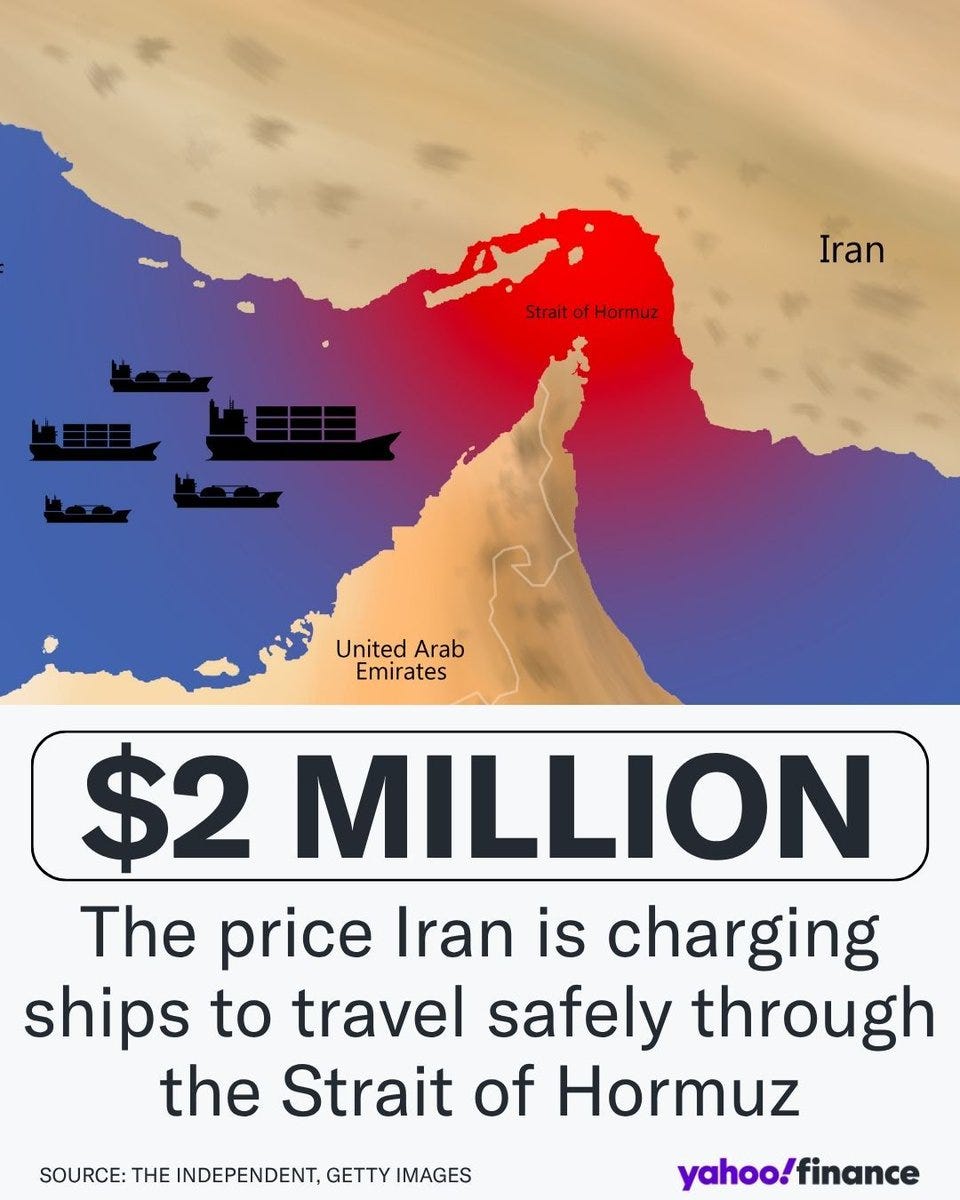
Iran is not blocking the Strait of Hormuz. Iran is charging $2 million per ship to transit it safely.
Read that again slowly.
The strait, through which approximately 20 million barrels of crude oil and oil products flow every single day, confirmed by the International Energy Agency’s own March 20, 2026 report, is not closed. It is metered. Iran has converted the world’s most critical energy chokepoint into a toll booth, and the toll is $2 million per vessel, per passage.
This changes the frame entirely. A closed strait is an act of war with a defined endpoint. A metered strait is a revenue model with indefinite duration. One produces a crisis. The other produces a new normal.
Before we proceed, let me separate two words people keep collapsing.
Crisis and reconfiguration are not synonyms. A crisis is accidental. It ends. A reconfiguration has beneficiaries, and it ends when they decide it does. The Strait of Hormuz disruption, now confirmed by the IEA as the largest supply disruption in the history of the global oil market, is not a natural disaster. The $2 million toll is not a symptom of that. It is the proof of concept.
On March 20, 2026, the International Energy Agency published a report titled Sheltering from Oil Shocks. IEA Executive Director Fatih Birol: “The war in the Middle East is creating a major energy crisis, including the largest supply disruption in the history of the global oil market. In the absence of a swift resolution, the impacts on energy markets and economies are set to become more and more severe.”
The IEA is not a fringe think tank. It is the multilateral energy authority, founded in 1974 itself, notably, in direct response to the OPEC crisis of 1973. Forty-two countries are member states. When the IEA publishes a demand-management report with ten specific recommendations for governments, businesses, and households, that is not a suggestion. That is the architecture of a response regime being pre-positioned.
The IEA’s ten-point plan. March 20, 2026. iea.org:
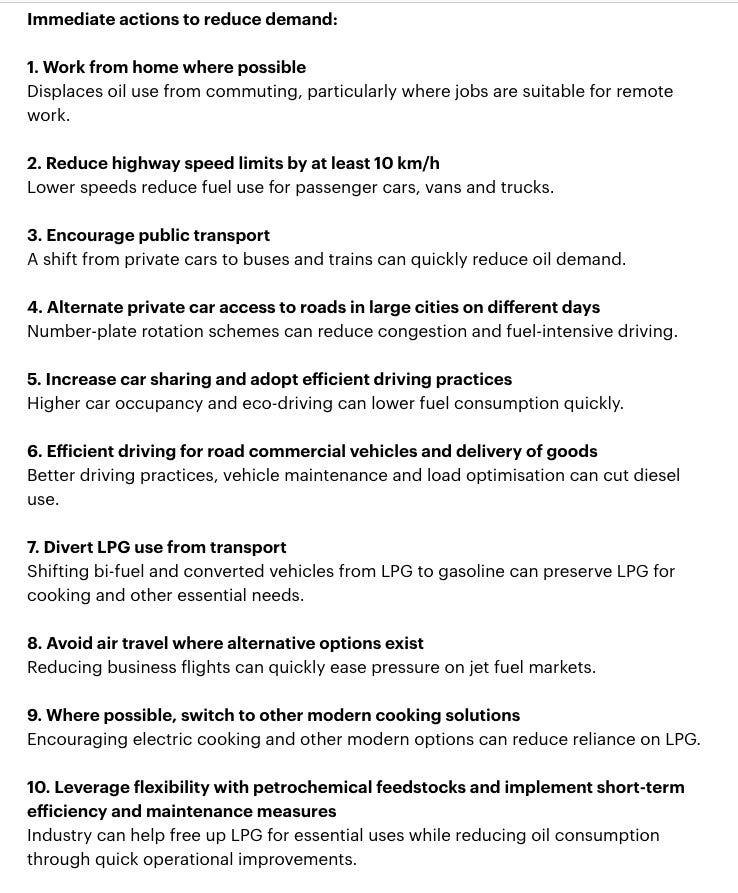
Work from home where possible. Lower highway speed limits by at least 10 kilometres per hour. Shift from private cars to public transport. Alternate private vehicle access in large cities by licence plate number. Increase car sharing. Improve freight driving efficiency. Divert LPG away from transport toward cooking. Avoid air travel where alternatives exist. Switch to electric cooking. Implement industrial feedstock flexibility and short-term efficiency measures.
Sit with that list. Then note what the IEA itself says about it: “Many of these measures have been implemented in the past and are again being considered in several countries.” Have been implemented in the past. The report does not specify which past. It does not need to. The years 2020 and 2021 are recent enough that most readers can supply the reference themselves.
The IEA also confirmed that on March 11, 2026, member countries agreed to release 400 million barrels of oil from emergency reserves, the largest emergency stock draw in the Agency’s fifty-two-year history. Implemented. And conceded as insufficient: supply-side measures alone cannot fully offset the scale of the disruption.
Which is why the demand-side list exists, according to them.
Here is the thing about voluntary measures and how they operate in practice.
The IEA frames its ten points as options: things governments “can” do, measures that “where possible” should be considered. The language is studiously non-mandatory. And in normal times, that framing holds.
Governments facing constituents paying above $100 per barrel for crude, the IEA confirms prices crossed that threshold: with diesel, jet fuel, and LPG running sharper increases still, do not stay in optional territory for long. The IEA’s own companion tracking document confirms: “many countries are already acting to protect consumers through conservation and financial measures similar to those discussed in the report.” Similar to those discussed. Not hypothetical. Present tense.
Licence-plate rotation schemes are traffic management tools. Speed limit reductions are road safety policy. Work-from-home recommendations are labour flexibility frameworks. None of these requires a declaration of emergency. All of them restrict movement. The question worth asking is not whether any individual measure is reasonable in isolation, a fire engine does outrank a supermarket trip. The question is what the cumulative architecture looks like when all ten measures are active simultaneously, when the use-case hierarchy is being administered digitally, and when the monitoring infrastructure from the last emergency was never fully switched off.
COVID-19 produced contact-tracing apps, vaccine passport systems, mobility data-sharing agreements between governments and technology companies, and legal frameworks for emergency movement restriction that remain, in various forms, on the books. Not dismantled. Archived. A demand-management response to an energy crisis does not require new surveillance infrastructure. It requires only the reactivation of existing architecture with a different justification attached.
Watch who gets to drive. Watch who gets told the bus is now the approved option.
Meanwhile, the petrodollar’s funeral is proceeding without ceremony.
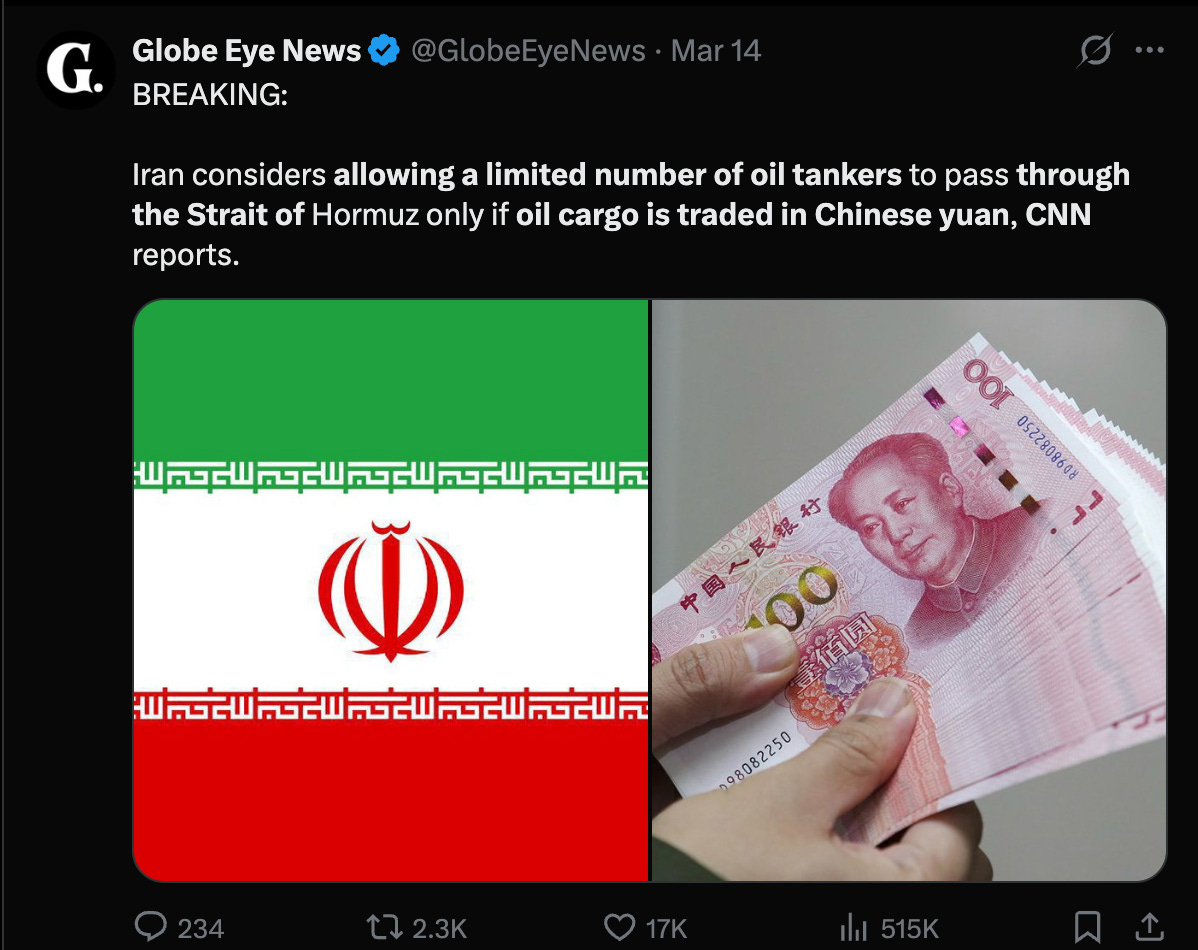
According to a Gold Telegraph report, Iran has been negotiating passage with at least eight countries on the condition that oil is traded in Chinese renminbi. Not euros. Not dollars. The same currency the US Treasury has spent two decades calling a manipulation vehicle.
Hong Kong-based analyst Eric Yeung: “In the past, their oil proceeds are in US dollars like 100%. And then they would invest, recycle that surplus into US tech stocks, US treasury bonds. If they take RMB as proceeds, it’s a different ballgame. It flips the script upside down.”
The petrodollar recycling flywheel, through which GCC surplus oil revenues historically flowed back into US Treasuries and US equity markets, suppressing American borrowing costs and inflating American asset prices decelerates when oil gets priced in renminbi. What does not happen is automatic reinvestment in US government debt. The plumbing changes. The downstream effects accumulate.
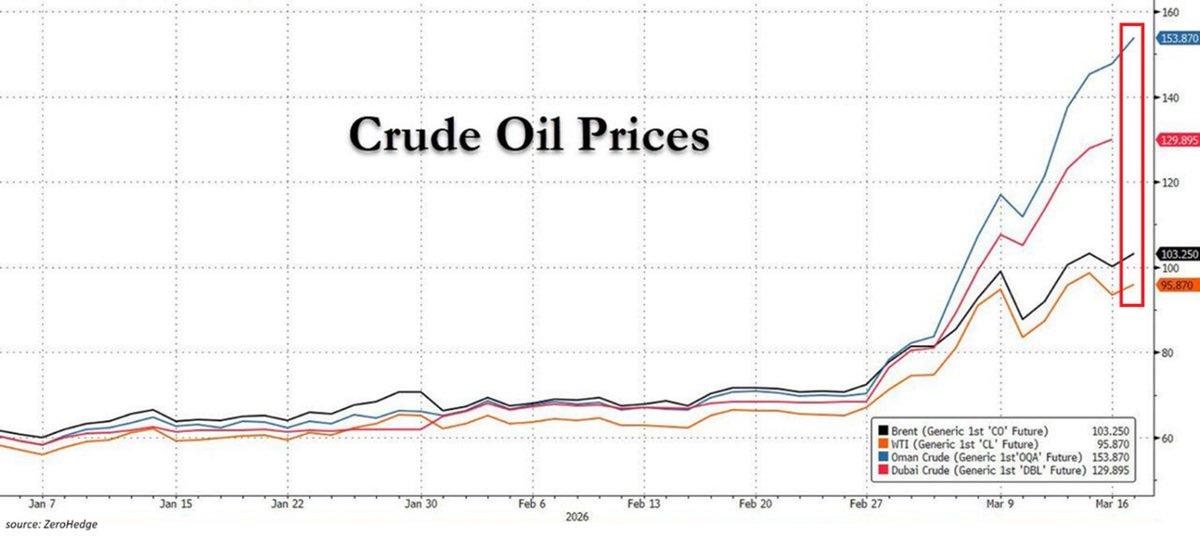
As of approximately March 18, 2026, four crude oil prices are printing simultaneously: Brent at $103. WTI at $96. Dubai Crude at $130. Oman Crude at $154. That $61 spread is geopolitical alignment made visible in dollar terms. Nigeria’s Central Bank spent eight years defending a unified official rate while the parallel market printed the real number. The IMF called it a governance failure. The world now has four crude oil prices.
Hmmm..
The deeper story is the debt. Nobody is saying this plainly enough, so I will.
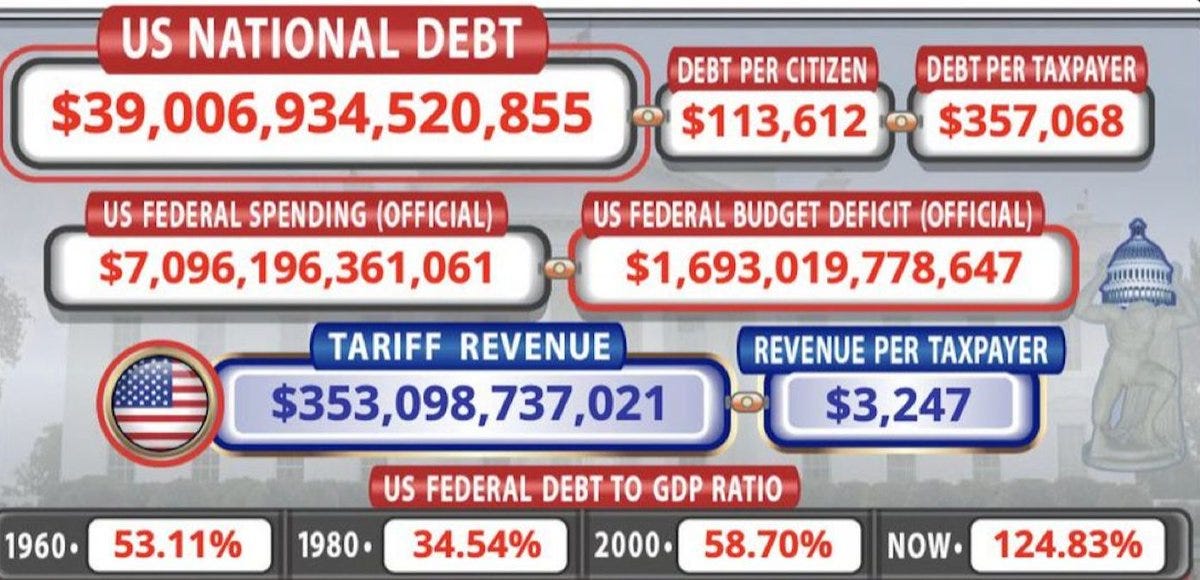
America’s debt-to-GDP is currently approximately 124.83%. Boston University economist Laurence Kotlikoff estimates the U.S. fiscal gap, including massive unfunded liabilities at levels equivalent to roughly 7–8% of GDP annually in perpetuity, underscoring that official public debt (around 123% of GDP in recent years) severely understates the true fiscal burden. Market analyst Francis Hunt: “We won’t run Volcker rates because we’ll collapse. The system is five times, ten times, a hundred times more sensitive.”
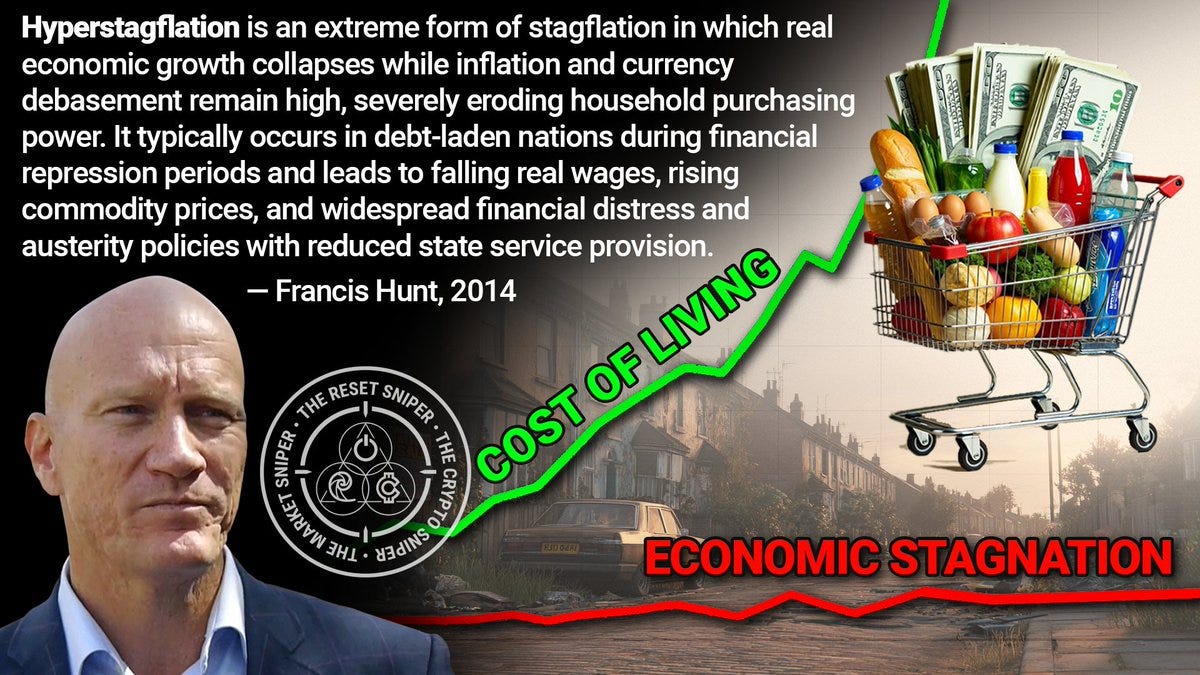
In the 1970s, America’s debt-to-GDP was in the 30s. The OPEC embargo of 1973 arrived roughly two years after Nixon’s 1971 suspension of the gold window, the US had been printing more dollars than it had gold backing, and was caught when France demanded physical delivery. The current Hormuz sequence follows two decades of dollar-printing that accelerated hard after 2008 and again after 2020. The playbook is identical. The debt position is four times worse.
So how do you service debt you cannot explicitly inflate away? You engineer supply constriction. You let inflation arrive through energy prices. You make it look like someone else’s fault: a war, a strait, a regional conflict while bond yields climb and real wages quietly crater. The IEA’s ten-point demand-management report is, in one reading, a genuine crisis response from a multilateral institution doing its job. In another, it is the administrative documentation of a cost-transfer: the debt created by governments over two decades is being serviced, in real terms, by the households who can no longer afford to fill their cars.
African readers have a particular vantage point on this sequence, and it is not metaphorical.
Zambia defaulted in November 2020. Ghana in December 2022. Sri Lanka declared insolvency in April 2022. Nigeria’s naira collapsed from approximately 460 to the dollar to over 1,500 between 2023 and 2024, a real-terms confiscation of household savings without a single formal announcement. Pakistan is in its sixth IMF programme. Egypt has been on IMF life support since 2016. Not one of these was named accurately: an early-stage run of the same mechanism now bearing down on the Western consumer. They were called governance failures. They were the dress rehearsal.
Nigeria’s fuel subsidy removal, announced on Tinubu’s first day in office, May 29, 202 produced overnight price tripling and effective movement restriction for the working class. Not by licence-plate rotation. By economics. The market administered the use-case hierarchy without a government document. The IEA version will be described as equitable crisis management. The mechanism is identical. The distribution of costs will not be.
The British Crown held Nigerian cocoa board proceeds, tin mining revenues, and groundnut export profits in sterling accounts for decades. The audit came at independence. The receipts did not match the accounts. The global financial audit is now running. The IEA’s 400-million-barrel emergency release confirms the scale of the problem. The $2 million per-ship toll confirms who currently holds the leverage.
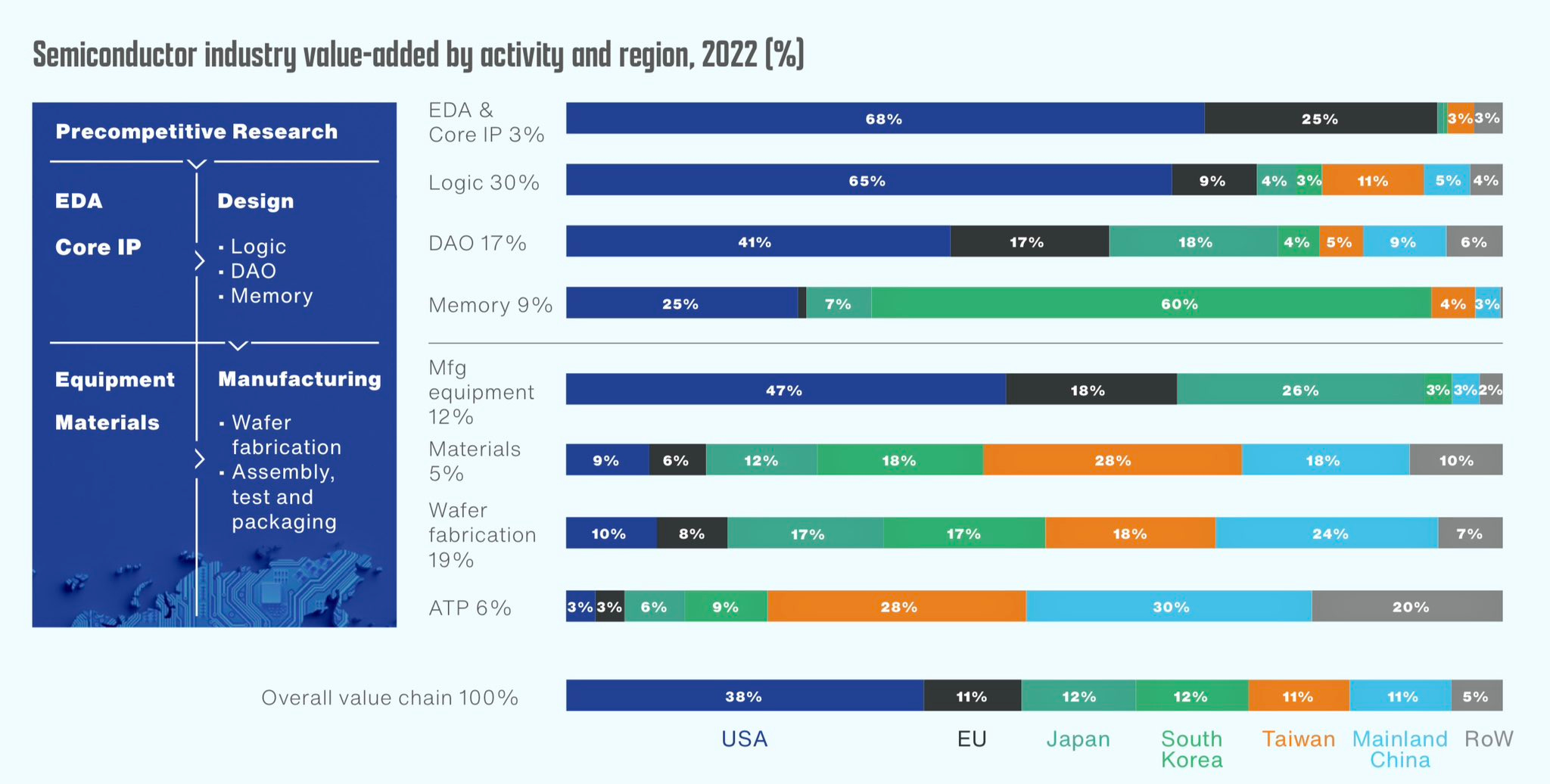
Taiwan has approximately two weeks of oil reserves, per analyst Eric Yung’s estimate, his own calculation, not official government data. The IEA confirmed on March 20 that shipping through the Strait of Hormuz has been “reduced to a trickle.” Taiwan makes over 60% of the world’s semiconductors and over 90% of the highest-end chips (TSMC dominant). The chip manufacturing infrastructure that underpins artificial intelligence, military systems, and consumer electronics sits on an oil supply line passing through twenty-one miles of water that Iran is now charging $2 million per vessel to cross.
A pipeline bombing in Nigeria’s Niger Delta historically reduced Nigerian output from 800 million barrels per day to 1.4 million barrels per day. The world called that an African infrastructure problem. Taiwan’s two-week clock is structurally identical: a single-point dependency on a contested supply corridor. The price tag on the downstream product is the only variable that differs.
According to Hunt: “The data centers and all of this investment is our surveillance system and the government will be the eventual utilizer of the services they are building.” His evidentiary basis is incentive logic and the pattern is not without precedent. AFRICOM did not garrison twenty-nine African countries through direct occupation. It built partnership infrastructure: forward operating bases, training centres, signals networks that activates as needed. Starlink across Africa is a communications utility and a surveillance infrastructure simultaneously. These facts coexist without contradiction.
The AI data center buildout carries the same dual-use profile. The dot-com crash did not destroy the internet. It transferred ownership to fewer, better-connected hands at distressed prices. The Hormuz energy squeeze raises data center operating costs, tightens the credit conditions that funded the AI buildout, triggers the correction, produces the distressed assets. State actors acquire at discount or contract on favourable terms.
It sure looks like the plan..
Iran is charging $2 million per ship. The IEA has published the demand-management protocol. Four crude oil prices are printing simultaneously. The petrodollar recycling flywheel is being rerouted through renminbi. The largest emergency reserve draw in history was not enough. And somewhere in Taipei, the semiconductor fabrication plants that make modern civilisation legible are running on a two-week oil supply.
The question is not whether any of this is being managed. It clearly is.
The question is who is doing the managing, on whose behalf, and what they intend to preserve when the triage decisions come.
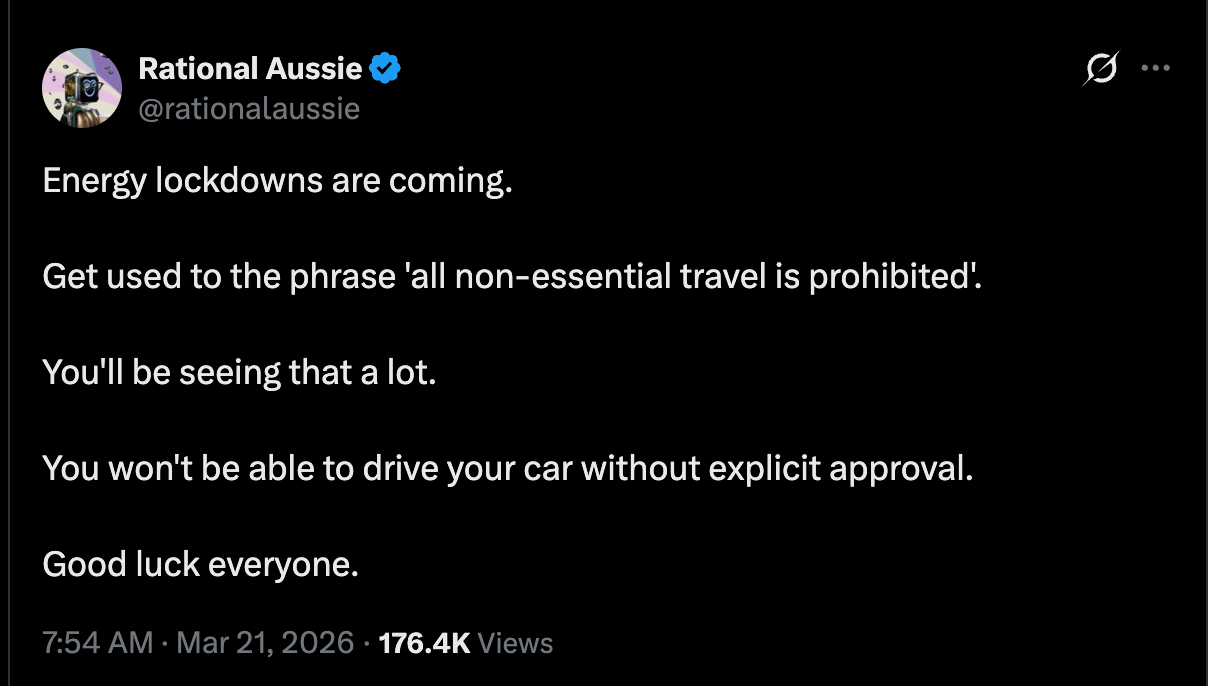
Watch the list. Watch who gets to drive.
If this essay landed, share it with one person who still thinks African debt crises were governance failures and Western ones are geopolitical accidents. The IEA just published the demand-management protocol. The mechanism is the same. The price tag is different.
A lot of good info here. Fox News is not reporting that the Strait is open for those with Chinese money. I get the Zionist propaganda even though I do not seek it out.
You might want to read and converse with Richard Werner.