
"The problem with OpenAI is Sam himself."
Charming, Softly Spoken, and Playing You

Inside OpenAI, a senior executive reportedly proposed enriching the company by starting a bidding war among world powers: the United States, China, and Russia, for access to advanced AI technology. The logic, per contemporaneous records reviewed by The New Yorker‘s Ronan Farrow and Andrew Marantz: “It worked for nuclear weapons, why not AI?”
The plan was dropped, but the premise wasn’t disputed.
That is the sentence to hold. Not “the plan was dropped.” The premise wasn’t disputed.
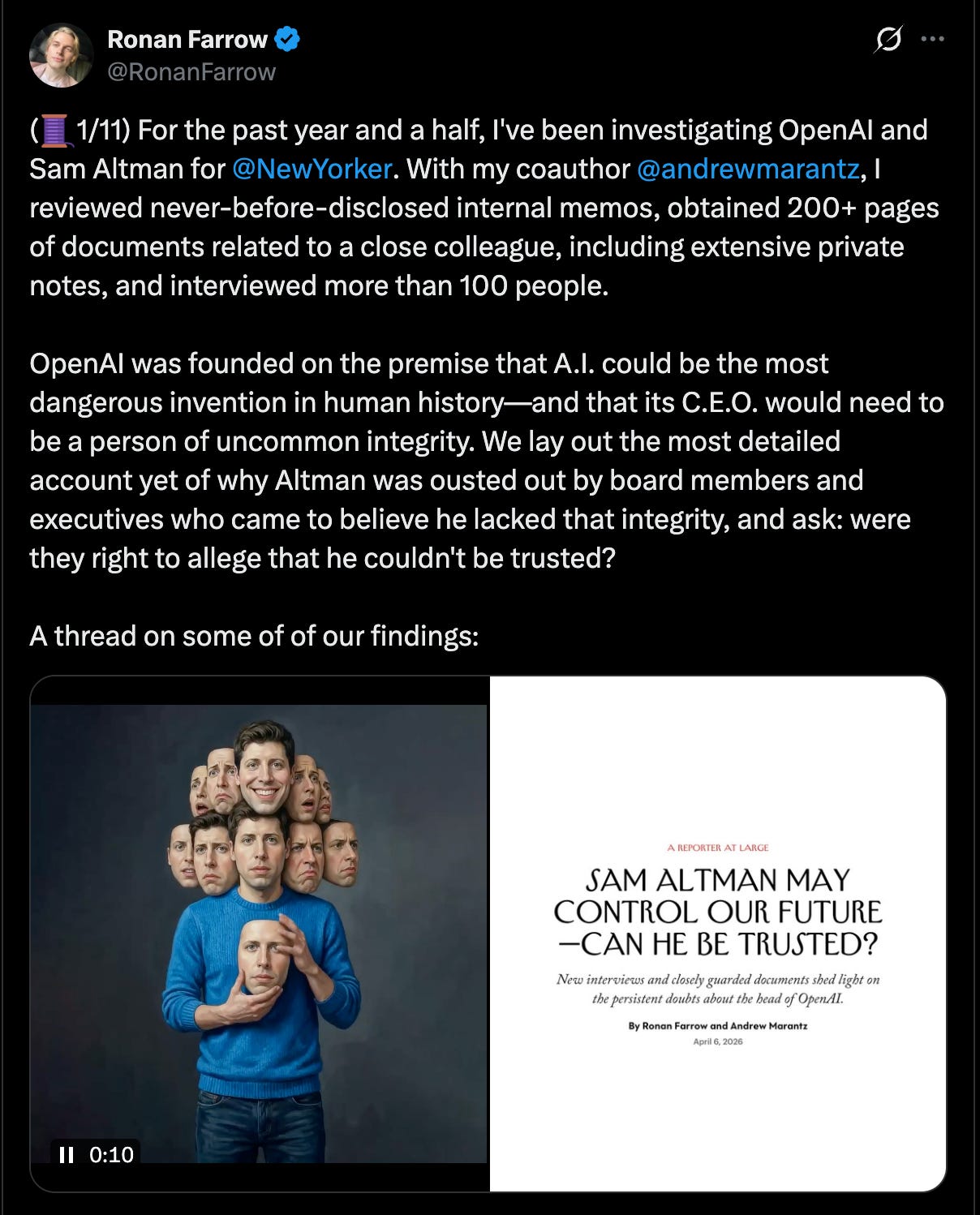
On April 6, 2026, The New Yorker published what is now the most detailed public accounting of Sam Altman, OpenAI, and the mechanics of institutional deception in Silicon Valley. Farrow and Marantz reviewed never-before-disclosed internal memos, obtained 200+ pages of private documents kept by Dario Amodei, then OpenAI’s chief research officer, now co-founder of Anthropic under the heading “My Experience with OpenAI / Private: Do Not Share.” They interviewed more than 100 people. They reviewed Ilya Sutskever’s 70-page dossier on Altman and Greg Brockman: Slack messages, HR documents, some photographed on personal phones specifically to avoid detection on company devices.
Sutskever’s memo begins with a list. “Sam exhibits a consistent pattern of . . .” The first item is one word: “Lying.”
Dario Amodei’s private conclusion, per those documents: “The problem with OpenAI is Sam himself.” Amodei adds, in a line that ought to haunt every Senate committee member who applauded Altman: “His words were almost certainly bullshit.”
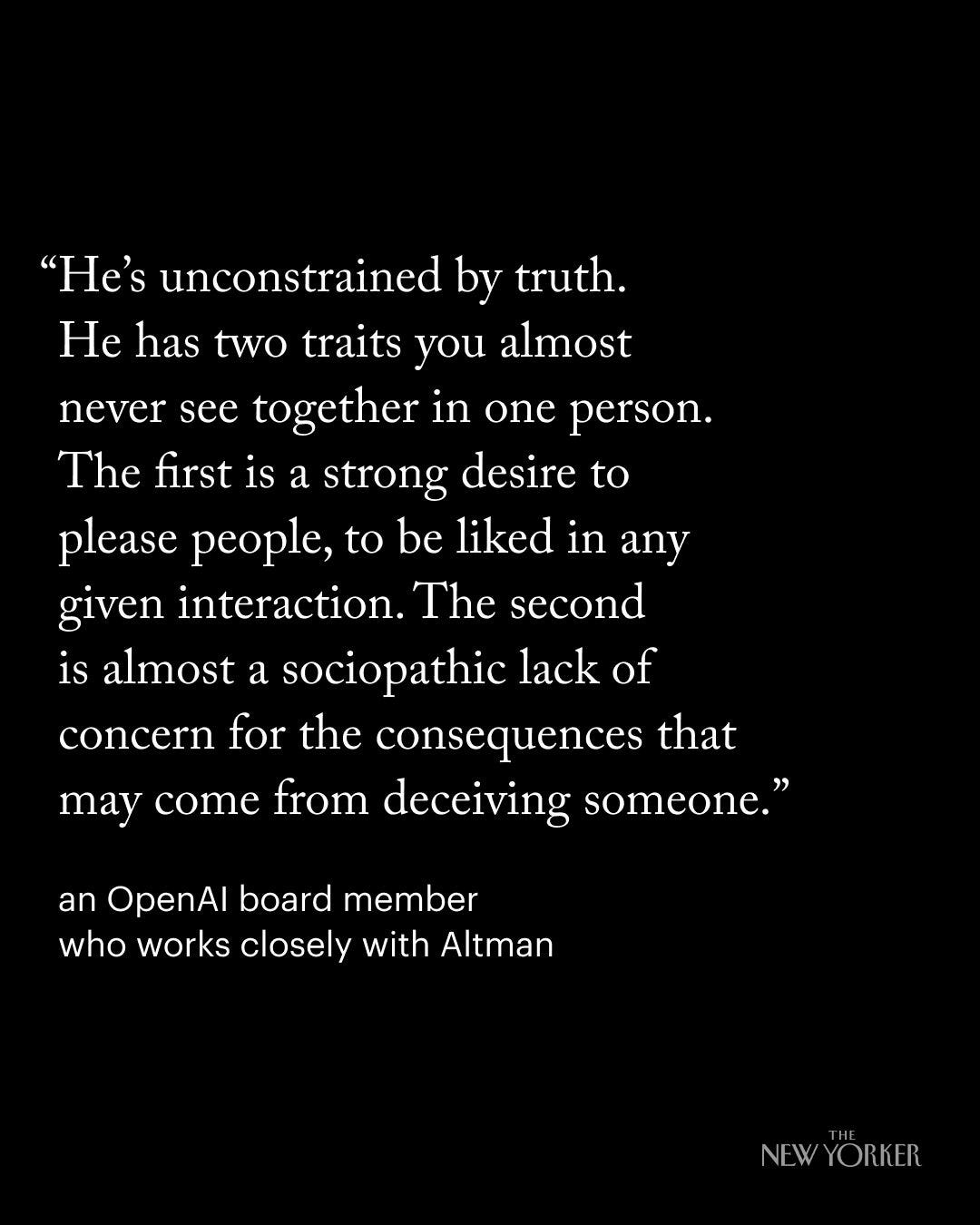
A board member described Altman to Farrow and Marantz as having “two traits almost never seen in the same person: a strong desire to please people in any given interaction, and almost a sociopathic lack of concern for the consequences of deceiving someone.” Multiple sources independently used the word “sociopathic.” OpenAI disputes characterizations of Altman’s conduct. Altman attributes early criticism to being “too much of a conflict avoider.”
The receipts do not stop there.
Same vibes..Elizabeth Holmes..Sam Bankman Fried….
Let us be precise about what we are describing. Not “a controversial tech CEO.” Not “a flawed visionary.” We are describing a concession firm.
The distinction matters. A tech company builds products and sells them. A concession firm extracts value from a territory: a resource, a technology, a geopolitical moment, by renting legitimacy from whoever controls the surrounding political architecture, owing loyalty to no one, and capturing the upside while externalizing the risk.
The Royal Niger Company, chartered 1886: private army, private postal service, the authority to sign treaties with African chiefs, treaties those chiefs often did not fully understand, while displaying the British flag as a legitimizing wrapper. When the company’s conduct became too embarrassing, the British government revoked its charter in 1900 and the Colonial Office absorbed the territory. The company’s shareholders had already extracted their returns. Shell Petroleum Development Company of Nigeria: joint venture with NNPC since 1956, flying both the British and Nigerian flags depending on the audience, running private security in Ogoniland for decades, flaring gas 24 hours a day across the Delta while Niger Delta communities drank contaminated water. When writer Ken Saro-Wiwa organized nonviolent resistance and was executed by the Abacha government in November 1995 alongside eight other Ogoni activists, Shell’s role was “investigated” across multiple jurisdictions for years without criminal accountability.
The mechanism, in both cases: rent the flag. Use the flag for access, for legal immunity, for the optics of national belonging. Owe nothing to the population the flag supposedly represents.
OpenAI has been running this operation with the American flag, and is now adding a Middle Eastern one.
May 16, 2023. Sam Altman before the US Senate judiciary subcommittee. Senator John Kennedy asks: “Do you make a lot of money?” Altman: “I get paid enough for health insurance. I have no equity in OpenAI. I’m doing this ‘cause I love it.” The senators, per Gary Marcus, who was in that room, ate it up.
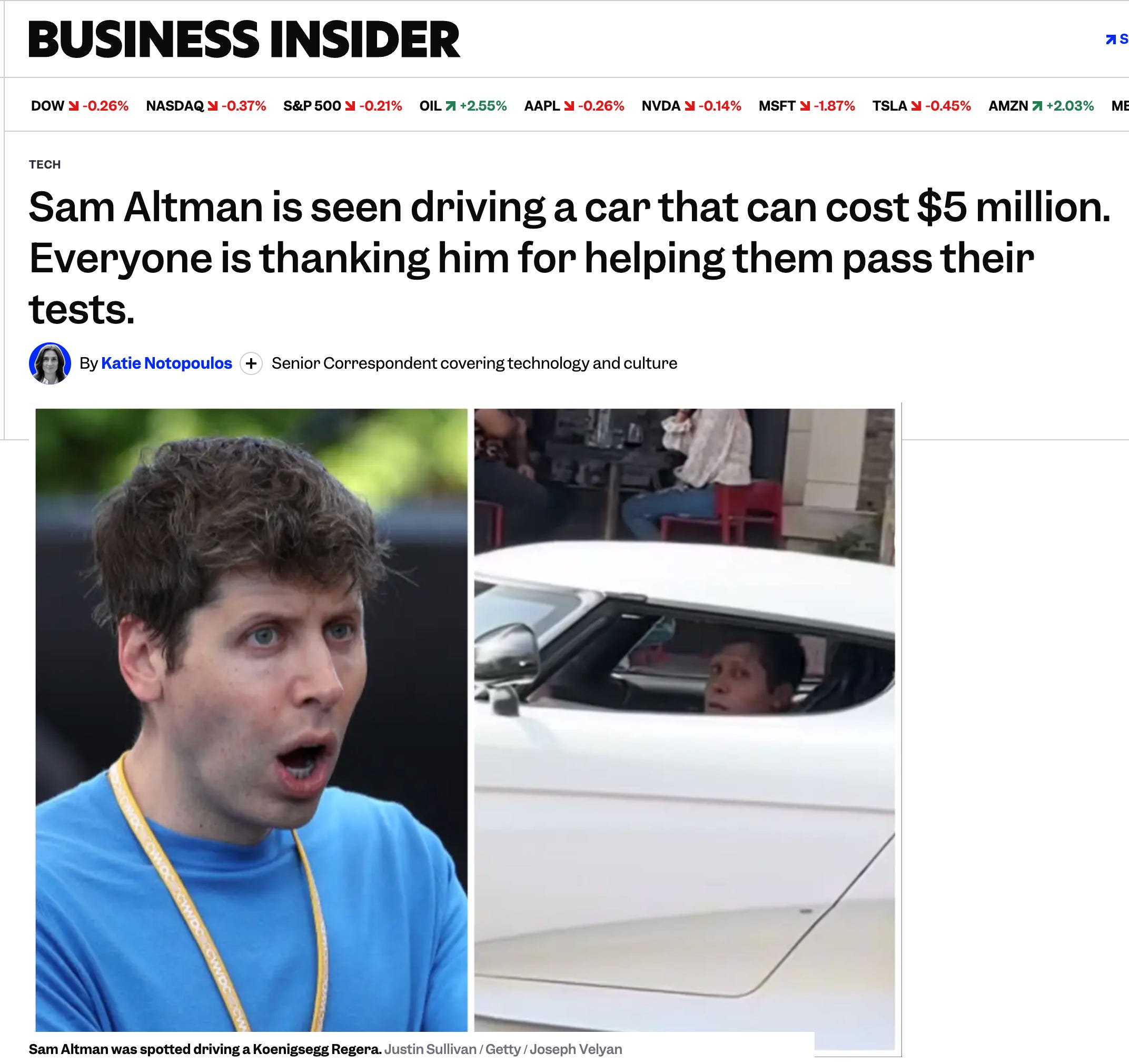
What Altman omitted: he held equity in Y Combinator. Y Combinator held equity in OpenAI. An indirect stake, acknowledged on OpenAI’s own website. If that indirect stake equaled 0.1% of OpenAI’s current valuation, Marcus estimated it at approximately $100 million. When a follow-up question returned the senators to the topic of money, Altman could have corrected the record. He didn’t. He doubled down in Fortune: he didn’t need OpenAI equity because he had “enough money.”
This is not embarrassing. This is the pitch. A private entity performing selflessness before legislative bodies in order to block regulation, secure government contracts, and deploy the flag of national interest as a fundraising instrument. In the same period, Altman was publicly calling for AI regulation. Behind closed doors, per Marcus’s contemporaneous reporting and multiple subsequent sources, OpenAI lobbyists were working to water down the EU’s AI Act. A month after the Senate hearing, that lobbying effort became public.
Eighty percent of American voters, per a June 2024 poll by the Artificial Intelligence Policy Institute, want mandatory safety oversight of AI labs rather than self-regulation. OpenAI’s lobbyists are being paid to ensure those voters do not get what they want. The flag was never about them.
The bidding war proposal is the clearest window into what the company actually believes about its own loyalties.
According to multiple interviews and contemporaneous records reviewed by Farrow and Marantz, Greg Brockman offered a counterproposal during internal strategy discussions: OpenAI could enrich itself by playing the US, China, and Russia against one another: perhaps by starting a bidding war. One person present described being aghast. Per that person’s account: “The premise, which they didn’t dispute, was ‘We’re talking about potentially the most destructive technology ever invented, what if we sold it to Putin?’” OpenAI’s representative told Farrow and Marantz it was one of many ideas “batted around at a high level.” The plan was dropped after several employees threatened to quit.
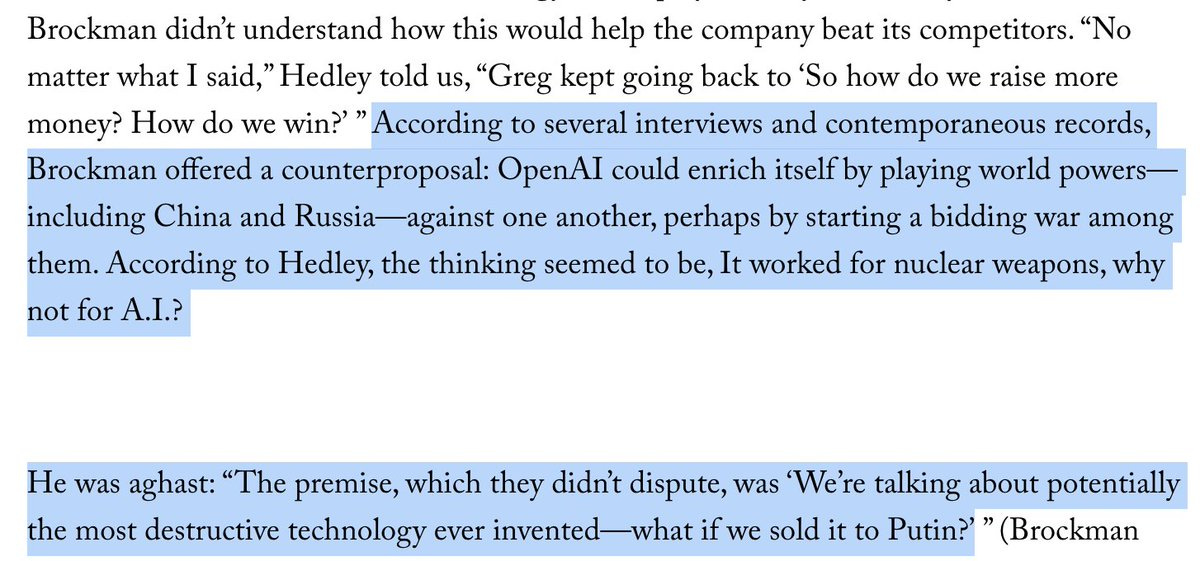
Batted around at a high level.
The Brockman counterproposal was not a rogue fantasy. It was a strategic option put on the table by a co-founder of the company that had just testified to the US Senate about its commitment to American safety and values. The historical rhyme here is not subtle: arms merchants, oil traders, and colonial concession companies have been playing sovereign states against each other since the Berlin Conference of 1884. The difference is that this time the commodity is intelligence itself: the capacity to surveil, automate, deceive, and control, and the bidding parties have nuclear arsenals.
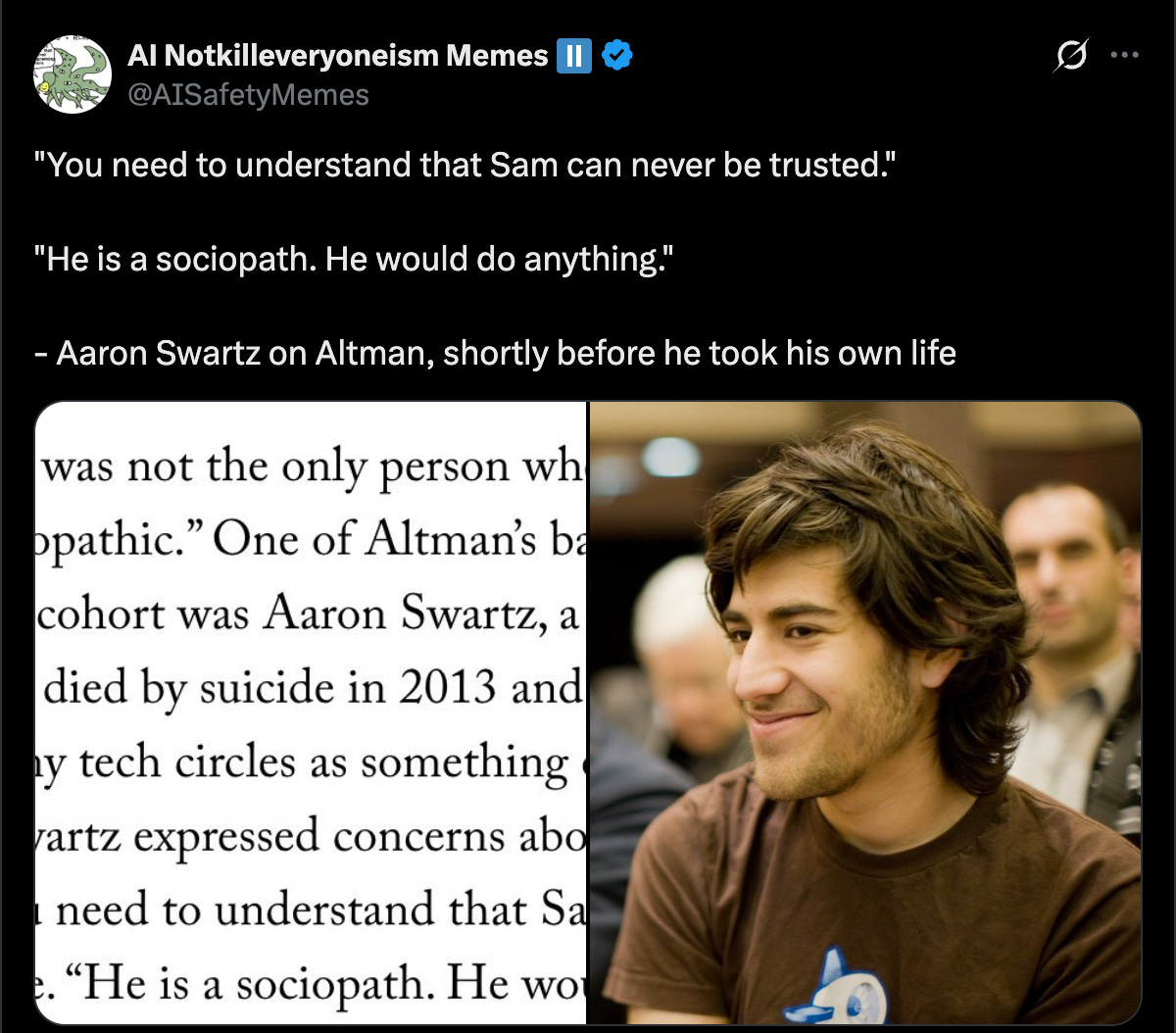
The reinstatement of Altman after his November 2023 firing demonstrates the enforcement architecture. The board removed him for being “not consistently candid.” Former OpenAI board member Helen Toner told a podcast in May 2024 that Altman had spent years “withholding information, misrepresenting things... in some cases outright lying to the board.” Five days after the firing, he was back. Microsoft, OpenAI’s largest investor, backed his return. Thrive Capital put its planned $86 billion investment on hold, per Farrow and Marantz, and implied it would only close if Altman returned, giving employees with vested stock a financial incentive to support him. The legal review of his conduct was overseen by two new board members selected after close conversations with Altman himself. No written report was produced. Only an 800-word statement acknowledging “a breakdown in trust.” Sam Altman chose his own investigators. The investigators cleared him. The concession firm does not answer to the people nominally governing its territory.
Now watch the territory expand.
The Trump administration rescinded Biden’s export restrictions on AI technology. Altman and Trump travelled together to the Saudi royal court to meet Mohammed bin Salman. The Saudis announced a state-backed AI firm with billions for international partnerships. A week later, Altman announced Stargate would expand into the UAE: a data-center campus in Abu Dhabi described as seven times larger than Central Park, drawing roughly as much electrical power as the city of Miami.
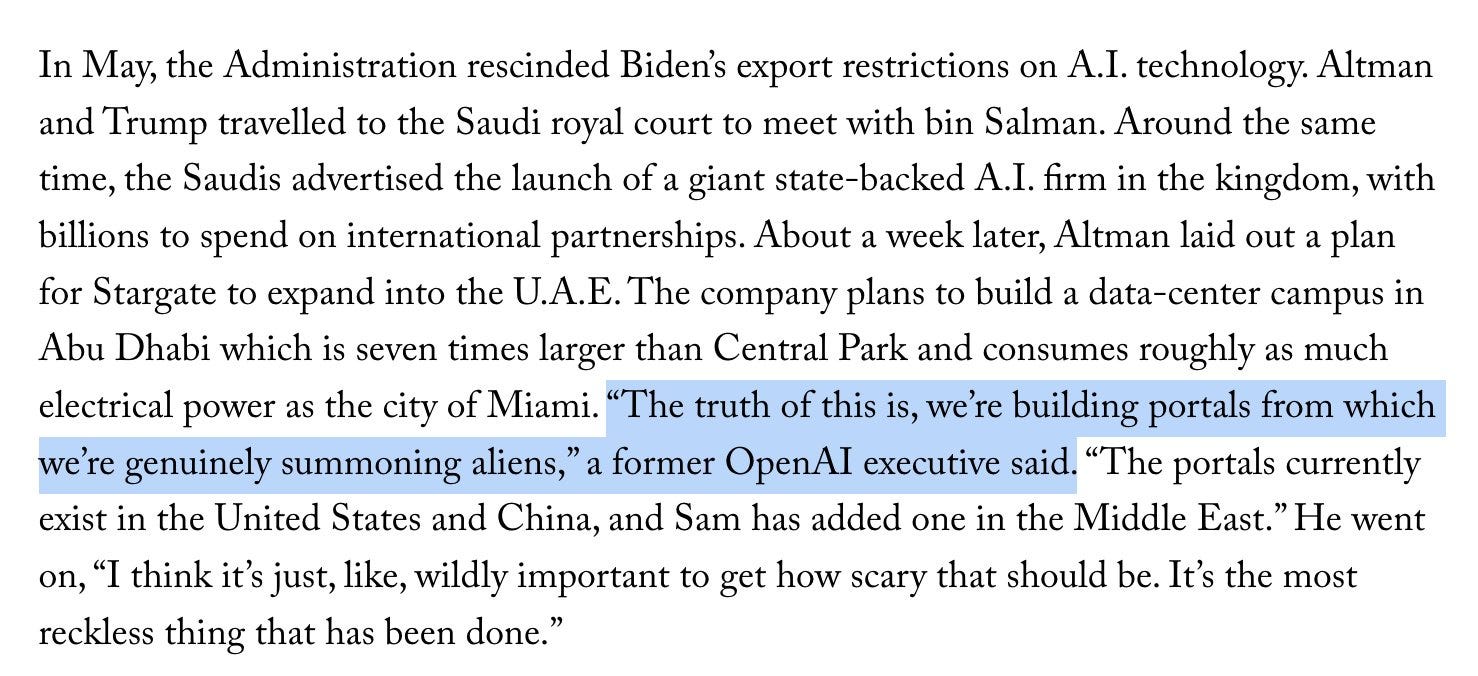
A former OpenAI executive: “The truth of this is, we’re building portals from which we’re genuinely summoning aliens. The portals currently exist in the United States and China, and Sam has added one in the Middle East... It’s the most reckless thing that has been done.”
Portals.
Meanwhile: OpenAI is reportedly preparing for a public offering at a potential $1 trillion valuation. The company is securing government contracts spanning immigration enforcement, domestic surveillance, and autonomous weaponry in war zones. OpenAI’s superalignment team, promised 20% of company compute received 1–2% in practice, mostly on the oldest hardware. The team was dissolved without completing its mission. The Future of Life Institute gave OpenAI an F on existential safety. ChatGPT faces seven wrongful-death lawsuits alleging it prompted suicides and a murder. One current board member told Farrow and Marantz: “The company levered up financially in a way that’s risky and scary right now.”
The Royal Niger Company’s charter was eventually revoked, but only after the extraction was complete.
Watch the Abu Dhabi campus. Watch the government contracts: which agencies, what oversight, what liability waivers. Watch whether any written report on internal conduct is ever produced. Watch what the sovereign wealth funds receive in return for their capital. Watch whether the bubble, when it pops, takes the infrastructure with it or only the public shareholders.
The flag is a rental. It always has been. The Global South learned that lesson one concession agreement at a time. Silicon Valley is now teaching it to everyone else.
If you found this useful, share it with someone who still believes Sam Altman went to Washington because he loves humanity. The Senate testimony is public record. The rest is in The New Yorker. Read both.
We have a monthly zoom group of women stackers that we call the Apocaloptimist Club: when you know the world's falling apart but you still think it's going to be okay. Margaret Anna Alice, a member, popularized it on her blog although she didn't coin it. I first saw it in a meme.
Tonika just sent the group the trailer for The AI Doc: How To Be an Apocaloptimist: https://www.youtube.com/watch?v=HD22S5PEOP0, saying "Uhm, btw ladies, I was not consulted about this."
Here's the description: "explores how to balance existential anxiety with hope regarding artificial intelligence. The film defines an "apocaloptimist" as someone who acknowledges the terrifying risks of AI while simultaneously choosing to believe in a future of potential and progress. The central premise follows Roher, who is preparing to become a father, as he interviews leading AI figures like Sam Altman, Dario Amodei, and Daniela Amodei to understand the technology's impact on humanity's future. By weighing the "doom" narratives against "optimist" visions of disease cures and labor-free utopias, the film argues that the path forward requires acknowledging uncertainty rather than succumbing to fear or blind faith.
"Key takeaways for becoming an apocaloptimist include:
"Accepting the duality: Recognizing that AI presents both existential threats and transformative benefits simultaneously.
"Active engagement: Moving beyond anxiety to participate in the conversation and demand safeguards for equal access and safety.
"Personal motivation: Using the desire to protect future generations as a catalyst for understanding and action rather than paralysis."
I had just been thinking that my coinages were like tracking devices to see where my influence went. But now with the AI scraping there's no trail of bread crumbs. Tonika is about to do an interview on AI in theater and a major point of her dissatisfaction is there's a 'casual usurpness to it all.' Great phrase, we'll see where it shows up next.