
The Sacred Costume
The Church That Runs the Country

Tokyo’s streets were full.
Not the polite, single-file kind of full. The kind that signals something has broken where ordinary people who never protested before are standing in rain holding signs, staring at a government that is not looking back.
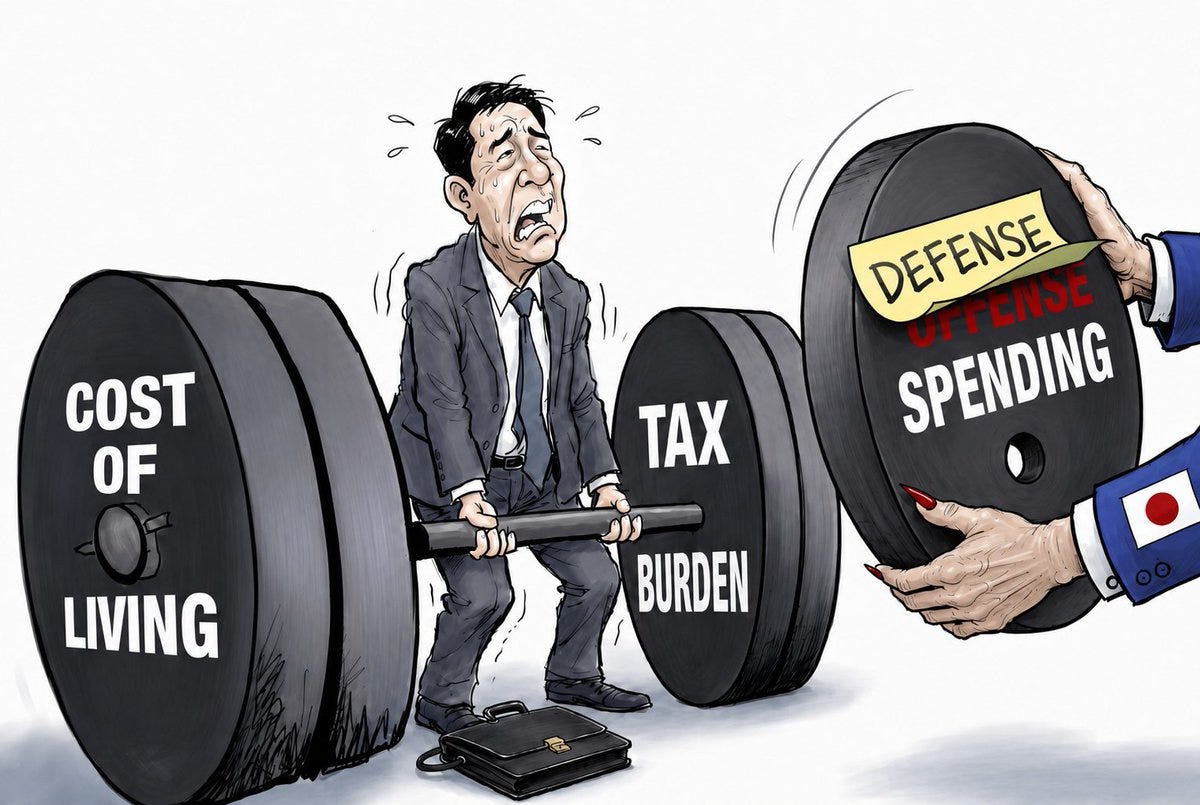
They were protesting the defense spending. The surveillance state. The security bills. The rushed constitutional revision. The feeling, which is actually a documented fact that the people making the laws are not working for the people living under them.
The government moved anyway.
Let’s name the mechanism before we go further, because this is not a story about Japanese politics. This is a story about a structural tool that gets deployed in country after country, generation after generation, wearing different national costumes each time.
The tool: a foreign‑origin ideological network embedded inside a ruling party’s electoral machinery, providing votes, volunteers, and financing in exchange for political protection and regulatory blind spots. The network extracts from the domestic population. The party provides cover. The deal is dressed as patriotism.
In Japan, that network is the Unification Church, specifically its anti‑communist political arm, the International Federation for Victory over Communism (IFVC). The party is the Liberal Democratic Party (LDP). The practical bargain was struck in the late 1960s, when former prime minister Nobusuke Kishi (1957–1960) and Shinzo Abe’s grandfather, helped midwife the Church’s IFVC apparatus into Japanese conservative politics and tied it into the LDP’s anti‑communist machine.
This is not conspiracy folklore. It is a historically documented, investigative‑journalism‑verified, Diet‑hearing‑interrogated political alliance: a cooperative relationship dating back to the 1960s in which the Church’s network supplied votes and on‑the‑ground campaign labor to LDP candidates, while LDP elites looked away from abusive fundraising and “spiritual sales” that hollowed out Japanese households. Over fifty years later, you can still see the residue in cabinet lists, internal party surveys, and election records that show hundreds of LDP lawmakers taking support from the same foreign‑origin ideological machine they were nominally regulating.
Here is how the bargain worked.
The Unification Church supplied what a ruling party needs and voters rarely see: disciplined, low‑cost campaign machinery. Its network delivered volunteers who showed up early, followed instructions, and could be deployed into key districts in bulk, along with block votes routed through congregations and affiliate groups. In return, LDP power brokers extended political cover that kept the Church’s money engine built on “spiritual sales,” in which followers were pressured into buying religious goods at wildly inflated prices to ward off curses or aid deceased relatives, largely insulated from hard regulatory enforcement. Japanese families lost life savings. Some lost their homes.
The protection held for decades. Not because the LDP didn’t know. Because knowing was the price of the arrangement.
The assassination of Shinzo Abe in July 2022, by Tetsuya Yamagami who explicitly blamed the Unification Church for his mother’s financial ruin, blew the lid off. Public backlash was immediate. Party leaders promised distance, internal surveys, and a cleanup of ties.
But post‑2022 reporting has kept turning up live wiring between the Church’s ecosystem and the ruling party. An internal LDP review admitted that roughly half of its Diet members had some form of relationship: event appearances, endorsements, organizational support with the Church or its fronts. Subsequent disclosures suggested that Church‑linked networks had backed close to 300 LDP lawmakers over the years, far above the party’s initial admission. The promises did not become distance. The alliance is structural, not personal. You can remove individuals. You cannot easily remove load‑bearing walls.
Then on March 4, 2026, the Tokyo High Court upheld a dissolution order against the church, only the third religious corporation dissolution in Japanese history, and the first ever based on civil tort liability rather than criminal offense. The Tokyo District Court had found that illegal donation solicitation practices ran from 1973 to 2016, causing documented damages to at least 506 people totaling approximately ¥7.4 billion. Including settlements, approximately 1,550 victims. Total settlement amounts: approximately ¥20.4 billion. The church’s total assets stood at approximately ¥104 billion as of fiscal year 2024.
Court-ordered dissolution. ¥104 billion in assets. A liquidator appointed.
Sounds like closure. It is not.
The dissolution strips the church of legal personhood. It does not stop religious activities, the constitution guarantees freedom of religion, so the church can continue operating as an unincorporated association. The liquidator lacks the compulsory investigation powers available to a bankruptcy trustee. The church has already designated a religious corporation called “Tenchi Seikyo” in Obihiro, Hokkaido, as the recipient of residual assets, a potential de facto transfer to affiliated organizations. For reference: Aum Shinrikyo received its dissolution order in 1995 and its liquidation took approximately thirteen years. Victims are still waiting.
This is the detail that matters for our purposes. The right to question religious corporations, a power created by a 1995 amendment to the Religious Corporations Act went unused for twenty-seven years. During which the church continued “spiritual sales.” During which LDP members used church members as secretaries and election volunteers. During which the harm expanded, quietly, inside an institutional silence that was not accidental.
That silence had a price. The protection held because the protection was paid for.
Now the judicial machinery has finally moved. The political machinery is also moving fast, in the other direction. Which raises the question nobody in the mainstream is asking directly:
Is the rush on constitutional revision, referendum law amendments, and security bills partly explained by the dissolution clock?
The Unification Church is being liquidated. Its vote-mobilization capacity is structurally degraded. The pipeline of organized campaign labor and block votes is under legal pressure. If the LDP-IFVC machine has a finite operational window before the dissolution proceedings bite into its infrastructure, then the mid-July Diet session deadline looks less like administrative ambition and more like a deadline with a specific calculation behind it.
I am not stating this as established fact. I am stating it as a structural question that the timing makes unavoidable. Cui bono from rushing a constitutional revision precisely when your primary organizational ally is being dissolved?
Watch the sequence.
Now watch what the Takaichi administration tabled in the current Diet session.
Not the constitution itself. The rules governing how Japan votes on constitutional revision.
The LDP proposed amendments to the National Referendum Law specifically targeting the appointment requirements for referendum monitors, aligning them with standard public office election rules. This is presented as administrative tidying. The administration’s stated timeline is to table a full constitutional revision proposal targeting Article 9 (legal recognition of the Self-Defense Forces) and a national emergency clause, before the Diet session closes in mid-July 2026.
To hit that timeline, the Commission on the Constitution of the House of Representatives is being pushed to fast-track debates.
Let’s sit with this for a second. Hmmm.
You are running a foreign-backed political machine that has faced massive public backlash and multiple investigations. Your public wants accountability. What do you do? You don’t stop. You rush the process law that governs how accountability gets structurally registered. You rewrite the rules for monitoring the vote before the vote is called.
This is not paranoia. This is a sequencing choice. And the sequence has been chosen deliberately.
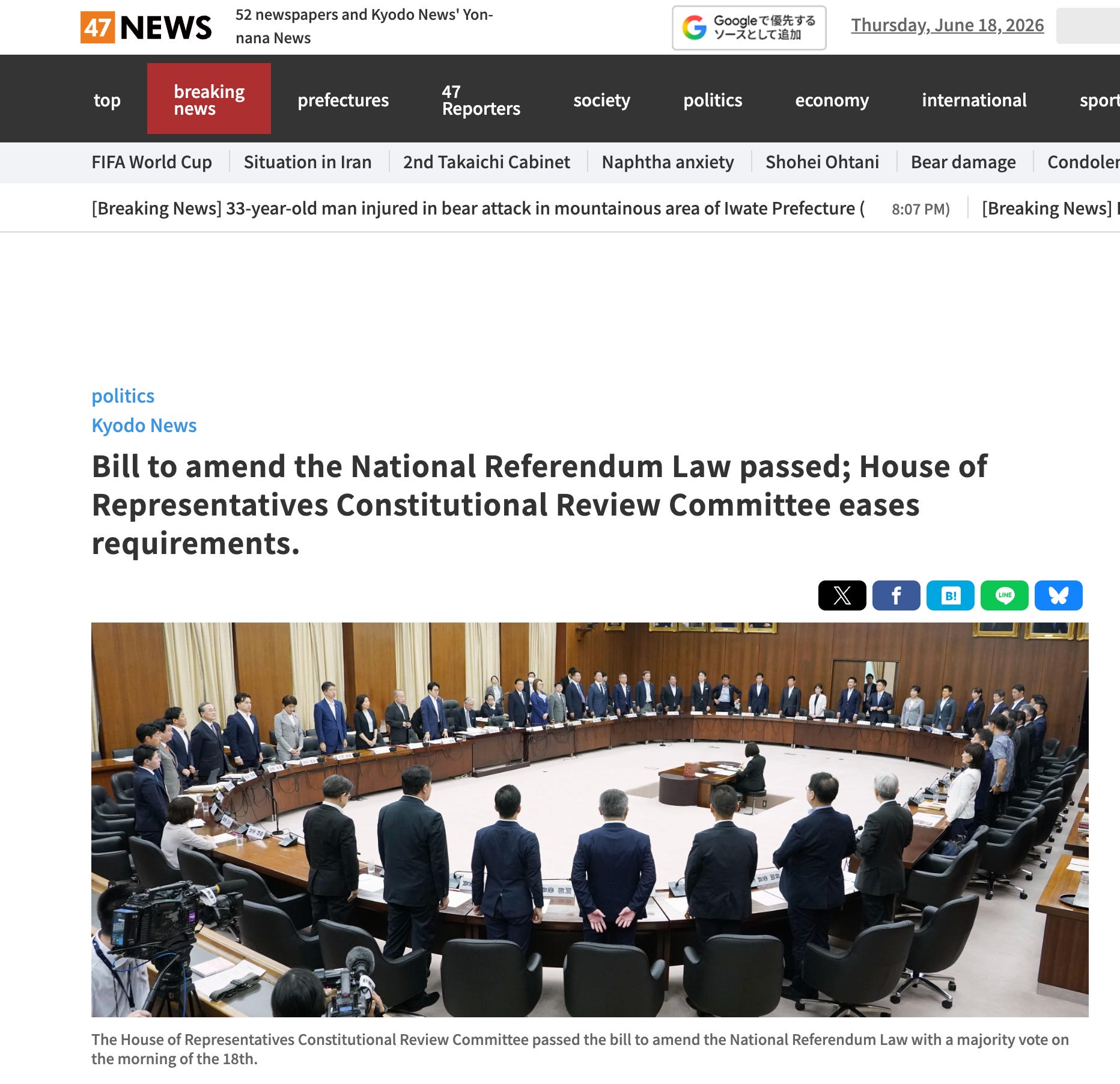
The Bill to amend the National Referendum Law passed earlier today!!!!
Now look at what the constitutional revision is actually for.
Article 9. Japan’s postwar pacifist clause. The provision that, since 1947, has legally prohibited Japan from maintaining war potential and renouncing the use of force as a sovereign right. The Takaichi administration wants it amended, specifically to grant explicit constitutional recognition to the Self-Defense Forces, and to introduce a national emergency clause that expands executive powers during crises.
This is not abstract. There is money already moving.
In December 2022, under then–Prime Minister Fumio Kishida, Japan locked in a plan to double defense outlays to roughly 2% of GDP by fiscal 2027, committing about ¥43 trillion in defense‑related spending over five years in its revised national security documents. This breaks with the informal 1%‑of‑GDP ceiling that had framed post‑1970s defense policy and marks the largest single remilitarization commitment in the postwar era.
The money is already flowing. Defense budgets have jumped from around ¥5.1–5.4 trillion in fiscal 2022 to nearly ¥8–9 trillion by fiscal 2024–2025, with total defense‑related spending (including coast guard and allied items) pushed toward the 2% target by supplemental packages. Major beneficiaries are exactly who you would expect: Mitsubishi Heavy Industries as Japan’s primary prime contractor (for long‑range missile programs and other systems), U.S. primes like Lockheed Martin and Raytheon via radar, missile, and fighter arrangements, and the broader US–Japan defense industrial complex built around an expanded “Taiwan contingency” mission set.
Point 1 of the IFVC’s published 2026 activity policy calls for “establishment of our country’s security system through measures including anti-spy legislation and defense capability strengthening.” Point 2: “protect Okinawa and the Senkaku Islands under the crisis awareness that ‘a Taiwan emergency is Japan’s emergency.’”
The cult’s political arm is publicly calling for the defense buildup. The ruling party is executing it. The constitutional revision legalizes and entrenches it. The referendum law amendments control how the public votes on whether to allow it.
Four instruments. One operational package.
And the money? A ¥43 trillion defense commitment in a country running structural fiscal deficits means debt. Debt means pressure on social spending. Pressure on social spending means ordinary Japanese people, the ones filling the streets absorb the cost of a security architecture they did not vote for, designed partly by an alliance they did not authorize, benefiting majority of contractors who are not Japanese.
Abi oh. We have seen this movie. Different cast, same director.
AFRICOM. The basing agreements across Chad, Niger, Djibouti. The security architecture upgrades that ran through the same US contractor ecosystem while domestic African populations absorbed the debt load and got the instability. The difference is Japan has more institutional padding between the decision and the body that pays for it. The mechanism is identical.
There is a third instrument running alongside this, quieter but structurally consistent.
The new adoption plan would change the Imperial House Law so “new” imperial family members can be adopted in, but only if they are male‑line descendants of the 11 collateral branches that were cut off in 1947. Legal scholars in Tokyo are already calling this out as discrimination by birth, and as a move that creates a closed hereditary tier above ordinary citizens. Former senior officials from within the Imperial Household system warn there is no historical precedent for pulling people more than twenty generations away, born as commoners, back into the imperial family just on the strength of bloodline.
Those branches were removed under the post‑1945 occupation settlement that deliberately shrank and depoliticized the imperial structure. Re‑admitting their male‑line descendants today, under the label of “tradition,” reverses that settlement while claiming continuity. The “tradition” doing the work here is not some timeless order; it is a postwar legal frame now being repurposed to legitimize a narrow, symbolic hereditary class at the same time the rules of democratic competition are being rewritten.
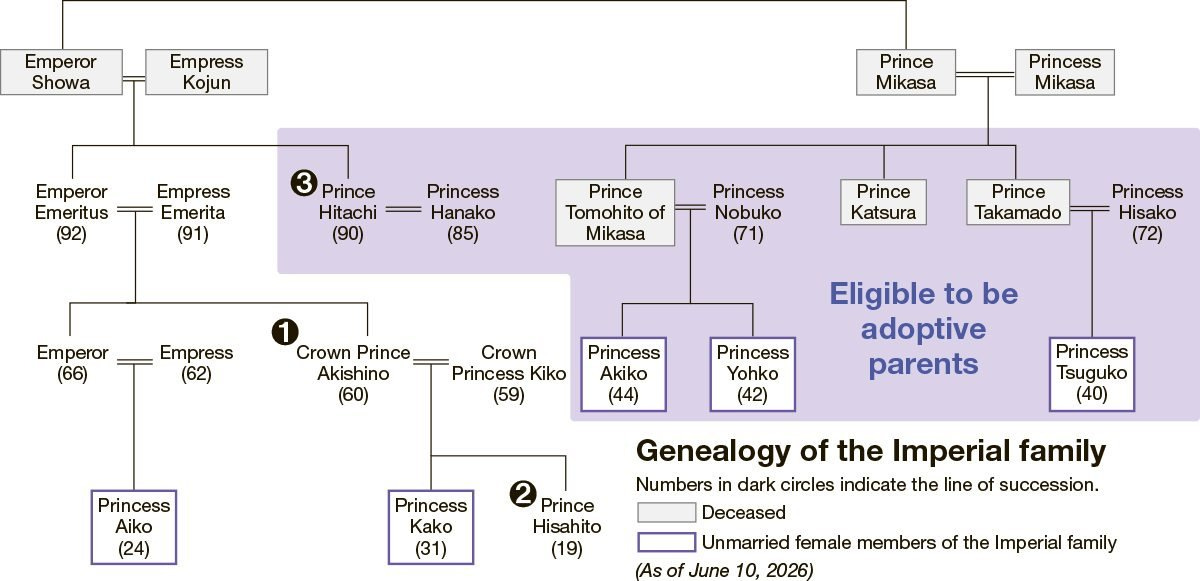
This is ritual legitimation. The symbol system is being switched on to pre‑authorize what the ballot cannot yet safely deliver. Three instruments. One note.
Lets use our map to identify the structure: Security and Military Architecture + Institutional Governance and International Law + Narrative and Information Infrastructure.
The frame is this: a Cold War security network: the LDP-Unification Church alliance, forged explicitly as anti-communist infrastructure during the 1960s has metastasized into a post-Cold War governance machine. Its third-generation operation involves using constitutional revision to legitimize military expansion while deploying a reconstructed hereditary narrative to provide symbolic cover for what the streets are actively rejecting.
The rushed referendum law revision is the pivot point. The security bills are the payload. The imperial bloodline restoration is the costume.
We have seen this before. We have lived it.
Sorry chiefs, this is not a uniquely Japanese pathology. This is a transferable operational package.
In Nigeria, the APC and PDP party machines have long operated with externally-funded ideological infrastructure embedded inside their electoral logistics. Gulf capital, evangelical networks: the Redeemed Christian Church of God, Winners Chapel, their affiliated political mobilization capacity provide block votes, campaign volunteers, and financial flows. The parties provide legislative protection from accountability and, where necessary, security cover for internal enforcement.
The extraction mechanism is identical to the Unification Church model: followers are financially depleted through tithes structured as mandatory taxation, through “seed” payments, through prosperity theology’s formalized extraction of the economically desperate while the political beneficiaries of their mobilization protect the leadership from regulatory scrutiny.
The financial data is sitting in the Revenue Mobilisation Allocation and Fiscal Commission records. Cross-reference it with the electoral map and the pastoral geography. Na so we see am.
Go further. Look at Kano.
The 2020 deposition and the 2024 reinstatement of Emir Muhammadu Sanusi II by successive Kano state administrations, one APC-aligned, one NNPP-aligned demonstrate the identical mechanics of hereditary symbolic authority as political instrument. The emirate is activated or deactivated by elected political operatives based on electoral calculus, not on “tradition.” The “tradition” is the costume. The instrument is the vote bank.
When the Takaichi administration rushes imperial bloodline restoration while also pushing constitutional revision, it is running the same play Kano governors have been running with the emirate system since 1999. Symbolic legitimation of political restructuring. Class re-entrenchment wearing cultural clothing.
The Global South is where you see the mechanism without the polish. Japan: wealthy, institutionally complex, with an independent judiciary and active civil society still produces the same architecture because the architecture is not a function of underdevelopment. It is a function of captured political parties, foreign-origin financial networks, and the universal human instinct to dress power in the language of the sacred.
Now let’s talk about the people in the streets.
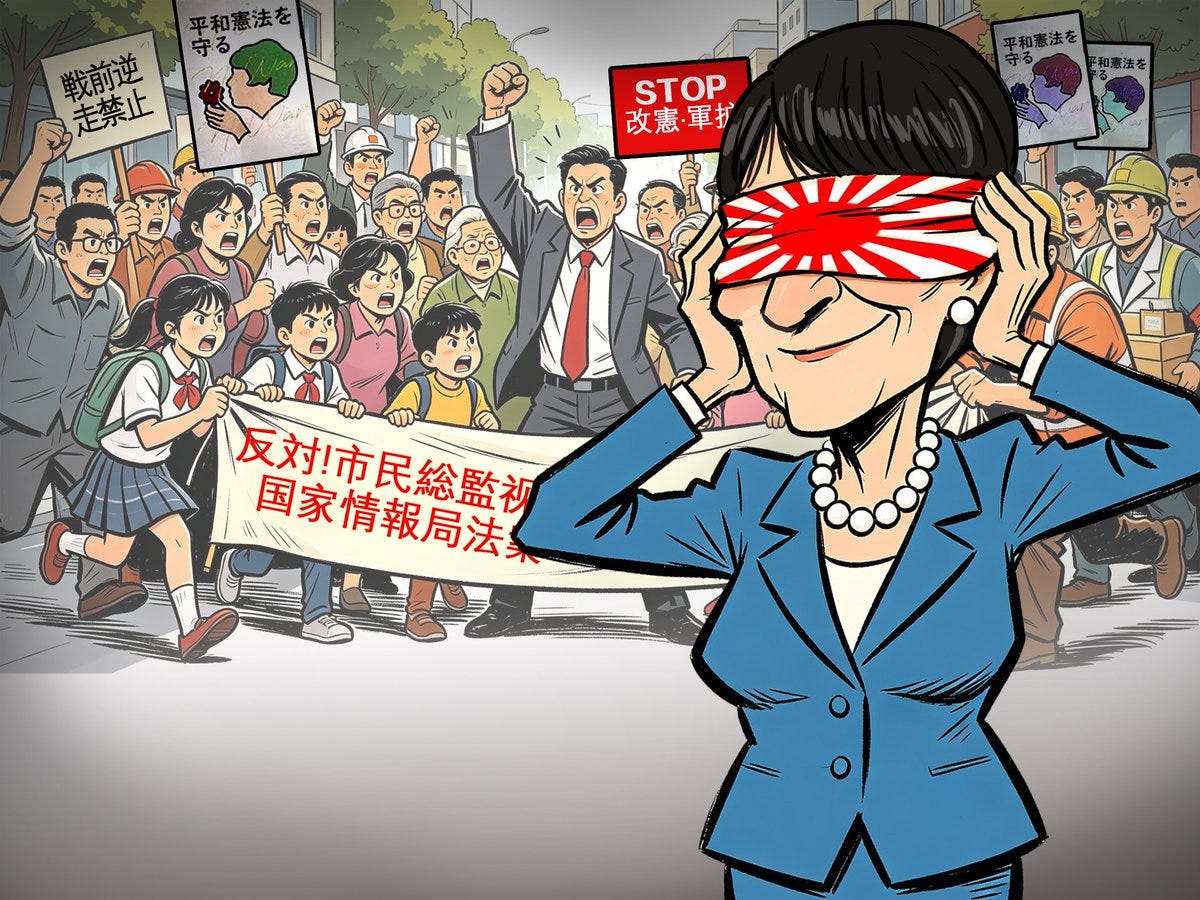
They are not marching against the Imperial Household. The Imperial Household holds zero legislative power in modern Japan’s constitutional framework. They are marching against the Takaichi administration’s specific policy agenda: the surveillance bills, the constitutional revision rush, the security expansion, the lack of political transparency.
They are marching against the machine that the Unification Church built and the LDP maintained for fifty-plus years and that Abe’s assassination forced briefly into the light before the lights were turned back off.
And what is the machine building right now?
A constitutional amendment process whose monitoring rules are being quietly rewritten before the public vote is called. A security architecture justified by the “Taiwan emergency is Japan’s emergency” framing, Point 2 of the IFVC’s publicly circulated 2026 activity policy document. A hereditary symbolic class restoration that pre-authorizes elite permanence.
The IFVC is not hiding. They published their 2026 activity policy. In public. In Japanese. Framed as the governing agenda of a political coalition that includes members of Japan’s ruling party.
That is the confidence of a network that has survived for fifty years inside a democratic state and knows exactly how to keep surviving.
The constitution isn’t written yet.
But the rules for how you vote on it, those are almost done. The mid-July Diet session deadline is ticking. The Commission on the Constitution has met and passed the first sitting on a fast-tracked schedule today.
Tokyo’s streets are full.
The government is moving anyway.
Watch the fine print. Watch whether the referendum monitors are independent or aligned. Watch whether the security bills get bundled with the constitutional revision package or introduced separately to reduce visible opposition.
And ask the question the streets are already asking: if this is sovereignty, whose sovereignty is it?
Cui bono.
If you've been reading a single wall of this building, Khaki & Leather exists to show you the floor plan. Subscribe and bring someone in.