
The Taxonomy Is the Weapon
Name the War correctly or lose it

The bomb that leveled Hiroshima was built with uranium mined in the Congo. You probably didn’t know that. You weren’t supposed to.
The Shinkolobwe mine in Katanga province, Democratic Republic of Congo, not yet called that in 1945, still Belgian territory then supplied the fissile material for both bombs dropped on Japan. Meanwhile, Senegalese tirailleurs were the troops who physically held French territory when the French state could not defend itself. Nigerian and Kenyan soldiers, conscripted under British imperial authority, fought the Japanese in what is now Myanmar. British warships and German U-boats both restocked regularly on the West African coast. The war that my school textbook call “the Second World War” was fought extensively on African bodies, on African soil, with African resources. None of this appears in the standard narrative of that conflict. The erasure is not an oversight. It is the methodology.
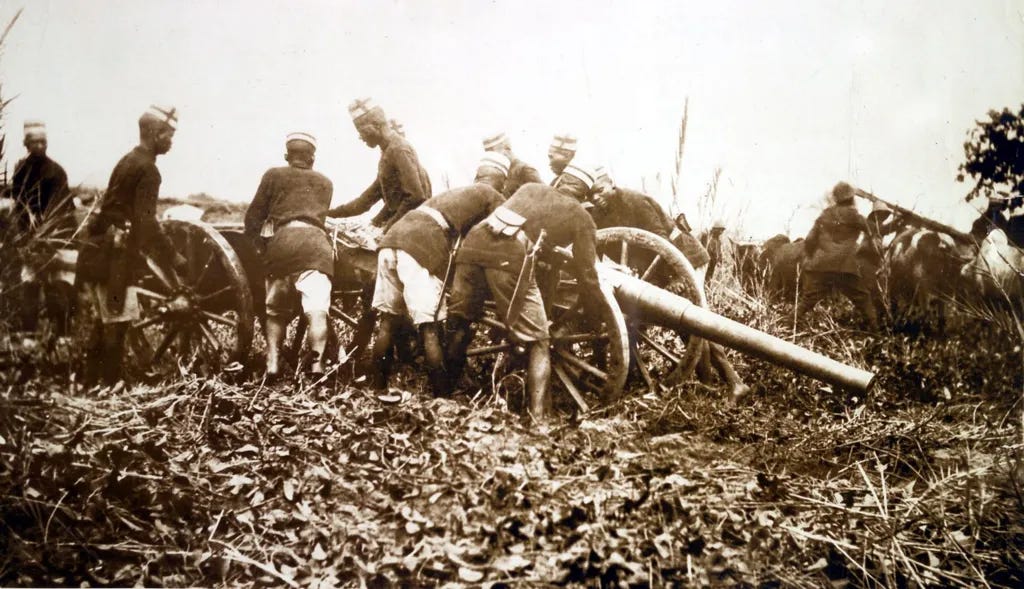
This is where I begin, because the erasure of Africa’s role in the wars of the 20th century is not a historical mistake that someone forgot to correct. It is the same operation, in a different format, as calling the April 25, 2026 assault on Bamako, Kati, Gao, and Kidal “Islamist terrorism.” The mechanism is identical. Name the conflict incorrectly. The incorrect name produces the wrong institutional response. The wrong institutional response keeps the accountability chain closed. The extraction corridor stays open. Everybody gets their cut. Nobody answers for it.
This highlights the Narrative & Information Infrastructure to Institutional Governance & International Law through the conflict taxonomy pipeline.
Mislabeling a proxy economic war as tribal, civil, ethnic, or religious conflict is not a journalistic failure. It is the opening legal move. The classification of a conflict determines which international institution claims jurisdiction over it. UN peacekeeping mandates activate for “civil conflict.” Counterterrorism resolutions and their associated financing architectures activate for “Islamist terrorism.” NATO Article 5 triggers for state-on-state warfare. The International Criminal Court process activates selectively, for “war crimes” in specific theaters. Each classification opens different doors, deploys different bodies, triggers different funding windows, and closes different accountability chains. Africa has been the primary laboratory for deploying the wrong taxonomy deliberately. The Sahel in 2026 is the first place the taxonomy is visibly, publicly, on-camera failing.
Let’s turn to Mozambique, specifically Cabo Delgado in the north. In 2010, major offshore natural gas reserves were confirmed there, setting off a scramble over one of the largest gas discoveries in sub-Saharan Africa in a generation. On one side stood Western corporate capital; on the other, Chinese investment and influence. Then, between 2017 and 2019, an ISIS-linked group known locally as Al-Shabaab, not the Somali organization emerged in Cabo Delgado, a country often described in terms of its Catholic majority. According to the group’s own communiqués, it was seeking to establish an Islamic caliphate. Yet the violence did not spread randomly: it clustered with striking precision around the gas extraction zone, and Chinese-linked investment sites were hit disproportionately. The taxonomy applied by Western media: “Islamic terrorism,” arrived first before the deeper questions did. The investment geopolitics, the spatial pattern of the attacks, and the underlying competition for resources were obscured; the taxonomy landed first, and the investigation never caught up.
David Hundeyin, a Nigerian investigative journalist made this point recently: “ISIS chooses to stage terror attacks where there’s Chinese investment. It’s all connected.” Mozambique is not exceptional. It is illustrative of the pattern, and the pattern has a name. It’s not Islamic extremism. It’s resource warfare with a religious costume, and the costume is selected specifically because it triggers the counterterrorism response architecture rather than the accountability architecture. You cannot sanction France for destabilizing Mozambique. You can hold Mozambique responsible for not defeating terrorism. The taxonomy determines the liability.
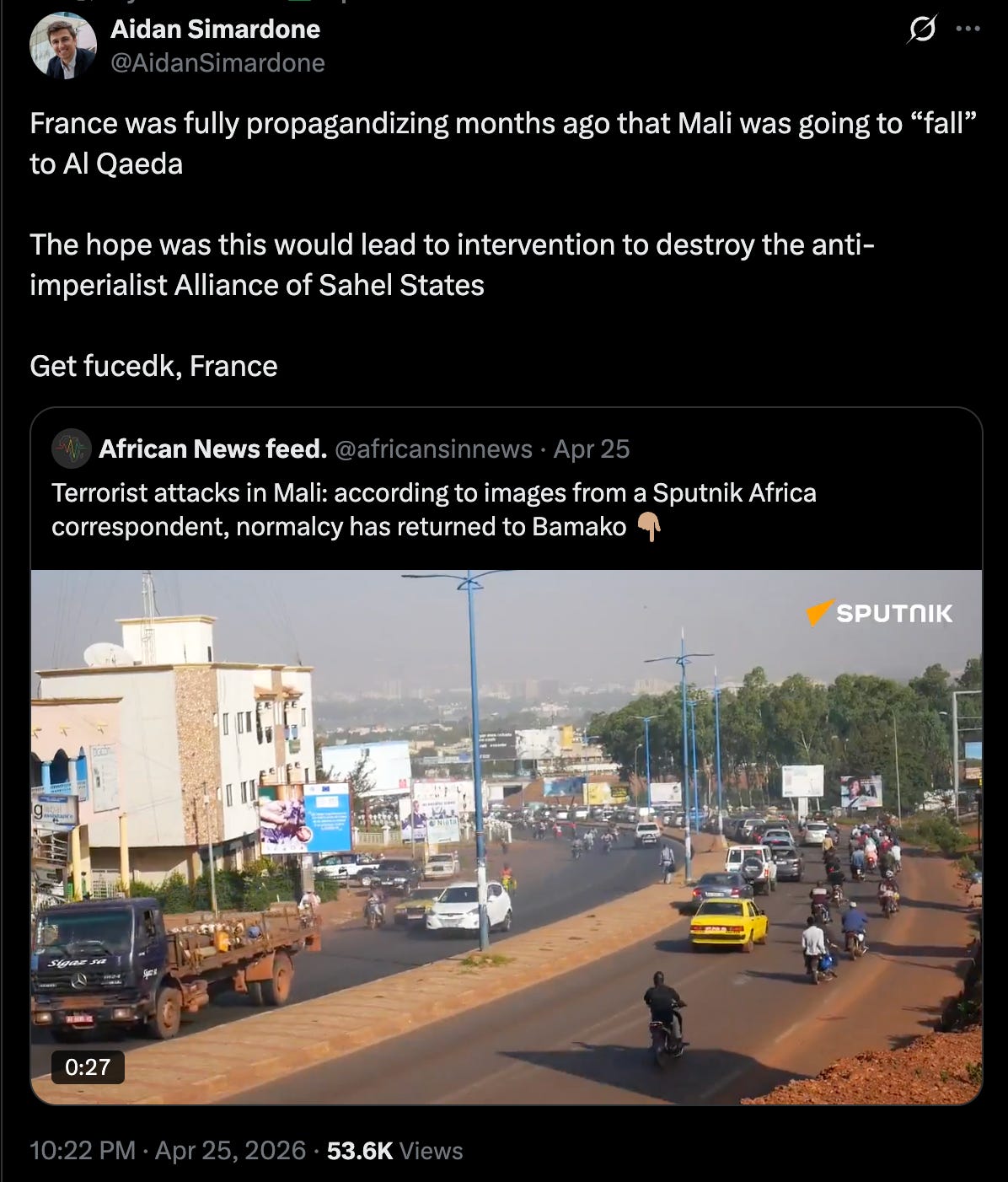
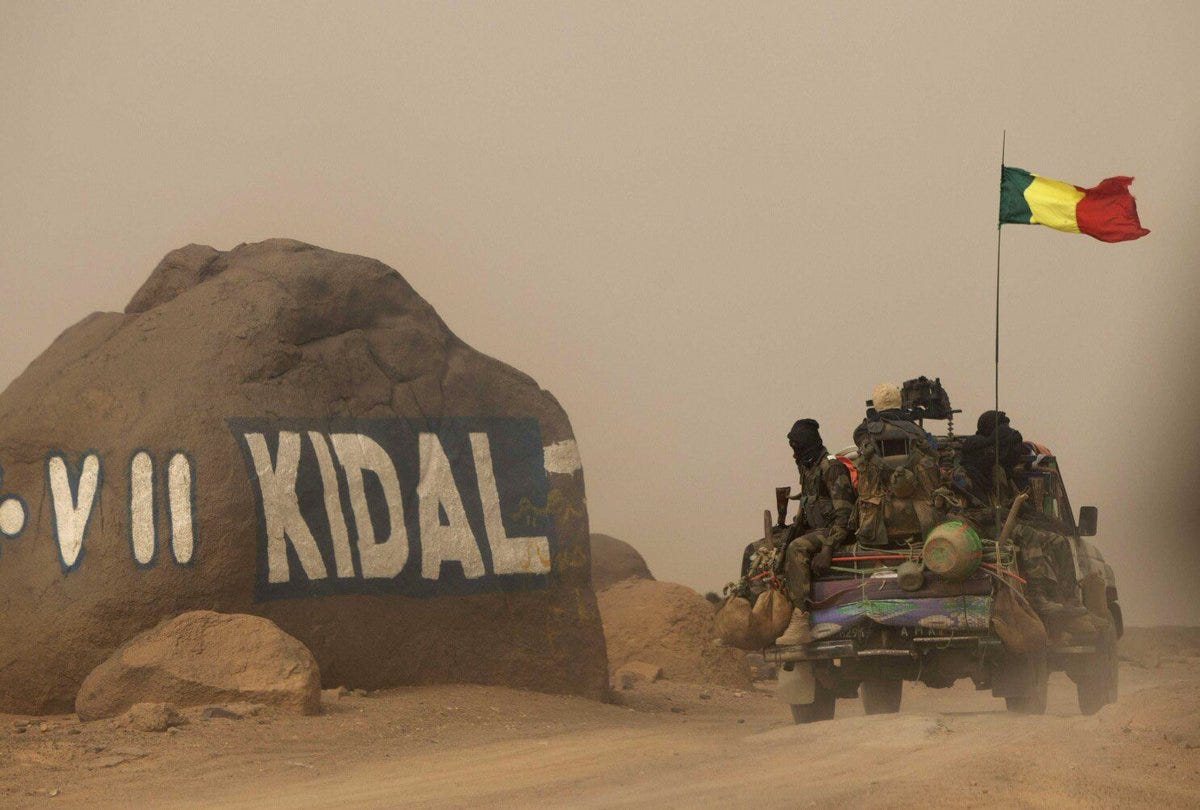
Now. Mali. April 25, 2026. JNIM and the newly formed Azawad Liberation Front launch a coordinated assault on multiple cities simultaneously: Bamako, Kati, Gao, Kidal, Sévaré. Roughly 10,000 to 12,000 fighters. The goal, explicitly stated, was not to hold territory. It was to collapse the Malian state. The assault on the presidential palace, the Kati national arsenal, the key airfields: this is the Syrian playbook, as Hundeyin noted immediately. “The closest comparison is what happened in late 2024 in Syria where a group of mercenaries and foreign military and intelligence contractors and Islamist terrorists form a coalition and try to physically take over the infrastructure of government.” The taxonomy being applied: terrorism. The operational fingerprint: state-collapse operation.
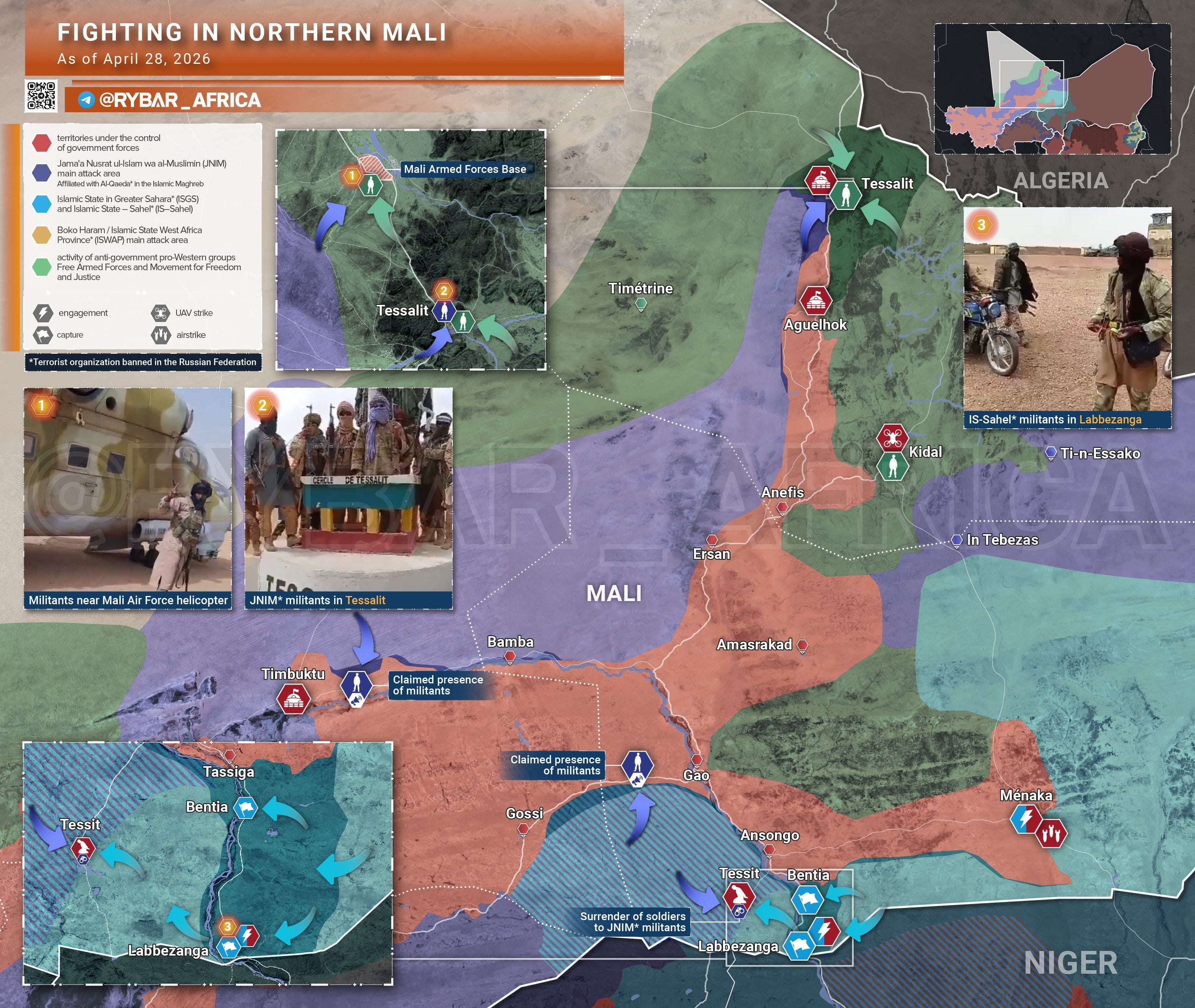
Let’s talk about the label that breaks. Mali is overwhelmingly Muslim (90%). JNIM is claiming to fight for Islam, to establish an Islamic caliphate. In a country where the vast majority of people already practice the faith JNIM says it’s fighting to protect. The narrative collapses under its own weight in Mali in a way it couldn’t quite collapse in Nigeria, where the Christian-Muslim demographic split gave the “religious conflict” framing enough surface area to sell. In Mali, the taxonomy has no landing strip.
And then the target list. What do the “Islamist militants” actually attack? In the months before April 2026, attacks in the Kayes-to-capital corridor focused on road construction machinery, specifically the superhighway connecting the tri-border region to Bamako through Senegal and Guinea. Mining equipment in concession zones near Loulo and Syama. State infrastructure. The government itself. Not mosques. Not rival religious communities. Not anything that an organization actually motivated by Islamic doctrine would logically target in a country that is already, on every metric, Islamic. The target list is an infrastructure war disguised as a theology war. The taxonomy calls it jihad. The targeting pattern calls it economic denial.
Ukraine’s role is where the proxy architecture makes itself undeniable. In 2024, the Ukrainian government publicly claimed credit for supplying military intelligence to the group that ambushed a joint Mali-Russian military convoy. Forty Malian soldiers were killed. Approximately twenty Russia Africa Corps personnel were killed. The AES formally broke diplomatic relations with Kyiv and filed a protest letter with the UN Security Council. This is not alleged. This is documented and publicly acknowledged by the attacking state. Then, in a separate incident, Ukrainian President Zelensky published on X that “Ghana is ready to finance our production, and we are ready to help our partners secure their borders.” Ukraine, the Western democracy project, running deniable intelligence operations in support of groups attacking sovereign West African governments, attempting to manufacture conflict on the borders of AES member states.
The institutional architecture cannot respond to any of this because the taxonomy won’t let it. NATO Article 5 doesn’t activate for what happens in Mali. The ICC’s jurisdiction is selectively applied: indictments of African leaders, structural immunity for the intelligence agencies that funded the proxies. FATF grey-listing is applied to the AES juntas for financial governance concerns. No FATF grey-listing for the states funding the proxy army. The Institutional Governance architecture distributes accountability precisely where the Narrative Infrastructure points it. The two domains function as a single operational unit. The narrative arm classifies. The institutional arm responds to the classification. Africa receives the classification that produces the least accountability and the most intervention.
The story has been sold for decades: “just crazy Africans who cannot live in peace with each other.” That line is easy to market because the audience has already been trained to receive it. Not because the world is uniformly racist, it isn’t, but because racist assumptions still circulate widely enough to make that kind of simplification feel natural to too many people. The classification works because it arrives pre-loaded with a familiar bias, and once that bias is activated, the deeper structure of the event never gets examined. The label doesn’t need to be accurate. It needs to land. The institutional architecture does the rest.
The Sahel broke this in 2026 because the numbers don’t cooperate. You cannot construct a jihad narrative in a 90% Muslim country where the militants attack road construction sites and leave the mosques standing. The plausible deniability that sustained the same operation in Congo, in Nigeria, in Mozambique, in Sudan, does not have enough material to work with in Mali. The taxonomy is failing publicly, on video, in real time. Civilians are rising up and calling it out for what it is. This is not a population that believes the government is oppressing them in the name of Islam. This is a population that recognizes the proxy army for what it is.
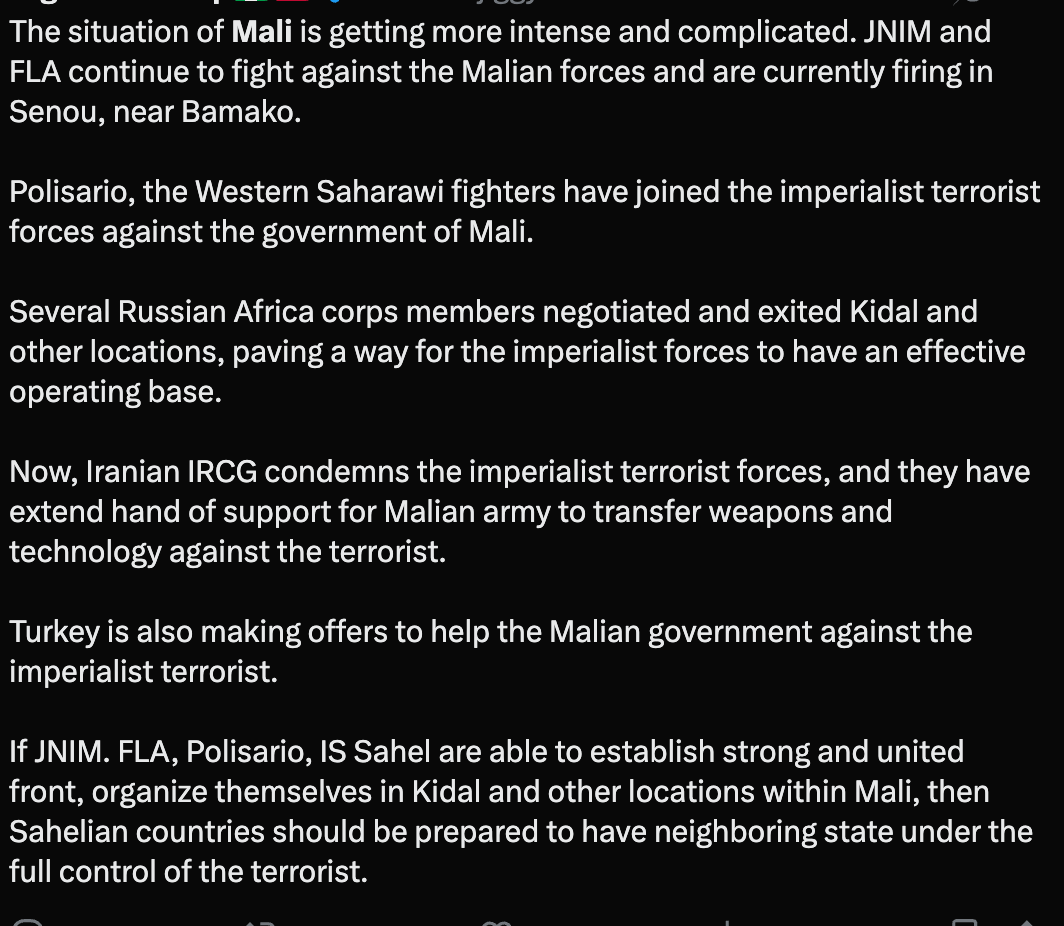
But here’s the thing about a failing taxonomy. It gets replaced. Watch what new classification gets deployed when the “Islamic terrorism” label loses its traction in the Sahel. Watch what the next conflict in Central Africa or East Africa gets called when the gas or lithium discovery map lines up with the attack geography. Watch which multilateral body gets called in to manage the new classification, and what that body’s mandate says about accountability for the forces who designed the operation.
The label arrives before the troops. It always has.
Cui bono?
Not the child in the Kayes tunnel. Not the Mozambican family displaced from Cabo Delgado. Not the Senegalese tirailleur whose grandchildren were never told their grandfather held France together while France was busy losing the war.
The same war. Different costume. Different decade. Same address.
The label arrives before the troops. It always has. Subscribe if you track who writes the classification.