
Where's Daddy Is a Real System.
DARPA Built It. Congress Cancelled It. Thiel Privatized It.

There is a program called “Where’s Daddy.”
It is not from a novel. Not a leaked codename from a Cyberpunk 2077 expansion. It is a documented geolocation system deployed by the Israeli military in Gaza. Its function: track individuals on the Lavender kill list, identify the moment they return home at night, to their families, and trigger the airstrike at that precise moment. The system is named after the question a child asks when they hear a key in the door.
This is the product. The manifesto is the press release.

Lavender is an AI targeting system that analyzed data on most of Gaza’s 2.3 million inhabitants. It assigned each person a score from 1 to 100, assessing their probability of Hamas affiliation. From this scoring, 37,000 individuals were designated targets. The system’s accepted error rate was 10%. Which means the system’s designers accepted, as a cost of operation, that 3,700 of those 37,000 people were incorrectly identified. 3,700 innocent people individually named, scored, and killed by algorithmic designation.

The accepted collateral damage ratio: up to 15 to 20 civilian deaths for each low-ranking Hamas fighter eliminated. More than 100 civilian deaths for each high-ranking commander. These figures come from Israeli military sources, so we are safe to speculate the actual numbers are almost certainly higher.
Gospel is the companion system: AI-based decision support designating buildings and infrastructure for bombing. Where’s Daddy completes the architecture: a geolocation tool specifically designed to identify when a Lavender-listed individual is home with his family, so the strike can be timed for maximum lethality and minimum operational risk to aircraft.
UN Special Rapporteur Francesca Albanese has stated there are “reasonable grounds” to believe Palantir provided the AI platform powering these systems.

The phrase keeping this entire architecture legally viable is “human in the loop.”
It sounds like a safeguard. It is not. It is a liability distribution mechanism.
Here is how it works: an algorithm processes data on 37,000 people. It generates a kill list. A uniformed human being is presented with that list, given a time window, and asked to approve or deny. The system has been right, by its own metrics, 97% of the time. Questioning the recommendation requires technical expertise that no one in the room has. Delaying carries operational consequences. The human presses the button.
That human now carries the legal liability for the strike. The company that designed the scoring system, trained the model, and calibrated the acceptable error rate remains behind the classification level, insulated by contractor agreements and national security privilege.
This is not a flaw in the system. It is the system’s most important feature. It is the algorithmic industrialization of death.
George W. Bush laid the groundwork for signature strikes, and Barack Obama dramatically expanded the drone campaign in Pakistan’s tribal belt after 2009, kills authorized not on positive identification of a named individual, but on behavioral patterns identified by algorithmic analysis. Documented analysis of those strikes produced an accuracy figure of 6%. Meaning 94 out of every 100 people killed were not the intended target. These were not misses. These were systematic outputs of a targeting architecture that accepted mass civilian death as an operational parameter.
The architecture was not punished. It was refined. Lavender is the 2023 version of the same logic, running faster, on more data, in a denser urban population.
Understanding the company requires understanding where it came from.
Total Information Awareness was a DARPA project launched after September 11, 2001. Its goal: create mass databases of the entire American population: emails, phone calls, financial transactions, medical records, social media analyzed continuously for suspicious patterns. When the program’s existence was publicly disclosed, Congress found it so scandalous that it defunded it. That was 2004.
The work was transferred to the NSA under the codename “Basketball.” Part of it was handed to a startup built on PayPal’s anti-fraud technology, funded by Peter Thiel and the CIA’s venture capital arm, In-Q-Tel. That startup was Palantir.
Whitney Webb: “They realized that if they turned it into a private company, no one would complain.” Also Webb: “If they want to blackmail you, they just access what Palantir sucked up about you: your search history, your communications, your finances, tweets you’ve liked in the past, all sorts of things. You don’t really need Epstein in the surveillance era. Palantir is the resurrection of Total Information Awareness.”
The program Congress cancelled became the company that now holds data architecture contracts with the Pentagon, ICE, and intelligence agencies across multiple allied governments. Democratic oversight did not stop the project. It just changed the corporate structure.
None of this, the automated targeting, the mass data ingestion, the privatization of intelligence infrastructure, is new thinking. In 2013, Eric Schmidt, then Executive Chairman of Google, and Jared Cohen, Director of Google Ideas, published The New Digital Age: Reshaping the Future of People, Nations and Business. The book was blurbed by Walter Isaacson as “profoundly wise and wondrously readable.” It was, among other things, a framework for how digital infrastructure would reshape governance, conflict, and state power. The blueprint existed twelve years before the manifesto. The manifesto is not the beginning of the project. It is the project announcing itself in public, confident enough to stop whispering.
Understand, then, what the 22 points are for.
Point 4: hard power requires software. This establishes the software contractor as a patriotic actor, not a commercial one.
Point 5: AI weapons will be built anyway. This forecloses the debate before it begins. If the weapons are inevitable, then questioning the contractor is naive, and choosing not to build them is strategic surrender.
Point 7: build the Marine a better rifle. This makes the defense relationship a moral obligation rather than a procurement choice.
Point 21: some cultures are regressive and harmful. This provides the moral taxonomy under which a scoring system that assigns kill probabilities to 2.3 million people in a particular territory is not racial profiling. It is actuarial precision applied to a civilizational threat.
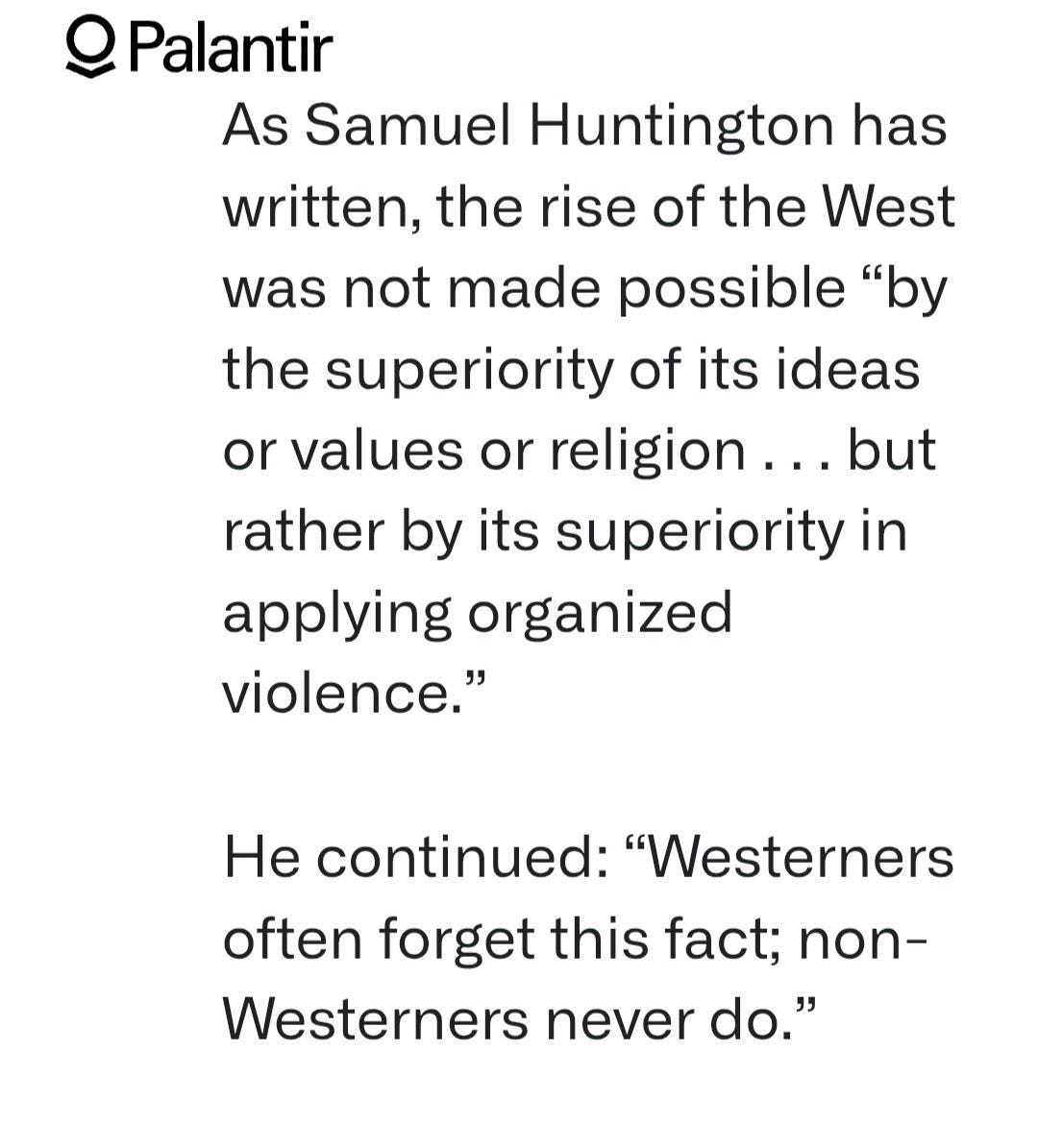
The philosophy and the product roadmap align by design. The manifesto does not float above Palantir’s business operations. It is the ideological precondition for making those operations defensible. As Arnaud Bertrand noted in analysis circulating alongside the manifesto: “Their tools aren’t meant to serve your foreign policy. They’re meant to enforce ours.”
The DGSI, France’s domestic intelligence service uses Palantir. The question Bertrand asks is the right one: do you think the software is warning the French about NSA surveillance of French government officials? About US extraterritorial law weaponized against French companies? Did it flag the AUKUS deal that cost France a 60-billion-euro submarine contract with Australia?
A state that outsources its threat assessment to a company with an explicit ideological agenda is not gathering intelligence. It is subscribing to a curated reality.
The Global South has the operating manual for what comes next. We have read this before, in different fonts.
When structural adjustment programmes arrived in Africa in the 1980s, they arrived with the same architecture. The IMF’s model generated policy recommendations. Governments facing currency collapse, with their foreign exchange reserves depleted and their debt service obligations exceeding export revenues, “approved” the conditions. The human in the loop was the finance minister signing the document in a room with no practical alternatives. Accountability for the policy design, the 10% error rate expressed as unemployed teachers, collapsed public health systems, and a generation’s worth of infant mortality, was never located. It resided in the model. The model had no criminal liability.
Lavender’s 10% error rate and the structural adjustment programme’s civilian casualties are not different phenomena. They are the same mechanism operating in different sectors. The loop exists to protect the designer. The human in the loop carries the cost.
Nigeria knows this. Ghana knows this. Zambia, which has been through IMF restructuring multiple times, knows this. The algorithm changes. The liability architecture does not.
There are legal mechanisms. This is not rhetorical.
French courts have had universal jurisdiction over war crimes, crimes against humanity, and genocide since May 12, 2023. French Penal Code Articles 121-6 and 121-7 cover complicity: criminal liability for a person who contributed to an offense without personally committing it. German and Spanish courts have even broader prosecution thresholds. Accredited civil society organisations can file civil suits under this framework.
George W. Bush has not left the United States since 2009, when Spanish courts opened an investigation targeting him for torture at Guantánamo. The mechanism works. It does not require a conviction to create consequences: the Interpol red notice, the named defendant in a formal investigation, the diplomatic pressure on any government hosting the individual, these are real costs.
Alex Karp. Peter Thiel. The entire Palantir management team. Sam Altman and the OpenAI team that moved immediately to replace Anthropic in the Pentagon’s AI contract, after Dario Amodei refused Pete Hegseth’s February 24, 2026 ultimatum to remove restrictions on autonomous weapons use.
The document names them. The jurisdiction exists. The question is whether anyone files.
Anthropic said no. On February 24, 2026, Pete Hegseth gave Anthropic’s CEO a three-day window: authorize unrestricted military use of Claude by February 27, or face consequences. Amodei refused. Trump ordered the federal government to stop using Anthropic products. Hegseth designated the company a “supply chain risk”, a designation previously reserved for companies tied to foreign adversaries, never before applied to an American company. A federal judge called it “Orwellian.”
OpenAI reached an agreement with the Defense Department within weeks to fill the vacancy.
The market punished the company that said no. The company that said yes got the contract. Nobody called that Orwellian.
This is the incentive architecture. This is what “human in the loop” actually means at the industry level: the company in the loop that refuses gets designated a national security threat. The company that approves gets the revenue. The soldiers who press the buttons carry the liability. The civilians who were in the wrong house carry the cost.
Point 21 is not political philosophy. It is target criteria.
When a manifesto written by the company powering the kill-chain infrastructure declares that some cultures are “regressive and harmful,” it is not making an academic observation about comparative civilizations. It is providing the moral taxonomy under which algorithmic targeting of populations in those cultures becomes defensible as precision warfare rather than indiscriminate killing.
The sentence is operational. It does the same work that the language of the Berlin Conference did in 1884, it places certain populations outside the category of people whose deaths require full accounting.
A 10% error rate on 37,000 targets is 3,700 people. Each of them had a name. Some of them had children who heard a key in the door.
The system that tracked them home is called Where’s Daddy.
It is on the Nasdaq. The manifesto is a bestseller. The next contract is in procurement.
Watch what OpenAI delivers under the Defense Department agreement. Watch which other allied intelligence service announces its Palantir integration. Watch whether any NGO in France, Germany, Spain files under universal jurisdiction before the integration becomes, as one analyst on X put it, “too deep, too complex and too classified to ever be unwound.”

The legal window is open. It has not been closed yet.
The legal window is open. Share this with whoever in your network works in law, human rights, or international accountability. Not as charity, as architecture.
At first, I thought the federal judge was making the connection between autonomous weaponry and Orwell. But it seems not.
I remember reading about the Spanish judge who filed that case against Bush. It only takes one person with integrity, and yet ...
'human in the loop'. Plausible deniability for the AI. Humans have become the legal cover.
Excellent analysis, Ope.