
Who Discovers a Resource?
Named in Manhattan, Buried in Marilani

Who discovered tanzanite?
That question has at least four answers, depending on which version of the story you’re reading, and who was still alive when the record got written down.
The answer matters. Because the way you answer it is the way you answer everything else that followed.
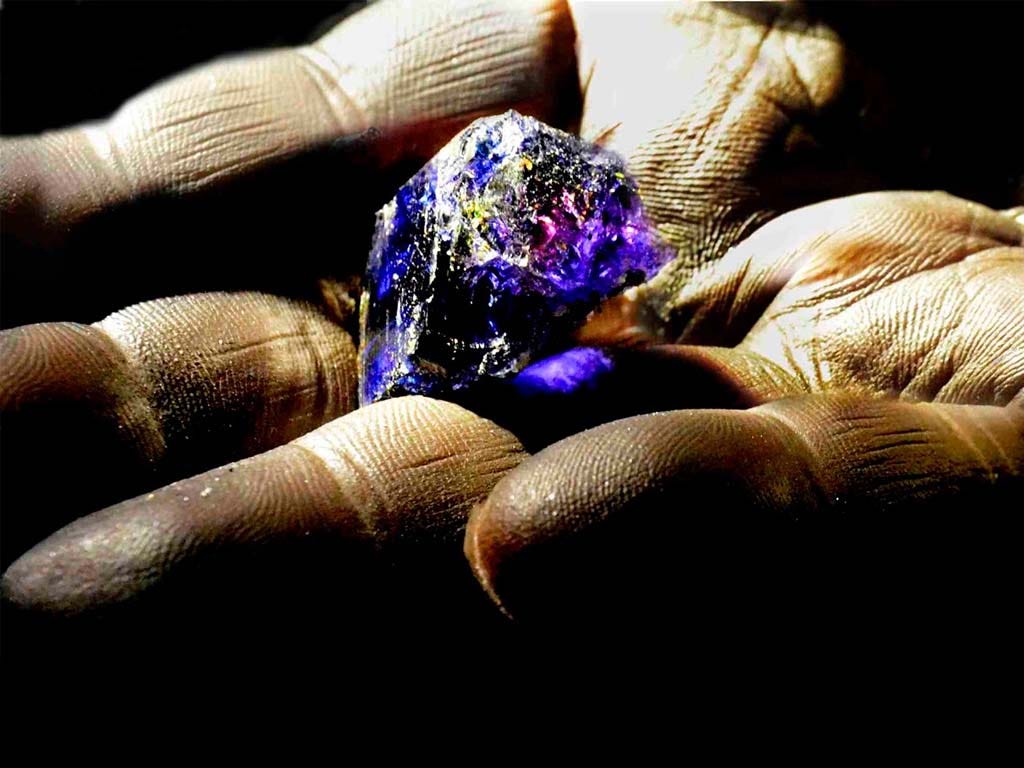
Before any prospector filed a claim, before any geologist shipped samples across the ocean, before Tiffany sat in a Manhattan boardroom searching for the right name, people in Mererani were already living with that stone.
Maasai herders moved cattle across those hills for generations. They saw the colors in the soil, picked up crystals, knew the land the way you know land you’ve worked your whole life. Whether that knowledge was ever written down in an English-language report is beside the point. It existed.
There is a story people tell in Tanzania: lightning hits the hills, the grasslands burn, and when the fire dies, the stones on the ground are no longer dull brown but a startling blue-violet. Maybe a legend, maybe a memory of something that actually happened, maybe both at once. Either way, it encodes something real about the land: heat changes the stone. Fire rearranges what lies beneath your feet.
Western geology gives that same process a different vocabulary: heat treatment, color centers, crystal structure transitions. But it is describing the same phenomenon locals had already narrated in their own language, through their own images, on their own terms. The fact that one description gets called science and the other gets filed as folklore is not about accuracy. It is about power.
Because in the commercial system that grew up around these hills, “discovery” does not mean the first people who knew this thing existed and thought it was special. Discovery starts when a particular kind of man shows up with prospecting papers. When samples reach a lab. When a company with the right address decides to brand the stone and sell it to the world. That is the point where the record suddenly becomes precise: dates, names, carat weights, export figures.
Everything before that is allowed in only as atmosphere. The herder becomes a colorful anecdote. The lightning story becomes a hook for a sales brochure. The community that lived on top of that deposit for generations becomes background scenery: their knowledge not denied, just downgraded.
So when the official histories say tanzanite was “discovered” in 1967, what they are really saying is: this is when the stone entered our paperwork. This is when it became legible to the apparatus of claims, licenses, laboratories, and luxury branding. By that definition, Africa is discovered over and over again, each time a resource passes through the gate of Western recognition.
The hills were never empty. The stones were never unknown. What arrived in 1967 was not knowledge. It was a system that only starts counting when it can convert knowledge into capital.
Hmmm
Now here is where it gets interesting, and suspicious.
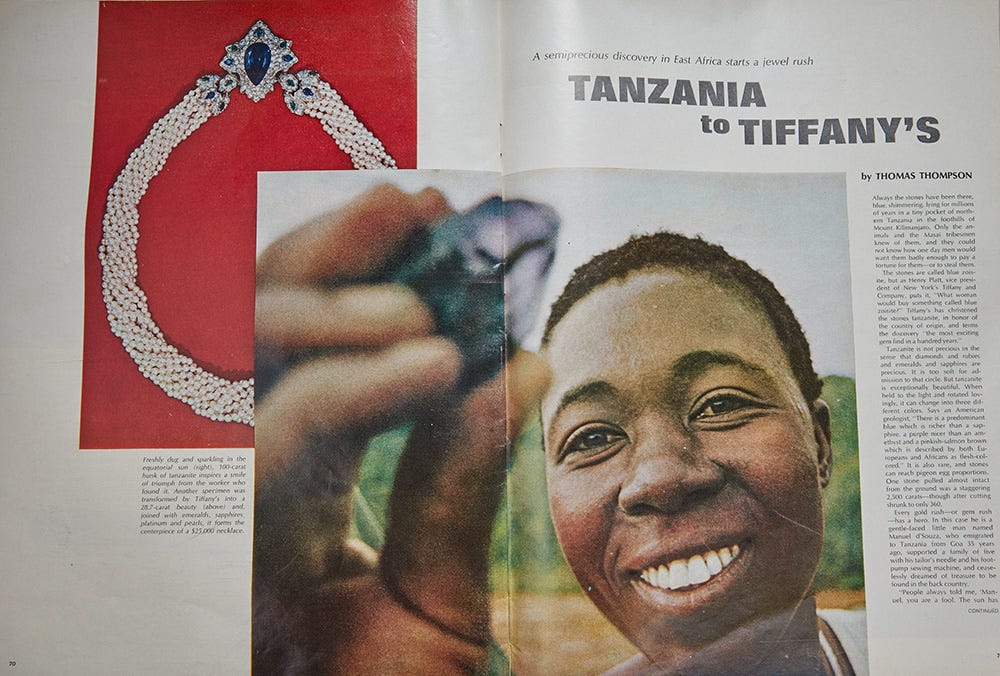
In July 1967, two men filed competing claims to the stone. Manuel de Souza, a Goan Indian tailor and part-time gold prospector living in Arusha, registered a claim on July 25th after finding blue crystals on a ridge in the Merelani Hills. His claim initially described the stone as olivine, later amended to zoisite in April 1968.
Around the same time, a Tanzanian Maasai herdsman named Jumanne Ngoma was also moving through those same foothills. The Tanzanian government would later, much later, recognize Ngoma as the discoverer. He received a certificate of recognition in 1980. Another in 1984. No money. Just certificates.
Also named at various points as the original finder: Ally Juyuwatu and Habib Esmail.
So you have at minimum four people associated with finding this stone in the same area in the same period. And within two years of the discovery, Manuel de Souza was dead, killed in a car accident on the road to Dar es Salaam in 1969, at the age of 56.
Then watch what happened.
The publications Bunte (January 1969), Der Spiegel, Jasmine (July 7, 1969), Time (January 24, 1969), and Life (May 9, 1969) all attributed the discovery to Manuel de Souza. Every major Western publication. All within two years of the find. All crediting the non-Tanzanian. De Souza was dead by then, killed in that car accident on the road to Dar es Salaam, unable to complicate the story further. Ngoma was alive. Still in Tanzania. Still breathing. Still, presumably, aware that he had found those same crystals on that same mountain.
The five publications didn’t need him to be dead to erase him. They did it anyway.
The Tanzanian government’s recognition of Ngoma didn’t arrive until 1980. Eleven years after de Souza died. Eleven years after the Western narrative hardened around the name that was no longer attached to a living person who could demand anything.
I’m not saying Manuel de Souza didn’t find the stone. He probably did find crystals, probably did file the first formal claim. But “finding” and “discovering” are being used here to mean something very specific, and what they specifically mean is: whose name gets attached to the resource at the moment it becomes commercially valuable.
De Souza, a non-Tanzanian who died conveniently early and could not dispute later accounts, was a cleaner origin story for an industry that was going to make hundreds of millions of dollars for everyone except Tanzanians. A Tanzanian discoverer at the center of the narrative would have complicated things. Would have created ongoing legitimacy claims. Would have been alive to notice what was happening to his country’s resource.
This is Narrative infrastructure operating at the origin point. Before the shell companies, before the terror allegations, before any of the more visible machinery of extraction. The first act of the tanzanite story is a question of whose discovery counts. And the answer was settled by five Western publications before the Tanzanian government even got around to issuing its first certificate.
Cui bono?
Once the discovery narrative was secured, the next move was the naming.
Henry Platt was the great-grandson of Louis Comfort Tiffany and a vice president at Tiffany & Co. When Hyman Saul brought him the blue stone from East Africa in late 1967, Platt saw a fortune. He also saw a branding problem. The stone’s scientific name was blue zoisite. Say it out loud. Blue suicide. Not exactly something you put in a glass case at $12,000 a carat.
So Platt renamed it. After the country. Tanzanite.
The story is usually told as charming: Platt, Hyman Saul, and John Saul sitting over steaks at a fine Italian restaurant in New York, deciding what to call it. A friendly dinner among men who appreciated beautiful things. What the telling leaves out is that in that restaurant, the resource of an entire nation was being branded and commercialized by people who had no legal claim to it, no contract with the Tanzanian state, and no obligation to share the upside with anyone on the ground.
Tiffany launched it to the world in 1968 with a tagline that makes the appropriation explicit: “Tanzanite can be found in only two places in the world, in Tanzania and Tiffany’s.”
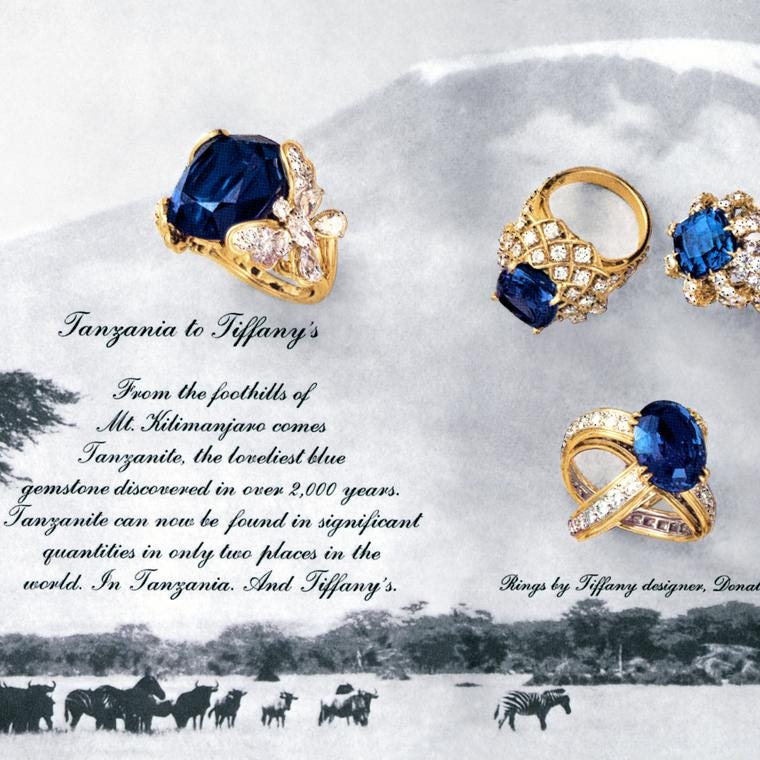
A luxury house in Manhattan claiming co-ownership of a Tanzanian resource through a name. Not a mining license. Not a legal agreement. A marketing tagline. The stone was found on Tanzanian soil, its existence known to Tanzanian people for generations, recognized by a Tanzanian government geologist named Ian McCloud as the first person to correctly identify it as zoisite, and it was named by Americans, branded by Americans, and launched to a Western market that would consume nearly 90% of every carat pulled from the ground.
The Tanzanian government received no royalty for the rebrand. No licensing fee. Nothing.
Jumanne Ngoma received certificates.
See the pattern: discovery narrative erases Tanzanian origin; naming move annexes Tanzanian resource through branding. Narrative and Information Infrastructure twice, before Monetary Infrastructure has even entered the room.
Now it becomes statistically provable.
In 2013, Tanzania the only place on Earth where tanzanite actually comes out of the ground, officially exported about $38 million worth of it, according to its own Ministry of Energy and Minerals and trade figures from that year.
That same year, Kenya, no tanzanite deposit, not one recognized mine, no documented production, somehow booked roughly $100 million in tanzanite exports in its trade statistics. India, also with zero tanzanite in its bedrock, showed about $300 million in tanzanite exports, riding on cutting and re‑export out of places like Jaipur.
Put those numbers together and you get a global trade on the order of 500 million dollars a year, with Tanzania’s 38 million working out to well under ten percent of the value of a stone that exists nowhere else on the planet. The rest slips out through “porous borders” and “unofficial channels”, Tanzanian officials’ polite language for smuggling across the northern frontier into Kenya, onward through courier networks, and into Indian cutting houses where the real money is made.
By the time those stones re‑enter the system as polished gems stamped “Kenyan export” or “Indian export,” the paperwork reads as if Tanzania were just a rumor, an inconvenient origin point that the numbers have already learned how to forget.
This is not smuggling as an unfortunate side effect. This is smuggling as the trade itself.
Follow one stone. A miner finds a high-quality rough crystal 400 metres underground. He earns $3 a day. He knows the official channel will lowball him and the government will tax what’s left. So he hides it. Passes it to a courier at the surface. The courier takes it to a broker in Arusha, often part of a South Asian trading diaspora that has operated in East Africa for generations. The broker aggregates, undervalues, and exports. The stone crosses into Kenya first. Then Jaipur. Then Dubai, Hong Kong, sometimes New York. By the time it sits in a Manhattan display case, it has changed hands four or five times, crossed at least two borders, and Tanzania has received almost nothing.
In the 2010s, Tanzanian authorities publicly implicated an Arusha‑based firm, Crown Lapidary, in a tanzanite smuggling syndicate, after one of its alleged associates was convicted of moving undeclared stones out through Kilimanjaro International Airport. It wasn’t an isolated scandal; Tanzanian officials estimate that the majority of tanzanite, as much as 80 percent, has historically left the country outside official channels, funneled through Kenya and on to cutting houses in India.
Crown Lapidary was just one node. The leakage wasn’t a glitch in the system. It was the system.
The Bermuda Architecture
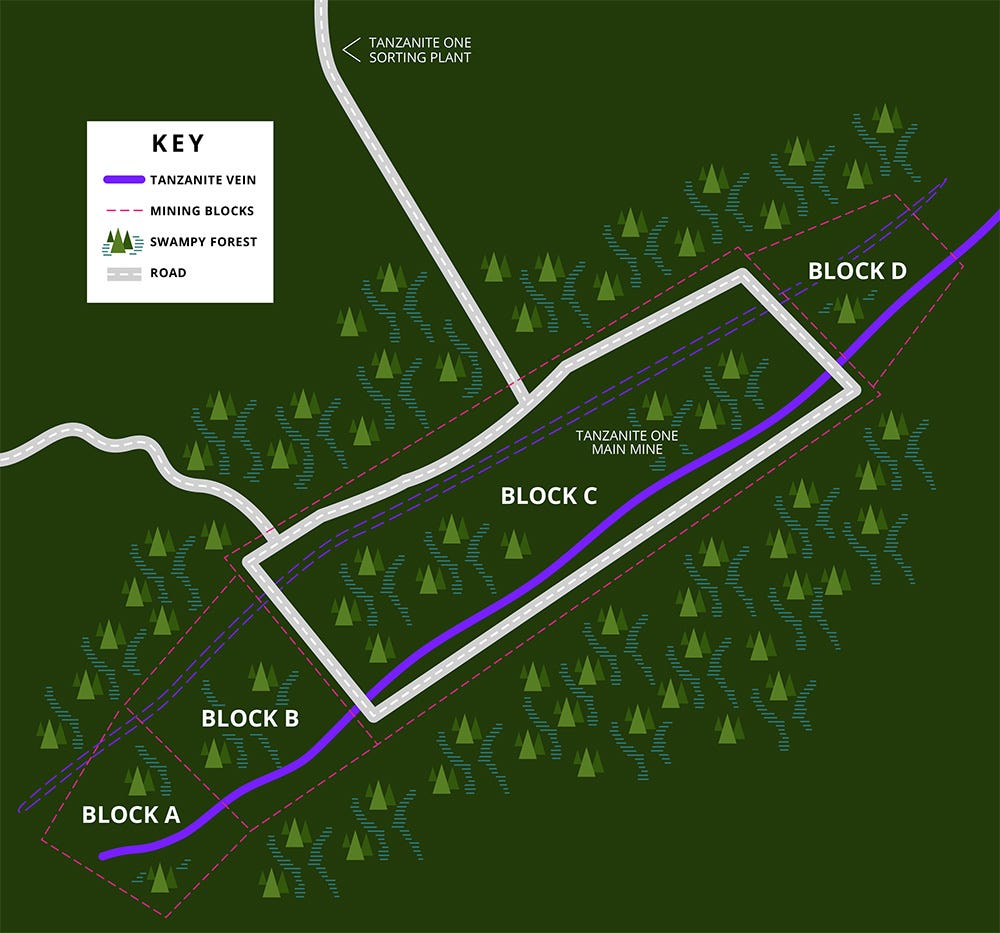
When Block C: the largest, most lucrative section of the world’s only tanzanite deposit, was carved out for large‑scale mining, it didn’t revert to the Tanzanian people. It went to African Gem Resources Limited: South African capital, Johannesburg‑listed, holding the licence from 1999 and moving into production in 2001. Almost immediately: violence. Clashes between AFGEM security guards and local miners became part of the landscape. A 17‑year‑old named Emmanuel Obed was shot dead during a confrontation at Block C, the second miner killed in less than a month. AFGEM denied direct responsibility.
A few years later, the ownership shell changed but the logic didn’t. AFGEM’s tanzanite business was sold into a new vehicle called TanzaniteOne, a Bermuda‑registered spin‑off created to hold the Mererani assets, for roughly 158 million South African rand, about 23–24 million dollars at the time. TanzaniteOne listed in London on the AIM market of the Stock Exchange. Then came the “Mark of Rarity”: a certification scheme that positioned TanzaniteOne‑aligned stones as the authenticated, ethical tanzanite, and quietly suggested that anything without their paper trail was of questionable pedigree.
Sorry chiefs. Read that again slowly.
A Bermuda-registered company, built from South African capital, holding a Tanzanian mining license, was now telling the world that tanzanite dug from Tanzanian soil by Tanzanian small-scale miners was somehow less legitimate than the tanzanite being extracted next door by a foreign corporation. Tanzanians’ own stones, from their own mountain, branded inferior by an offshore entity that existed specifically to extract value and repatriate none of it.
Then watch how the Narrative and Information Infrastructure returns.
In November 2001, barely weeks after September 11, the Wall Street Journal ran a front‑page story claiming that al‑Qaeda sympathizers in East Africa were using tanzanite as a way to move and park money, buying stones in Mererani and pushing them through Mombasa, Dubai, and Hong Kong. One of the names that surfaced in that ecosystem was Wadih el‑Hage, bin Laden’s personal secretary, who, according to his own diary and court evidence, had operated through a Nairobi gemstone outfit called Tanzanite King in the mid‑1990s before helping coordinate the 1998 US Embassy bombings in Nairobi and Dar es Salaam that killed 224 people, almost all of them Kenyan and Tanzanian civilians.
The American Gem Trade Association slammed the brakes, issuing warnings while the US government and intelligence agencies probed the allegations. Big retailers panicked. Chains like Zale and QVC pulled tanzanite from their counters, and a North American market that accounted for the bulk of global demand, often pegged at around 70 percent, suddenly walked away. Prices fell. Tanzanian exports stalled. A US$400‑million‑a‑year stone lost its sparkle almost overnight.
In February 2002, the trade tried to put a bandage on the wound: a “Tanzanite Protocol” drafted and signed in Tucson, Arizona, promising to source only from clean channels and keep the gem out of terrorist hands. Voluntary. Self‑policed. No external enforcement. It functioned less as a hard constraint on the supply chain than as a piece of paperwork, a way to reassure nervous regulators and retailers that the problem had been handled, without really touching the structure of the trade.
Now hold the full timeline together.
Narrative/Information Infrastructure erases Tanzanian discovery origin in 1969: five Western publications credit the dead non-Tanzanian, while Ngoma waits eleven years for a certificate. Monetary Infrastruture enters in 2000-2003: AFGEM’s Johannesburg listing, Tanzanite One’s Bermuda registration, the “Mark of Rarity” certification cutting artisanal miners out of premium supply chains. Narrative Infrastruture returns in 2001: the Wall Street Journal terror investigation collapses the informal market those same miners depended on.
Same two weapons. Two separate deployments. One set of victims every time.
The 30,000 artisanal miners at Marilani who had no connection to Al-Qaeda, no offshore registration, no lobbyists in Tucson, no claim in the Western discovery narrative, they just had stones. And now they had neither corporate legitimacy nor moral clearance to sell them.
Did Al-Qaeda profit from tanzanite? Probably, opportunistically, one channel among many. However, the narrative had already done its work.
When corporate capture faces resistance: from artisanal volume, from local competition, from a market that doesn’t need your Bermuda certification, you don’t fight it with better economics. You fight it with a narrative that makes the alternative look dangerous. You make the informal trade radioactive.
Same as the Tanzanian discovery account was made inconvenient. You don’t fight it with archaeology. You fight it with five magazine covers.
John Pombe Joseph Magufuli became Tanzania’s fifth president in November 2015. He did not govern the way the usual circuits in Dar es Salaam, London, or Toronto expected.
In 2017, the presidential commissions he appointed on mining and mineral sands came back with a staggering number: fraud and under‑declaration in the sector since the late 1990s had cost Tanzania an estimated 75 billion euros, about $84 billion in lost taxes, royalties, and undervalued exports. That’s a hole larger than the country’s entire annual GDP at the time.
He moved from numbers to leverage. The government banned exports of gold and copper concentrates and impounded more than 250–270 containers of Acacia Mining’s concentrate at Dar es Salaam port, material belonging to the local subsidiaries of a company ultimately controlled by Canadian giant Barrick. Then the tax authority dropped a bomb: a back‑tax and penalties assessment of roughly $190 billion, about four times Tanzania’s GDP and one of the largest tax claims ever issued against a single corporate group.
In July 2017, Magufuli signed three laws that rewired the legal ground under every mining contract in the country: the Natural Wealth and Resources (Permanent Sovereignty) Act, the Natural Wealth and Resources Contracts (Review and Renegotiation of Unconscionable Terms) Act, and the Written Laws (Miscellaneous Amendments) Act. From that point on, the state was entitled to at least a 16 percent free‑carried interest in all mining projects, with the right to take more, and the era of shipping raw concentrates out of Tanzania for processing overseas was, on paper at least, over.
Then he built a wall. A literal perimeter wall. 24 kilometres around the entire Marilani mining area, guarded by the army, single controlled exit, every stone tracked and taxed before leaving the mountain.
Official production jumped from 158 kg in 2018 to a record 781 kg in 2019.
At the wall ceremony, Magufuli pointed to Jumanne Ngoma, the Maasai herdsman whose name the Tanzanian government had put on a certificate in 1980 and again in 1984 but had never paid, now half-paralyzed and dependent on medical treatment, and said: “Mzee Ngoma is a veritable Tanzanian hero. But what did he get after discovering Tanzanite about 50 years ago? Nothing. Nothing at all. In fact it is people from other countries who have benefited more from this unique gemstone.”
He handed Ngoma $44,000 on the spot. The Western publications that credited Manuel de Souza in 1969 did not update their records.
Ngoma died in 2019.
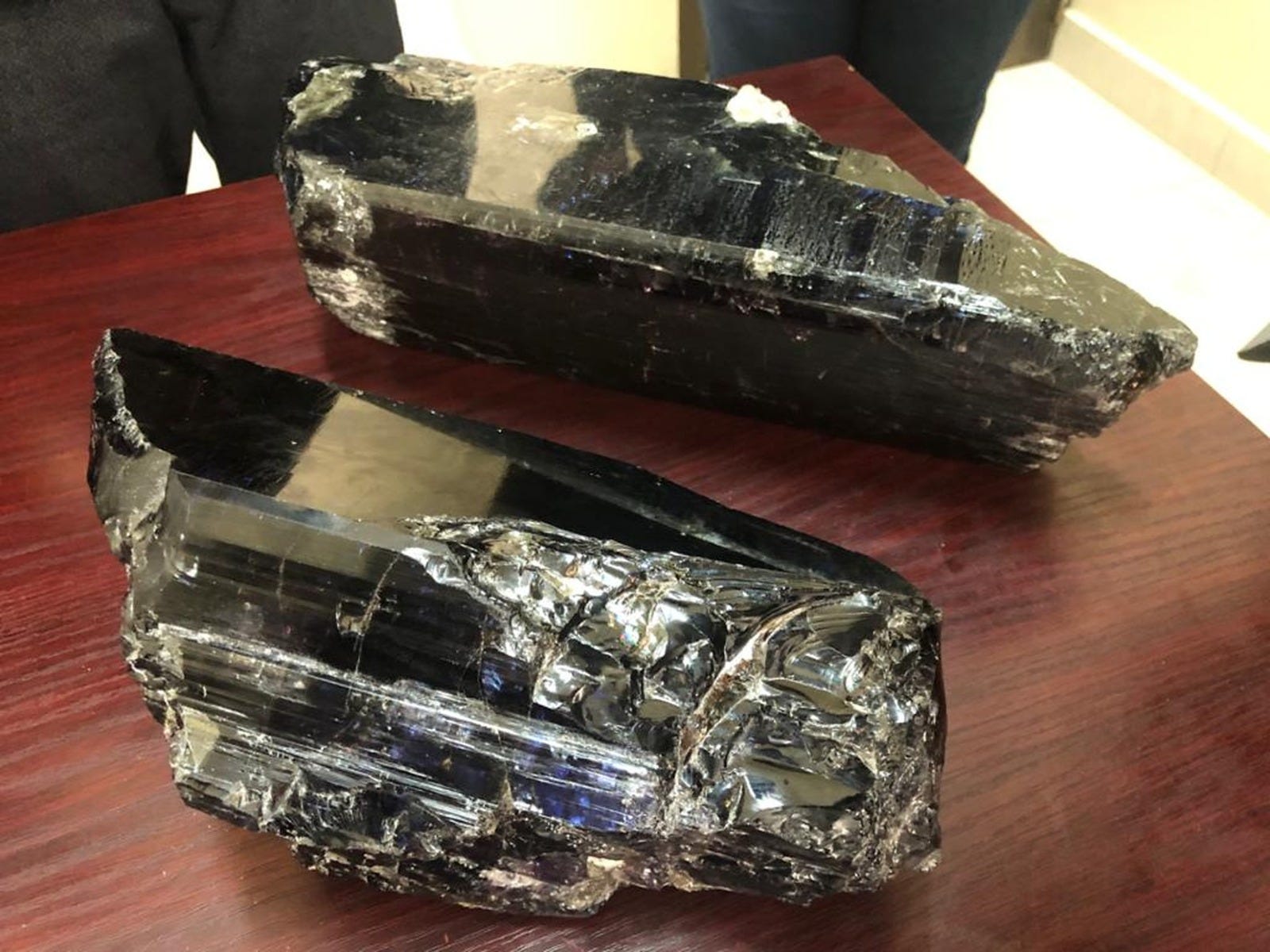
Later in June 2020, a Maasai miner named Saniniu Laizer walked into the Ministry of Minerals in Arusha carrying two tanzanite specimens, the largest ever discovered. The first weighed 9.27 kg. The second, 5.103 kg. The government bought them for 7.74 billion Tanzanian shillings, about $3.4 million. Laizer said he planned to build a school and a shopping centre for his community. For one brief moment, the system worked as it was supposed to.
Then Magufuli died in March 2021 at 61, officially from heart complications. Third African leader to die in office in rapid succession after opposing the official COVID-19 narrative. The wall still stands. The incentive structure is more fragile.
Before you conclude this is purely a story about narrative and corporate architecture, which it is, remember who is at the bottom of the shaft.
In 1998, floods killed more than 100 miners at Marilani. The water filled the tunnels in minutes. No escape routes. No emergency systems. They drowned in the dark, 400 metres below the surface. In June 2002, at least 39 miners died from carbon monoxide after a dynamite blast. That same year, 40 more died when the air compressor supplying oxygen to a deep tunnel failed. Ten more died during the rescue attempt. In March 2008, 155 millimetres of rain fell in 90 minutes. Fifty-seven confirmed dead. Seventeen never found.
A study of the Marilani Health Center examined 248 mining injury patients over a single period. Mortality rate: 41.3%. Nearly half of every miner who made it to the health centre alive still died there.
No safety regulation. No insurance. No worker protections. No accountability. The miners dig because there is nothing else. The stones are worth a fortune. Their lives are worth $3 a day.
The people who take all the risk get almost none of the reward. The reward goes to the middlemen, the couriers, the international dealers, and the retailers who put a finished stone in a glass case and charge $12,000 for something that earned its miner $10.
Na so we see am.
Geologists and industry analysts keep repeating the same quiet warning: at current extraction rates, the Mererani tanzanite belt could be mined out within a human lifetime. Some studies put commercial depletion at 20 to 30 years from today’s output levels; others, under gentler assumptions, stretch it to a few generations at most.
There is no second deposit. Tanzanite formed roughly 585 million years ago, during the tectonic violence that folded the Mozambique Belt and raised the shoulders of Kilimanjaro. A specific mix of aluminium‑rich, vanadium‑bearing rock, subject to extreme heat and pressure, turned into blue‑violet zoisite along a narrow strip only a few kilometres wide beneath the Mererani Hills. Geologists describe it as a geological accident, the kind of alignment you get once in a planet’s lifetime: the chances of another tanzanite‑grade occurrence are put at about one in a million. When this seam is gone, it’s gone. No new field in some friendlier jurisdiction. No second chance.
In the space of less than two decades, Block C, the richest slice of the only tanzanite deposit on Earth, moved through three sets of offshore hands. First AFGEM, a South African company listed in Johannesburg. Then TanzaniteOne, a Bermuda‑registered spin‑off listed on London’s AIM market. In November 2014, Richland Resources signed it away again, selling its entire Tanzanian tanzanite business, including TanzaniteOne Mining Limited and the Block C operation, to a private vehicle called Sky Associates Group Limited for US$5.1 million in cash and about US$10.8 million in assumed liabilities. Private. Opaque. The mountain kept producing.
Ask who gets remembered. In Tanzania’s own telling, a man named Jumanne Ngoma discovered tanzanite at Mirerani in 1967. Nyerere’s government issued him a certificate; fifty‑one years later, in 2018, Magufuli added another 100 million shillings about US$44,000, while Ngoma sat half‑paralysed at the state ceremony. He died the following year. Meanwhile, Western gem histories kept circulating the same old names: the Maasai herder with no surname, Manuel d’Souza the prospector, and very few of them bothered to update the record once Tanzania finally said, in public and in law, “This is the man who found it.”
The Maasai were moving cattle across those hills long before any of those names were printed on certificates or prospecting licences. They were the ones living on top of the seam when the crystals weathered out of the soil. Their stories about lightning, fire, and stones changing colour are still treated as myth in the same texts that treat Tiffany’s advertising copy as history. Their knowledge didn’t count as discovery then. It still doesn’t, unless and until it passes through someone else’s paperwork.
When the last carat comes out of the ground, watch what happens to the story. Watch which “discoverer” gets written into museum labels. Watch which archive gets acquired by which Western institution. Watch which luxury house runs the retrospective campaign about a gem that can now only be found in vintage safes and estate sales. Watch how carefully the origin narrative is curated once there is nothing left to contest on the ground.
If they could strip the discovery down to something that fits on a London prospectus and a Tiffany mood board, they can do the same thing to the entire history. The only question is whether enough of the other version: the Mererani version, the Maasai version, Ngoma’s version is being written down, cited, and remembered fast enough to make that harder to do.
You found this. Someone else needs to. Share it.
What a story! It's the story of Africa. On UK TV, we see appeals for Africa for water aid, supporting students financially, etc., but no-one seems to ask why the largest continent with the most resources, still is without sanitation and electricity. I knew Magafuli called out the fake PCR tests which did not go down well, especially for him. My cousin spent his working life in Botswana, working for De Beer, which allowed him to retire at 50, over 20 years ago, and furnish him with an extremely comfortable retirement!