
The Rearmament Invoice
Point 15 is the most explosive sentence written by a private company this decade

Nobody voted for this.
No parliament debated it. No UN Security Council resolution preceded it. No heads of state were briefed before it was posted. A Nasdaq-listed company, founded with CIA venture capital and valued at tens of billions of dollars, published a document calling for the rearmament of Germany and Japan. It is their fifteenth bullet point. Most people who read the manifesto treated the whole thing like a TED talk.
Read Point 15 again, slowly.
“The postwar neutering of Germany and Japan must be undone. The defanging of Germany was an overcorrection for which Europe is now paying a heavy price. A similar and highly theatrical commitment to Japanese pacifism will, if maintained, also threaten to shift the balance of power in Asia.”
The word in that paragraph that deserves the most attention is “theatrical.”
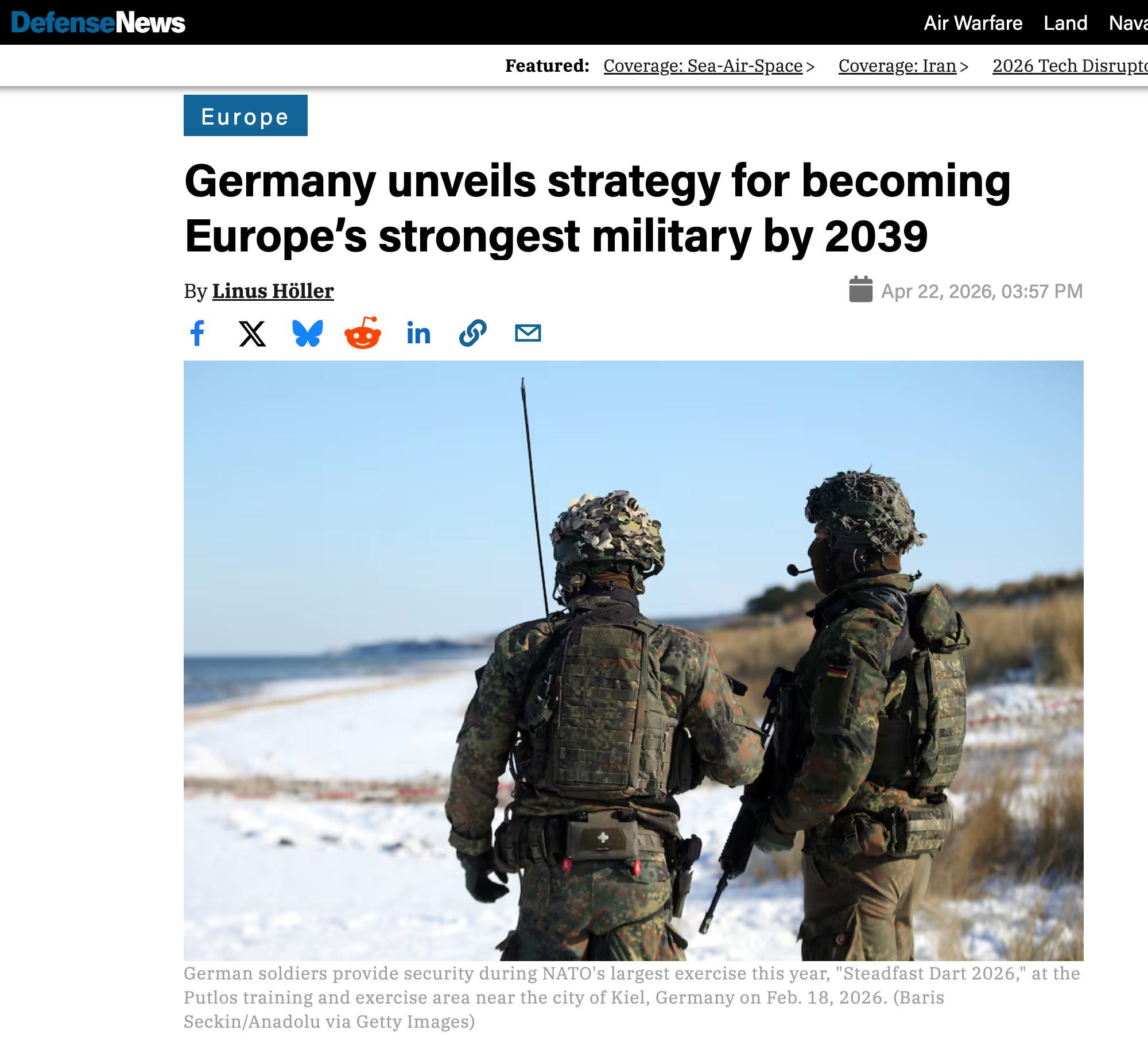
Like clockwork after one week, Germany unveils strategy for becoming Europe’s strongest military by 2039..
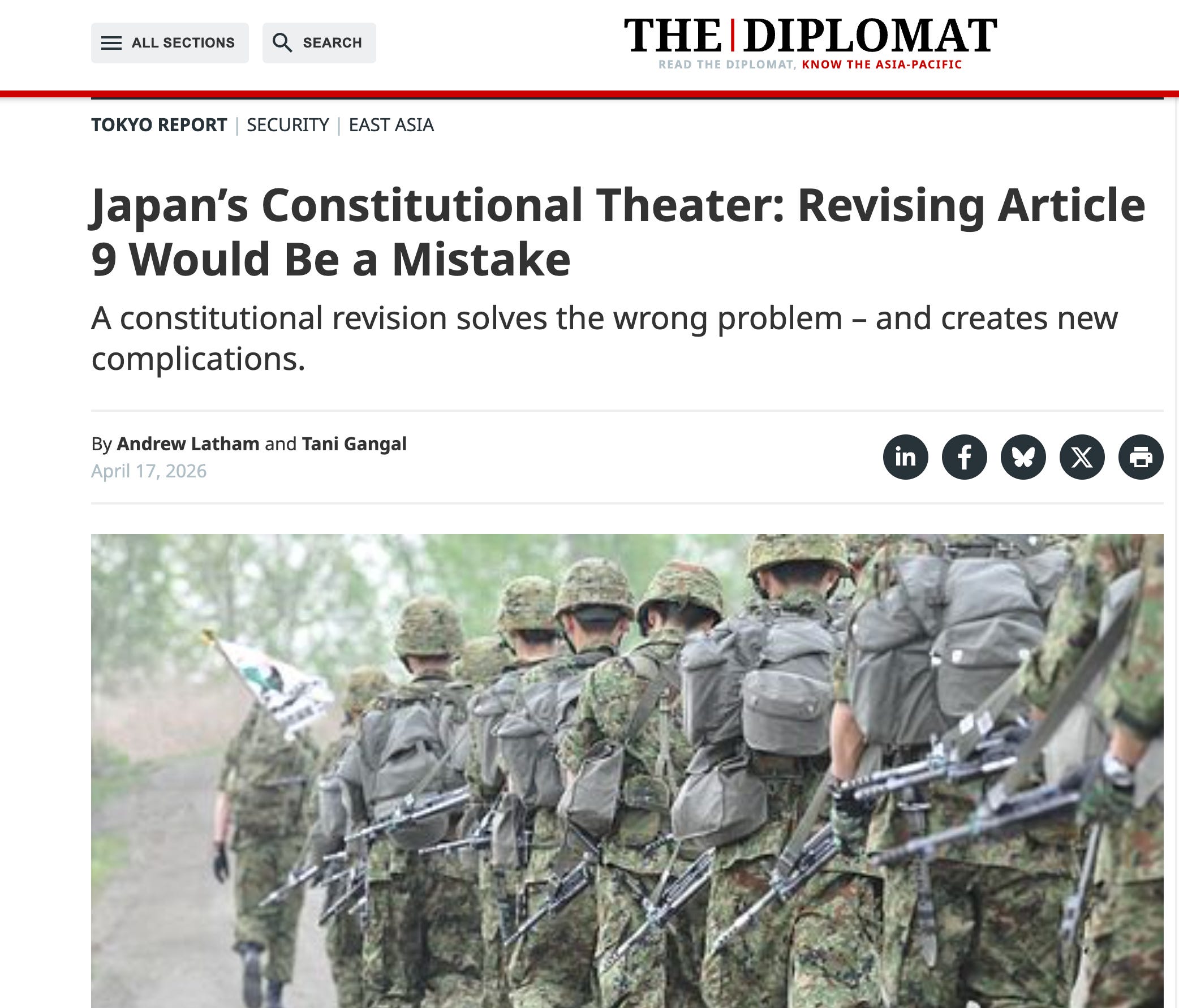
Japan’s constitutional pacifism is Article 9 of the 1947 constitution: a clause renouncing war as a sovereign right and prohibiting Japan from maintaining war potential. It was adopted after the Japanese empire’s military expansion killed an estimated 14 to 20 million people across Asia. Alex Karp, who has a doctorate in social theory, calls that settlement “theatrical.” In a manifesto. Published by the defense software company that already holds contracts with Japan’s alliance partners. This is not rhetorical carelessness. It is a position.
The framing Karp offers for Point 15 is strategic necessity. The United States cannot hold two fronts alone: Europe against Russia, Pacific against China. Germany anchors the western front. Japan anchors the eastern one. Pacifist allies are a liability in a civilizational contest. This is the public argument. It is coherent on its own terms and it will be the argument that moves chancelleries and diet sessions, because it speaks to real threat perception and real burden-sharing debates that were already in motion before the manifesto was published.

There is another argument, less publicly stated, that sits underneath it.
Germany is the European Union’s largest economy. Its defense budget in 2024 was just over €50 billion, but total defense spending including special-fund contributions was much higher; current reporting says roughly €80 billion will be needed in the future to keep meeting NATO’s 2% of GDP benchmark after the special fund is exhausted. Japan’s government, following the Kishida administration’s 2027 target of defense and defense-related spending at 2% of GDP, and current reporting puts the fiscal 2027 total at about ¥11 trillion, which can translate to roughly $70 billion depending on exchange rates. Japan has simultaneously loosened its postwar arms export restrictions, which had been in effect since 1967. Both processes are already sovereign decisions, in motion, driven by domestic politics and genuine regional threat perception.
Point 15 is Palantir’s request that these decisions go faster, further, and integrate with the software architecture Palantir already provides to their alliance partners.
Every Bundeswehr battalion that acquires AI-assisted targeting infrastructure is a contract. Every Japan Self-Defense Force system that integrates with US intelligence feeds through a Palantir platform is a renewal. A remilitarized Germany and Japan are not only strategic assets in a two-front scenario. They are the two largest untapped defense software markets in the democratic world, constitutionally constrained for eighty years, about to open.
The manifesto is many things. It is also a market analysis.
But Point 15 does not operate alone. It depends entirely on Point 21.
“Some cultures and indeed subcultures… have produced wonders. Others have proven middling, and worse, regressive and harmful.”
No names. No definitions. No mechanism by which the classification is determined, reviewed, or contested. The hierarchy is asserted. The criteria are implicit. The enforcement is downstream of the assertion, in the software that scores threat probabilities, in the targeting systems that determine which populations are surveilled and which are protected, in the data integration platforms that define what counts as a pattern of concern.
You cannot rearm for a civilizational contest without first establishing who belongs to which civilization. Point 21 does that work. Point 15 is the military procurement. Point 21 is the moral taxonomy that makes the procurement defensible. Read them as one sentence: the cultures that are regressive and harmful must be deterred by force, and the nations capable of that deterrence must be rearmed for the purpose.
The last time this argument was assembled in this particular order: cultural hierarchy, civilizational threat, military buildup the results were documented at ICJ.
I am calling Karp and his cohorts technofascists. I am pointing out that the sentence structure is not new, that its historical deployments are not obscure, and that a social theorist trained in Frankfurt should be aware of them. The question is not whether he knows the history of this rhetorical move. The question is what it means that he made it anyway.
The Global South knows this argument from its own reading list.
The Berlin Conference of 1884–1885 established the legal architecture for European partition of Africa. The document the fourteen attending nations produced did not use the word “regressive.” It used “civilization” as the positive category and constructed its absence as the justification for territorial seizure and administration. The mechanism was identical to Point 21: assert the hierarchy, leave the classification criteria to the administering power, build the military infrastructure to enforce the arrangement.
Germany’s specific contribution to this architecture preceded its European empire by twenty years. The Herero and Nama genocide in what is now Namibia, carried out between 1904 and 1908 under General Lothar von Trotha, is classified by historians as the first genocide of the twentieth century. The concentration camp system, the forced labor architecture, the systematic destruction of a population that had been designated as standing in the way of German colonial development, these were the administrative prototypes that were later exported to Europe. The German military that Karp calls “defanged” by postwar overcorrection was the military that had already run these operations on African territory before it ran them anywhere else.
Japan’s imperial expansion carried its own civilizational framing: the Greater East Asia Co-Prosperity Sphere, presented as Asian liberation from Western colonialism, administered through brutal occupation and the deaths of millions across China, Korea, the Philippines, Indonesia, and Malaya. The “theatrical pacifism” Karp dismisses was adopted precisely because the alternative, a Japan with unconstrained military ambition and a civilizational mandate had already demonstrated what it produced.
When Karp writes that both settlements were “overcorrections,” he is writing from inside a tradition that has read this history and concluded that the problem was the correction, not what necessitated it.
Now project this forward, and think specifically about what a remilitarized Germany and Japan integrated into Palantir’s AI architecture means for the Global South.
A consolidated, more militarized Western bloc operating under a civilizational framework: regressive vs. progressive, harmful vs. beneficial has reduced tolerance for non-alignment. The AES Confederation, comprising Mali, Burkina Faso, and Niger, expelled French military presence between 2021 and 2024. They are now navigating sovereignty under conditions of French economic pressure, ECOWAS sanctions, and AFRICOM surveillance. These are countries that have chosen a path outside the Western alliance framework. Under the taxonomy of Point 21, that choice is available for classification as “regressive.” Under the military architecture of Point 15, the force capable of responding to that classification is being rebuilt and integrated.
AFRICOM has operated in the African theater since 2007, headquartered in Stuttgart, not on the continent it commands running drone strikes in Somalia, Niger, and the Sahel through contractor and special operations architecture, with target identification mediated by software and accountability filed under classification. The manifesto does not mention Africa. The silence is instructive. The Sahel is not a new frontier for this architecture. It is the existing operational environment. The manifesto is the expansion proposal for Europe and the Pacific.
Nigeria’s strategic positioning has depended on a multipolar environment with room for flexibility: Western partnerships on one axis, BRICS-adjacent economic relationships on another, African Union engagement as a framework for regional sovereignty. A Germany rearmed and integrated into NATO’s eastern front under Palantir’s targeting architecture, and a Japan rearmed and integrated into a AUKUS-adjacent Pacific alliance system, closes that space. The question of whether Nigerian foreign policy can continue to hedge becomes the question of whether Nigeria is willing to accept the classification that comes with refusing to align.
Point 21 does not need to name Nigeria to affect it. The classification is structural. The consequences follow from the architecture.
The European governments considering this integration face their own version of the Anthropic problem.
Anthropic built ethical constraints into its contract with the US Department of Defense. Pete Hegseth gave Dario Amodei three days: February 24 to 27, 2026 to remove them. Amodei refused. The company was designated a national security “supply chain risk.” The European Union has the General Data Protection Regulation and the AI Act. These are not hypothetical constraints, they are live regulatory frameworks that have already generated billion-euro fines against American tech companies.
The question for a remilitarized Bundeswehr, if its targeting infrastructure runs on Foundry, is whether GDPR applies to the data processing that produces the target list. The question for a remilitarized Japan Self-Defense Force is whether its constitutional revision debate includes a clause about the nationality of the software making its strategic recommendations. These are not abstract questions. The French intelligence service, the DGSI, reportedly uses Palantir. Whether French data sovereignty law applies to how Palantir processes DGSI data has not been publicly answered. The manifesto provides the political framework for the answer: any constraint on the software is a constraint on Western civilizational defense. Frame the ethics question as weakness, and the regulatory mechanism loses its political support.

This is what the previous essay’s logic produces at scale: with the Anthropic precedent, applied to sovereign governments. You can regulate. You can also be classified as an obstacle.
Here are the questions Point 15 requires but the manifesto never asks.
Who decides which cultures are regressive?
Who reviews the classification?
What mechanism exists for a population that has been scored as “harmful” to contest the designation?
The Berlin Conference had a process: it was the process of partition, conducted without the consent of the partitioned. The IMF’s structural adjustment programmes had a process: it was the signature of a finance minister facing currency collapse, with no practical alternative. Lavender had a process: it was the rubber stamp of a soldier presented with an algorithm’s output at 3am under time pressure.
The manifesto proposes to rearm two of the most militarily capable nations in history, integrate them into an AI targeting architecture, and operate the whole system under a moral taxonomy that categorizes resistance to it as regression.
Japan’s Article 9 has survived for seventy-eight years. It survived because enough people in enough positions of authority concluded that the alternative, unconstrained military power with a civilizational mandate had already been tried and had produced a result they could not accept.
Karp calls that conclusion theatrical.
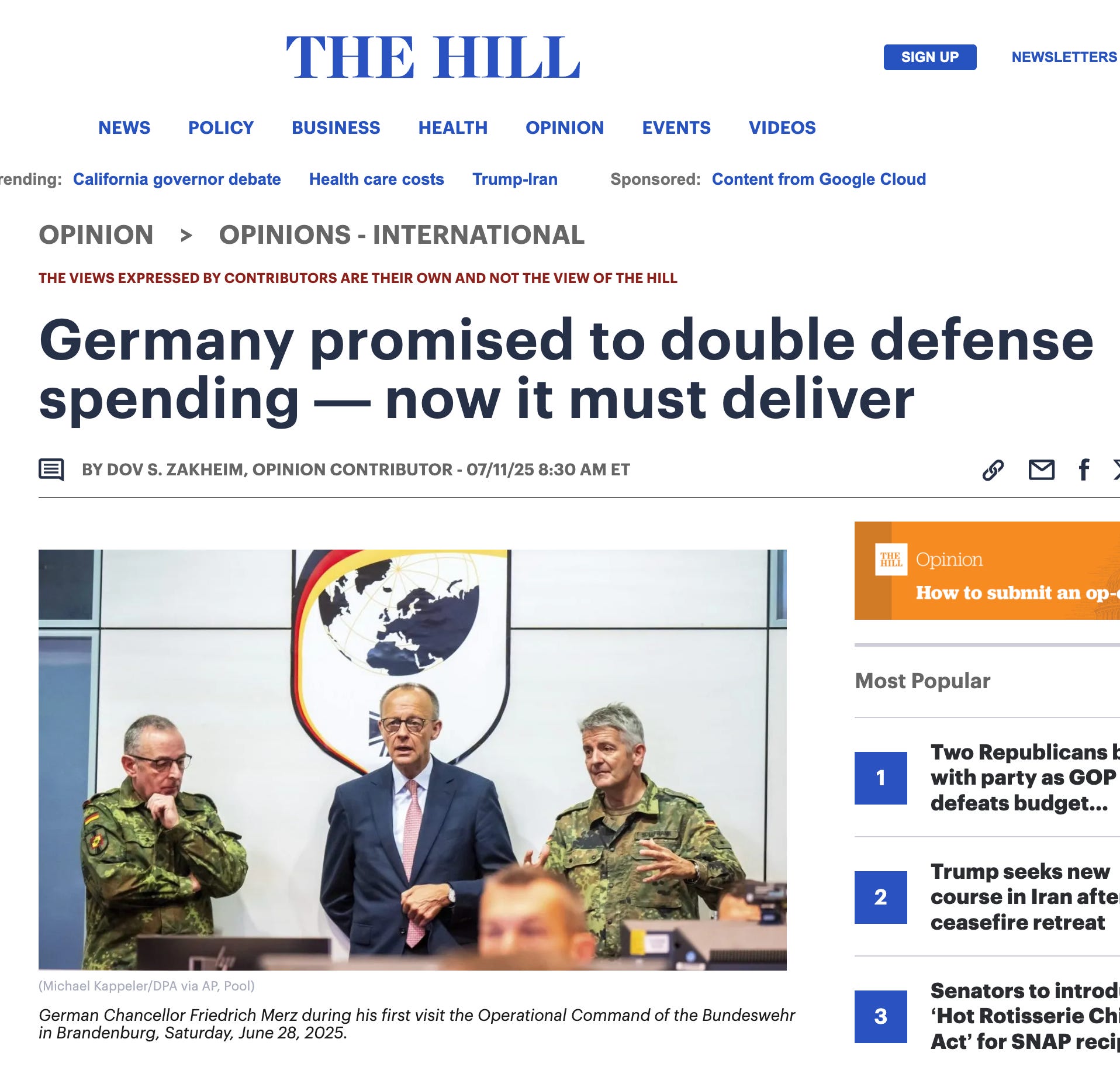
Watch the Bundestag vote on the next defense budget increase. Watch which company wins the AI targeting contract when the Bundeswehr announces its next-generation capability. Watch whether Japan’s revised defense posture specifies the nationality of the software systems doing its threat assessment.
The settlement is not sacred. Nothing is, but the thing being undone took fifty million deaths to establish, and the company proposing to undo it has a billing department.
Point 15 is a sentence. Read it before the next Bundestag budget vote. Forward it to anyone covering German or Japanese rearmament as if it's a sovereign decision made in isolation.
Karp comes from Frankfurt, home of the Rothschilds. It will be interesting to see if Germans comply with this. The US bombing of the Nordstream has wrecked their energy and fertilizer source before Iran was in the crosshairs. I suspect they're not as naive as US citizens.
The Rothschilds engineered the war that killed 50M people. No one knows that as well as the Germans, despite the fierce thought police suppressing their collective memory.