
The Second Invoice: How Peace Became a Billing Event

Trump called Obama’s $1.7 billion transfer to Iran “treason” in 2016.
He is now party to a $300 billion reconstruction fund going in the same direction.
Everyone’s calling it hypocrisy. That’s the wrong word. Hypocrisy implies inconsistency. This is perfectly consistent. Just not in the way people think.
Neither number was ever a gift to Iran. Not Obama’s. Not Trump’s. And the taxpayer everyone’s performing outrage on behalf of was never getting a cent of either.
Let me explain what is actually happening.
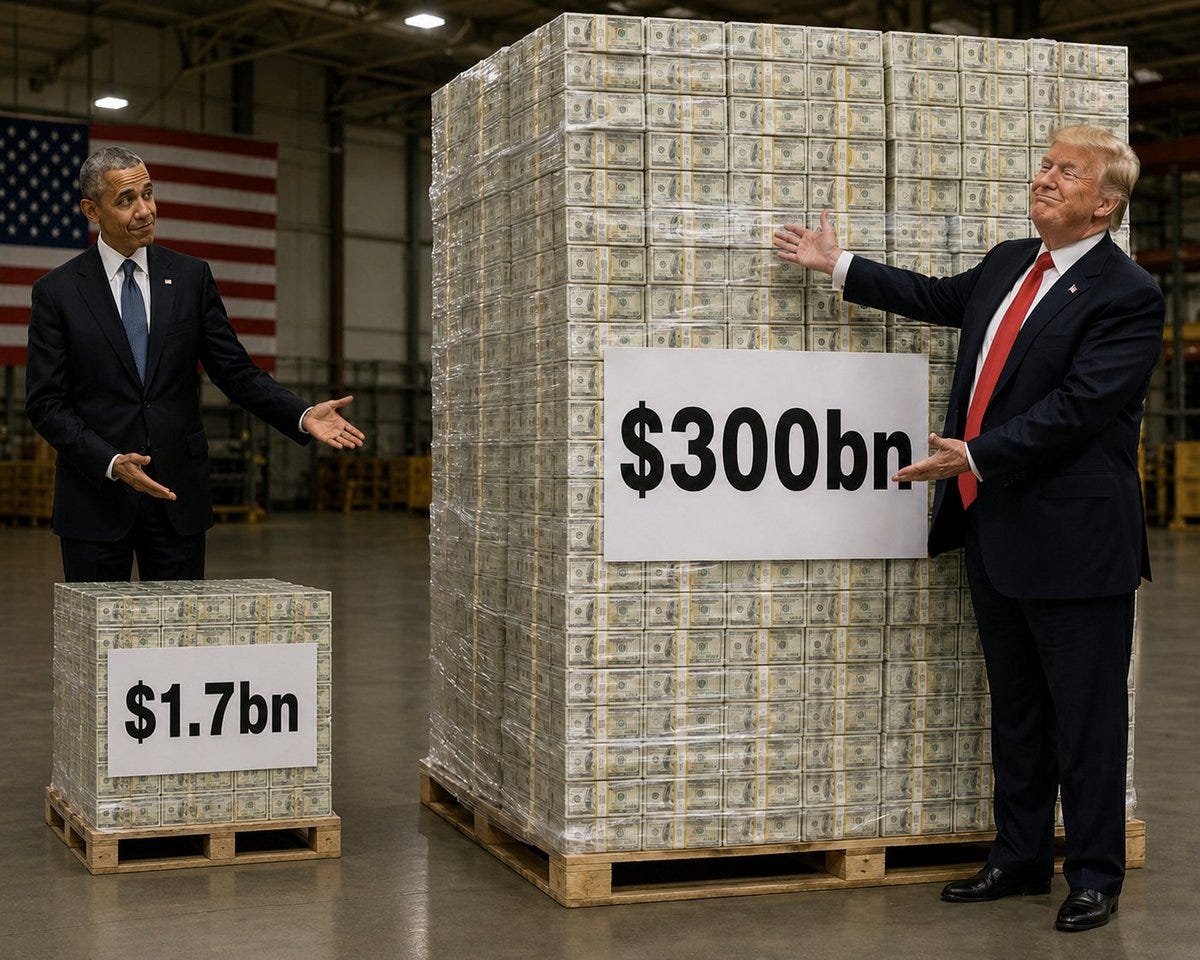
Obama’s $1.7 billion was Iran’s own money. $400M original deposit plus interest calculated at approximately $1.3B after 40 years. In the 1970s, Iran paid the United States $400 million for weapons it ordered and never received after the revolution. A tribunal was moving toward ruling against the US. They settled first, paid the interest they’d been sitting on for four decades.
The money was shipped on pallets, physically as cash. Not because it was a secret deal or a dramatic gesture. Because the US had locked Iran so completely out of the dollar banking system that Iran couldn’t receive a wire transfer of its own funds. The pallets weren’t proof of a gift. They were proof of something more interesting: how total US control over global financial plumbing actually works. If you can’t wire money to a sovereign state, you own the pipes.
Hmmm.
Now the $300 billion.
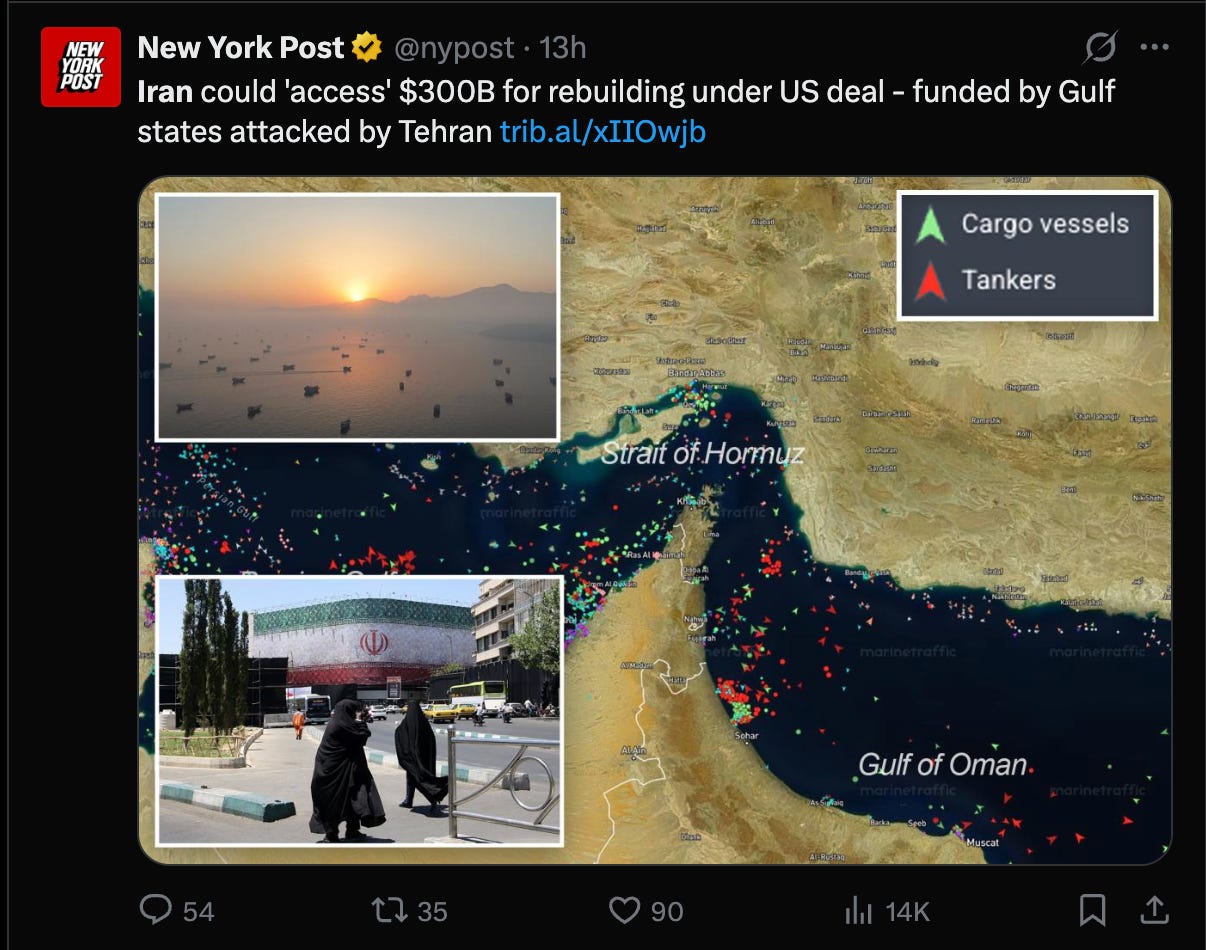
Read past the number. Here’s what the reporting actually says: it’s an “investment fund.” A “reconstruction program.” The administration is reportedly trying to get Gulf states to fund it. Trump’s own stated red line: he will not sign anything that looks like cash going to Iran.
Put those three facts together.
A fund. Gulf money. No cash to Iran.
Iran does not receive $300 billion. A fund does. And a fund doesn’t write a government a check. It issues contracts.

Iran’s grid was hit in the war. Refineries. Ports. Telecom infrastructure. Housing stock. Somebody rebuilds all of it. And it will not be Iranian firms, not with the sanctions architecture still partially in place, not with the capital constraints Iran has operated under for four decades.
It will be the Wall Street engineering and construction companies that show up after every war. The same names that rebuilt Iraq after 2003. The energy majors that put oil and gas infrastructure back online. The telecom and digital firms that rewire the country. The financial services firms that structure the debt instruments underneath all of it.
The $300 billion is the budget. The contracts are the product. The profit at every stage is the point.
Whether the money is US taxpayer, Gulf sovereign wealth, or both only changes whose name is on the deposit slip. It doesn’t change who collects. The same handful of corporations collect either way. The geopolitics is the wrapper. The contracts are the contents.
So why does Iran sign this?
Because it won’t call it that.
The framing coming out of Tehran: we forced the aggressor to pay $300 billion in reparations for what they did to us. We made them compensate. We won.
Same money. Same contracts. Same foreign firms walking into Iranian infrastructure with mandates and equity stakes. Opposite story. That’s how a party in a weak structural position accepts terms it could never accept in the open, not by changing the terms, by changing the wrapper.
Iran gets the parades. The contractors get the assets.
This is not new. This is not a Middle Eastern peculiarity. This is a documented architecture that Africa has experienced repeatedly, and Ghana just ran the updated version four years ago.
Ghana, 2022. The economy collapses. Debt default. Cedi in freefall. The IMF arrives with a $3 billion program, conditionalities attached: subsidy removal, privatization targets, revenue mobilization requirements.
Finance Minister Ofori-Atta, and later Ato Forson under the new Mahama government had to sell this to Ghanaians. The language in official government communications: “homegrown solutions,” “stabilizing our economy on our own terms,” “national economic recovery.” The IMF paperwork said something structurally different.
Same architecture. The lending institution sets the terms. The foreign contractors hold the implementation mandates. The domestic government rebrands the transaction as agency. The population holds the austerity and calls it sovereignty.
Tehran will use “reparations” language for what is, structurally, an IMF-adjacent reconstruction program with Gulf equity and Western contractor dominance. Accra used “homegrown solutions” for what was, structurally, an IMF program. Different latitude. Same playbook.
This is monetary architecture and narrative infrastructure running as a single machine. The narrative wrapper is not decoration. It is the operational mechanism that makes the financial transaction politically survivable for the domestic leadership. Without the reparations frame, Araghchi cannot sell this in Tehran. Without the “homegrown” frame, Akufo-Addo cannot sell this in Accra. The narrative is the delivery mechanism. The money is the product.
Now let me show you the full architecture.
The war was Invoice One. The MIC: military-industrial complex, collected on the destruction phase. Every bomb, every missile, every air defense system activated, every naval deployment, every weapon platform used in the conflict generated a line item. $1 billion a day in war costs is not a tragedy for the defense contractors. It is revenue recognition. The bombs are the product. The war is the sales channel.
The reconstruction fund is Invoice Two. The FIC: financial-industrial complex, collects on the rebuild. The engineering firms. The energy infrastructure companies. The telecom providers. The private equity structures that will take equity positions in rebuilt Iranian assets in exchange for capital.
One transaction. Two invoices. First they bill you to break it. Then they bill you to rebuild it.
The same architecture, run at scale, on Libya after 2011. NATO’s military campaign (Invoice One) created the conditions for reconstruction investment. The UN-recognized transitional government then signed oil concession agreements with the countries that bombed Libya. Total, ENI, BP repositioned within 24 months. Gaddafi’s Libyan Investment Authority, $200 billion in sovereign wealth was frozen (still) and partially absorbed into the reconstruction cost accounting. The war was the entry fee. The reconstruction was the asset acquisition.
Libya is the Lebanon of North Africa. Lebanon is the Gaza of the Levant. The geometry of destruction follows the geometry of extractable value: transit corridors, ports, energy infrastructure, real estate in strategic urban centers.
Nobody is going to pin this on the United States government. And that’s the elegance of it.
America comes out of the Iran deal looking weak. Paying $300 billion to the country you just bombed is not a strong look. But the corporations executing the deal don’t care whose flag is on the fund. They care about the contract award. They care about the equity stake. They care about the 20-year concession.
The political theatre: Trump vs. Obama hypocrisy, “does Iran get cash,” Senate hearings, press conferences, is noise. The signal is the contract mandates when they’re awarded. That’s the document that tells you what actually happened.
Cui bono? Not Iran. Not America. Not the Ayatollah. Not Trump.
The firms with the engineering mandates. The energy majors with the field development contracts. The financial institutions structuring the debt instruments.
That’s who benefits. Watch their announcements in the 18 months following any signed deal.
The DRC has been at war since 1996. Thirty years of conflict. The most resource-rich territory on earth, $24 trillion in mineral wealth estimated beneath the ground. GDP hovering around $70 billion (2024).
Congo doesn’t get a reconstruction fund. Congo gets peacekeeping missions and NGO operations and bilateral aid with conditionalities. Why? Because Congo’s value isn’t in rebuilding, it’s in maintaining the conditions that allow extraction without the complications of sovereign infrastructure. A strong Congolese state with functioning institutions and revenue-capturing capacity would be worth far less to the mining companies than a weak one requiring security partnerships to operate.
The reconstruction never comes to certain territories because reconstruction would mean sovereignty. And sovereignty would mean negotiating from strength.
Iran is not the DRC. Iran is a state with institutional durability, a large educated population, and strategic geography. Iran gets the reconstruction fund because Iran’s value, in this phase, comes from rebuilding it and then holding the rebuilt assets.
The question of whether Iran becomes a partner or a vassal in that process comes down to one thing: competition. If GCC capital competes with Chinese capital competes with European capital for Iranian reconstruction contracts, Iran has leverage. If it’s only China, Iran becomes an energy vassal with a reconstruction wrapper.
Watch the contract awards. Count the bidders.
The taxpayer paid for the bombs.
The taxpayer will pay again for the rebuild, through Gulf states drawing down sovereign wealth linked to US financial architecture, through defense and development budgets, through the inflation that war-spending generates globally.
None of it goes back to the taxpayer. The taxpayer sees none of it.
The corporations collecting from both invoices will do so quietly, with proper paperwork, under proper institutional cover, without anyone in the room cross-referencing Invoice One and Invoice Two in the same ledger.
That’s not hypocrisy. That’s architecture.
Don’t ask whether Trump is a hypocrite. Ask who’s in the room when the reconstruction contracts are awarded.
That room will tell you more about what this war was really for than anything Trump or Araghchi will say at any press conference.
If you're still watching the press conferences to understand the deal: you're watching the wrapper, not the contents. The contract awards tell the actual story. Forward this to someone who's still counting Trump's contradictions instead of the contractor mandates.
Thanks for helping me put my thoughts in order