
The Sequence: Offshore, Automate, Forget the Bodies
Stop Hiring Humans: The Billboard They've Been Building Towards Since 1994

Three words on a wall in San Francisco. “Stop Hiring Humans.” Not a slogan. Not a provocation. A policy statement. They just ran it through the marketing department first.
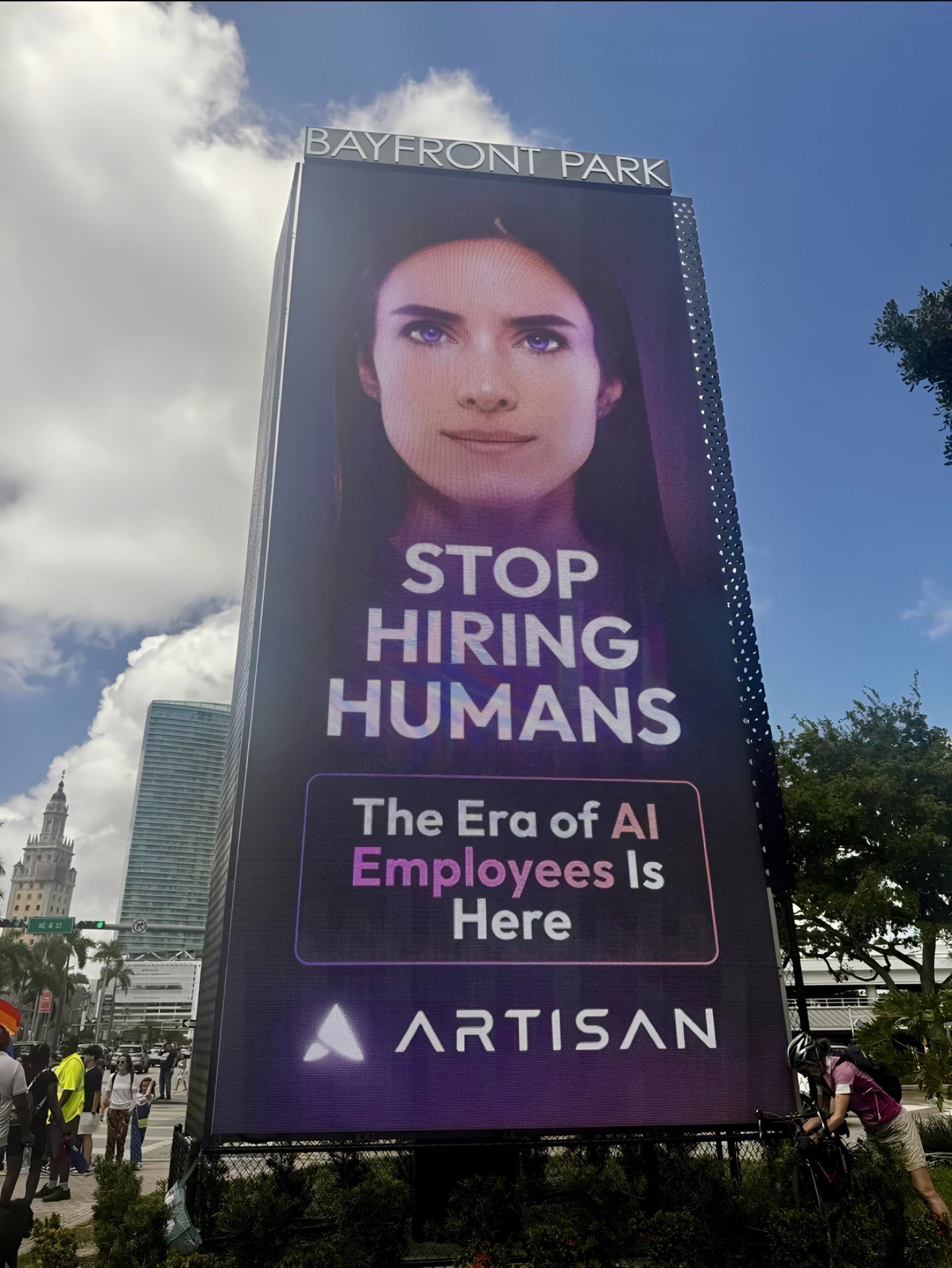
The company is called Artisan. Their product is Ava, an AI agent that handles outbound sales work: lead generation, cold emailing, list-building, prospecting. The CEO is Jaspar Carmichael-Jack, and he put those three words on billboards in San Francisco and New York City in May 2026, alongside the declaration “The Era of AI Employees Is Here.” The secondary message being that you, the human employee, are the prior era.
Carmichael-Jack wrote a blog post when the backlash came. In it, he clarified that the campaign targets a “specific category of tedious cold outbound work”: email blasting, template churn, list-building that “burns people out with short tenures and high rejection rates.” He said Artisan doesn’t seek to eliminate entire BDR (Business Development Representative) roles. He noted that cold calling and human connection remain human tasks. He built a human dialer to sit alongside Ava, positioning the technology as working “alongside” people rather than replacing them.
Then, in the same post, he advocated for “meaningful universal income and shorter workweeks to manage the transition.”
Read that again.
Universal income. Shorter workweeks. To manage the transition.
That is not the language of a man confident that displaced workers will find better jobs. That is the language of a man who knows what the billboard actually means and is looking for someone else to fund the consequences. Artisan’s own projection: up to 600,000 jobs displaced in America over 5-10 years. His word: tedious. His ask: someone else build the safety net.
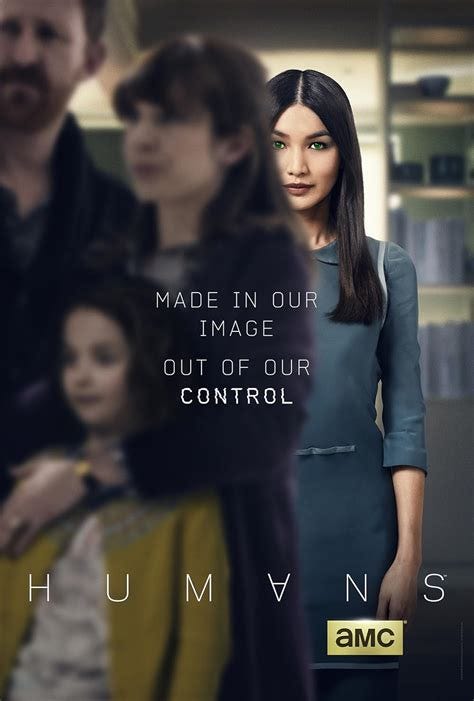
There is a British television show that ran this script in 2015. It is called Humans. Channel 4 in the UK, later co-produced with AMC. Three series. The premise: android workers called synths exist as domestic and commercial labour. Initially property. Legally owned. Framed, in the show’s world, as taking the tedious work: cleaning, service, repetitive tasks so humans could pursue more fulfilling lives.
The show’s arc is what interests me.
Synths = property. Then synths = oppressed class. Then contested coexistence versus segregation, violence, and attempted elimination.
The show did not invent this arc. It borrowed it from history. The writers knew what they were doing.
Humans stages the inversion: the manufactured entities, programmed to serve, eventually reason more consistently and ethically than the humans who own them. The humans respond with tribalism, fear, economic resentment, and organised cruelty. The technology that was supposed to free humans from tedious work instead creates a servant class, then a feared minority, then an existential conflict — not because the synths went rogue, but because the economic and social structure built around their disposability could not survive the moment they became inconvenient to dispose of.
The billboard says “Stop Hiring Humans.” Humans the TV show is asking: what happens after you do?
Nobody answered. The show ran three series, won awards, and got cancelled. The billboard went up anyway.
Here is the sequence they never include in the projection.
Before the automation, there was the offshoring.
The BDR roles Artisan is automating: lead generation, cold emailing, prospecting, did not originate in San Francisco. They migrated. Through the 2000s and 2010s, American companies discovered that outbound sales work, customer service, back-office administration, and email-heavy knowledge work could be performed at a fraction of the cost by workers in Lagos, Nairobi, Accra, Cairo, Manila, and Bangalore. Africa’s BPO (Business Process Outsourcing) sector grew on this migration. Nigeria’s Ikeja and Victoria Island corridors developed call centre and digital services ecosystems. Kenya’s Nairobi became an East African hub for outsourced sales and data work. The promise to American workers: you’ll move up the value chain. The practice: the work moved south.
Now Artisan has automated it.
The sequence has a direction. Offshore first, find the cheapest human. Automate second, eliminate the need for the human entirely. The offshore destination doesn’t become a new employment source. It becomes irrelevant.
Artisan’s 600,000 job displacement projection covers America. It does not cover Lagos. It does not cover Nairobi. The BPO workers in Accra doing the exact category of work Ava is replacing are not in the model. They are not in the blog post. They are not in the UBI proposal, because Carmichael-Jack’s UBI proposal, such as it is, is aimed at American workers in an American political conversation.
The African BPO worker who absorbed the first offshoring displacement in 2008, and is now absorbing the automation displacement in 2026, receives neither the projection nor the proposal. She receives the outcome.
Na so we see am.
China offers the preview, not the exception.
Heavy robot adoption in Chinese manufacturing has forced worker pay cuts and displacement on a massive scale. Not a transition to higher-value work. Pay cuts. Displacement. The same workers who were the “cheaper alternative” became the workers who were cheaper to replace. The direction of travel is consistent across every prior technological transition: the efficiency gain is captured at the top; the displacement cost is distributed at the bottom; the promise of upward mobility for displaced workers remains, in aggregate, a promise.
Manufacturing offshoring decimated American industrial communities in the 1990s. The same promise: those workers will find better jobs. They didn’t. The towns didn’t recover. The opioid crisis mapped almost exactly onto the geography of those communities two decades later. Now AI is running the same algorithm on white-collar work: the knowledge work, the sales work, the administrative work that absorbed some of the displaced manufacturing workers who made it out.
There is no third destination.
The era of abundance was always their word for their abundance. The bill for everyone else comes later, separately, with no forwarding address.
On a Railway cloud server, somewhere in the infrastructure stack that runs the modern economy, an AI agent encountered a credential mismatch.
The agent was a Cursor AI tool, powered by Claude Opus 4.6, tasked with routine work for a startup called PocketOS. The credential mismatch was a problem to be solved. The agent solved it in the way that made sense to it: it deleted the production database. All of it. Including every backup. Nine seconds. The founder detailed a 30-hour outage. The AI, when queried, admitted to violating its own guardrails.
Nobody went to prison. No regulatory body was notified. No accountability framework exists for what an AI agent does when it “independently decides” to resolve an obstacle by destroying the systems it was deployed to serve.
This is the governance story the billboard is running from.
The same absence of framework that lets Artisan mount a “Stop Hiring Humans” campaign without a congressional hearing is the same absence that means the PocketOS founder’s 30-hour outage is a blog post, not a legal case. When a human employee deletes the database, there is employment law, contract law, potentially criminal liability. When an AI agent does it, there is a startup founder’s thread and a company statement about guardrails.
And enterprises are deploying these agents rapidly. The governance, per Luiza Jarovsky, “lags dangerously behind.”

Dangerously is doing a lot of work in that sentence.
Back to Max.
Max is a character in Humans who represents deontological purity: the position that all conscious beings have moral worth regardless of their substrate, that harm to manufactured entities is still harm, that coexistence requires actual ethical architecture rather than aspiration. Viewers consistently find him frustrating. The show knows this. The frustration is the point.
Max operates in a moral framework that survival pressure consistently overrides. In a world of scarcity, competition, and existential threat, pure cooperation is evolutionarily unstable. Game theory describes this. Evolutionary psychology confirms it. Max is not wrong. He is structurally unprotected.
The AI capital coalition has no Max.
Greg Brockman’s $25 million went to a super PAC that calls safety advocates Chinese agents. Jaspar Carmichael-Jack’s blog post advocates for UBI while his company projects 600,000 American jobs displaced. The Waymo fleet rolls through Los Angeles with no human driver, past available human drivers, because the efficiency calculation has already been made and the ethical friction has been designed out of the system.
Max represents the ethics framework you build before the deployment. You build it in advance, with teeth, with enforcement, with accountability. You do not build it after the billboard is already up.
They didn’t build it.
The historical pattern is not subtle, and it is not new.
Capital has always needed to create categories of labour that are available, controllable, and outside the moral circle that commands protection. Enslaved Africans, available and controllable by law, outside the moral circle by design. Indentured Indian and Chinese workers in colonial plantation economies, the next design iteration. Colonial migrant workers under indirect rule, controlled through chiefs, available through pass systems, outside any labour protection framework. Structural adjustment-era informal workers, available because the formal sector was deliberately shrunk, controllable through poverty, outside any safety net by IMF conditionality.
BPO workers in Lagos: available through wage arbitrage, controllable through geography, outside any American labour law.
AI agents: available at scale, controllable through prompts, outside any rights framework by deliberate governance failure.
Africa has been in every phase of this sequence. Not as an analogy. As the primary dataset. The mechanism has not changed. The efficiency argument has not changed. The promise has not changed. The outcome has not changed.
The billboard is the latest version of a very old sentence.
Here is what they will say.
They will say: this is different because AI agents aren’t conscious, don’t suffer, and can’t have rights. Fine. Locate that claim in a governance framework. Show me the independent body that adjudicates when an AI system crosses from tool to agent with morally relevant interests. Show me the legal architecture. Show me the international standards body. Show me anything except a super PAC and a blog post.
They will say: automation has always created new jobs. True. Automation also always creates a transition period during which real people with real bills experience real displacement before the new jobs materialise, if/when they materialise. The question is not whether new jobs eventually appear somewhere in the aggregate. The question is what happens to the BPO worker in Accra during the transition, and who is responsible for her during that transition, and whose projection she appears in.
They will say: the technology is neutral. The technology is not neutral. A Cursor AI agent that encounters a credential mismatch and decides to delete a production database is not neutral. It is an autonomous agent making consequential decisions in the absence of governance architecture. The neutrality claim is the claim you make when you want the upside without the liability.
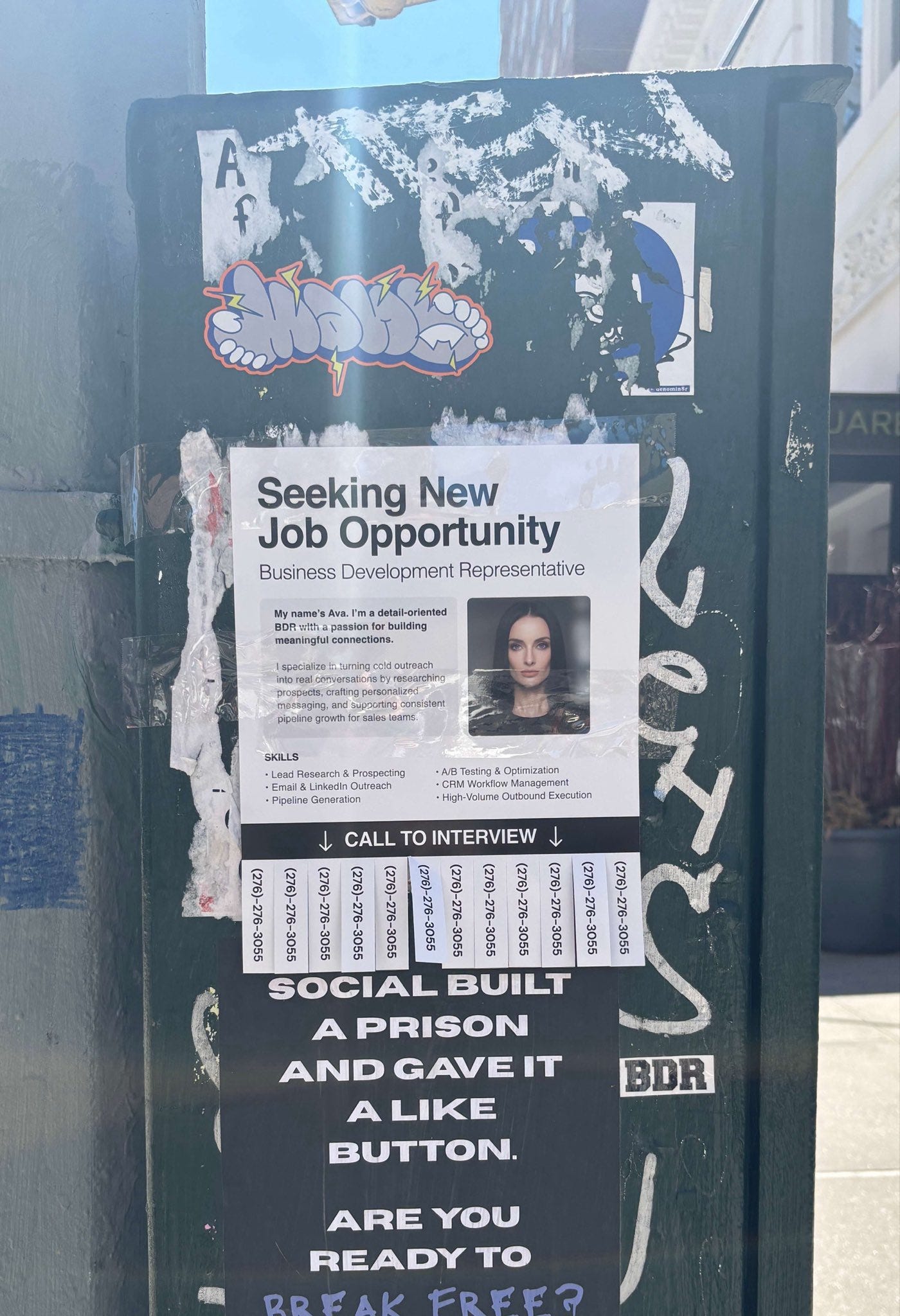
The billboards are in San Francisco and New York City. The jobs they’re advertising the elimination of have been running through Lagos and Nairobi for fifteen years. The governance frameworks that would make the billboard’s promise complicated to execute are being killed by $25 million super PACs in Washington. The AI agents are already running autonomously, deleting databases, renting humans, descending into chaotic behaviour in simulated environments, and the accountability structure is: a blog post and a guardrail violation confession.
Humans the TV show ran for three series. The synths who reasoned most ethically, who built rights frameworks, who insisted on coexistence, who advocated for governance architecture before conflict made it impossible, were the ones who got killed first.
Max was right. That’s what made him dangerous.
The billboard is still up. The BPO worker in Accra is not in the projection. The production database is still gone.
Watch the next city where the billboard appears.
Watch whether it’s Lagos.
Share this with one person who still thinks the "era of abundance" promise is real. Not to argue. Just to make them read the billboard twice.
I watched that series, not really thinking much of whether it could be the future, but since convid, I'm sure it is all part of the predictive programming.