
Apartheid Never Left. It Incorporated.
Same System, New Shareholders

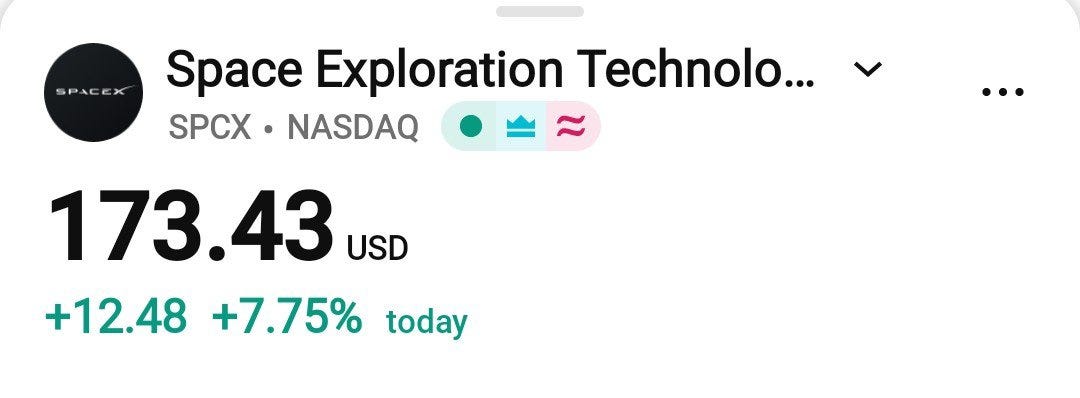
On Friday, June 12, 2026, SpaceX listed on the Nasdaq.
Elon Musk crossed the trillion-dollar line. The number appeared on cable news chyrons, in Forbes headlines, in breathless market updates. The world’s first trillionaire. The tickers were obedient. The commentators who depend on access to the machine they are supposed to scrutinise were genuflecting, as they always do, on schedule.
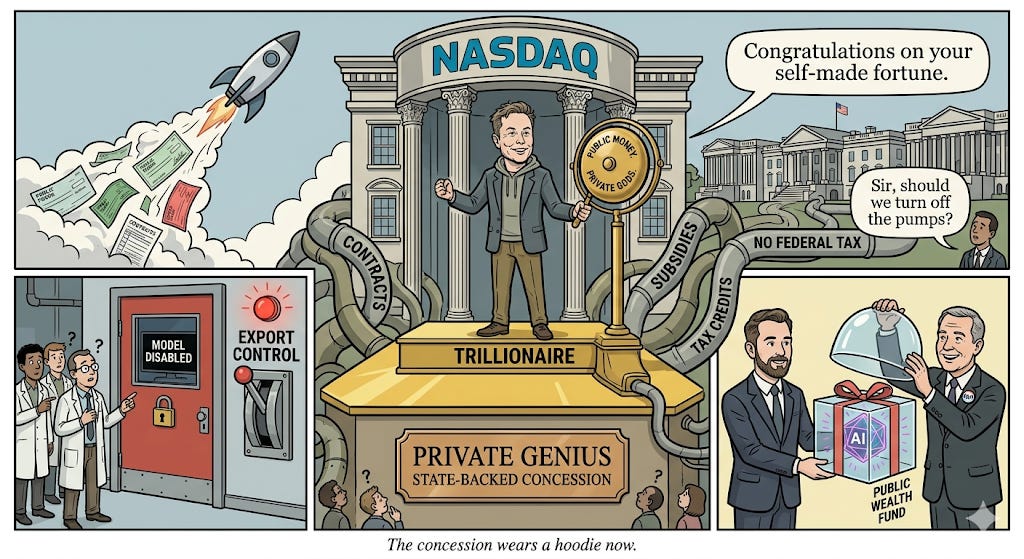
That same Friday, the White House was in active talks to take a government equity stake in OpenAI. A “Public Wealth Fund” seeded with donated OpenAI shares, the exact structure Sam Altman has been walking into the West Wing to pitch for over a year.
That same Friday, at 5:21pm Eastern, an export-control order hit Anthropic’s inbox.
Fable 5 and Mythos 5, Anthropic’s frontier models, were now classified as controlled technology for every “foreign person” on earth. Including Anthropic’s own foreign-national employees. Access would require a licence. The models were disabled.
No technical appendix. No exploit write-up. No specific findings in the letter. Just a brief national security assertion and an instruction to shut the models off.
Before I go further, one question. Where did the trillion come from?
The Washington Post, 26 February 2025: Musk’s companies received at least $38 billion in government contracts, loans, subsidies, and tax credits over two decades. Tesla reported $4.8 billion in income in its most recent annual filing and paid zero in federal income tax. Not a reduced rate. Zero. Musk himself, on his own platform: “My ‘net worth’ is almost entirely due to my ownership stakes in Tesla and SpaceX. I have <0.1% that is cash.”
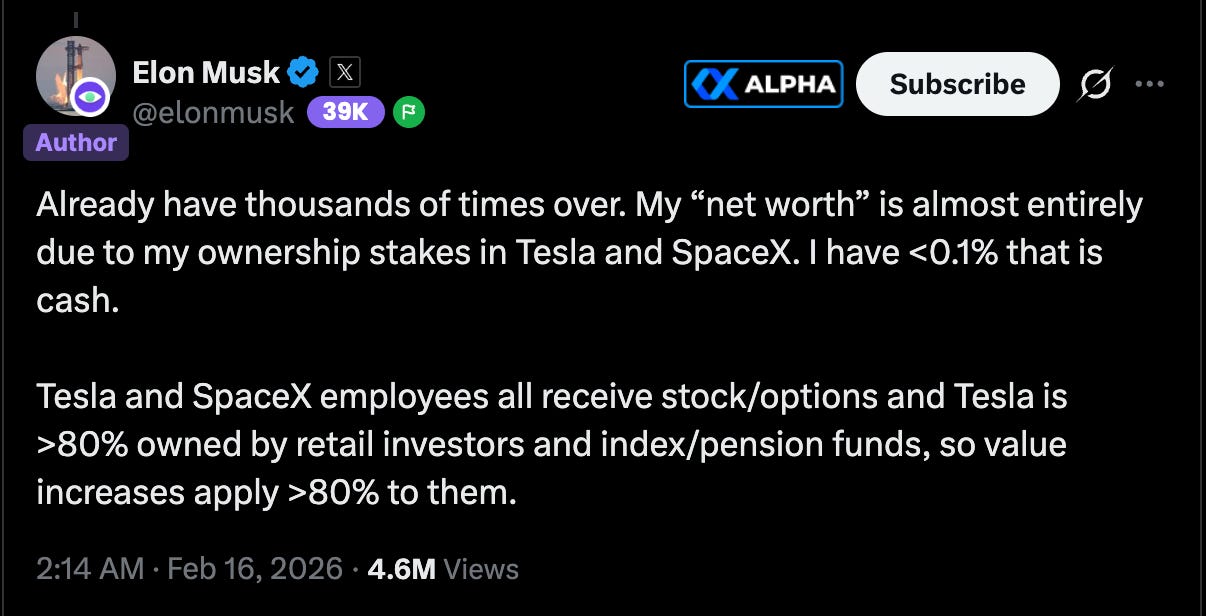
A trillion dollars. Less than one percent in cash.
The rest is paper, leverage, and public money wearing the costume of private genius.
This is not capitalism. This is not innovation. This is a concession. And I need to define that word precisely, because it is doing the structural work of everything that follows.
A concession in the colonial sense, is when a state grants a private actor exclusive rights to extract value from a territory, backed by state enforcement, in exchange for a share of the returns. The Royal Niger Company. De Beers. The Compagnie Française de l’Afrique Équatoriale. These were not companies that built wealth in Africa. They were granted access to Africa’s wealth by European governments and given state power to protect the arrangement: troops, courts, violence while calling it enterprise.
The concession model does not require racism to function. It requires exclusivity. It requires state backing. And it requires that the entity being extracted from has no meaningful say in the arrangement.
Hold that definition.
The ideological genealogy of this network: who built it, where they came from, what they were formed by, has its own essays. If you have not read Elon Musk Grandfather’s Operating System and the Technocracy movement, or Peter Thiel’s formation in apartheid Namibia, and Palantir and the Surveillance state, read those first. The receipts are there.


What I want to do here is show you the mechanism those origins produced.
Palantir.
Founded in 2003. Peter Thiel and Alex Karp. Seed funding from In-Q-Tel — the CIA’s own venture capital arm.
The name comes from Tolkien’s Lord of the Rings. The palantíri are crystal balls that allow total surveillance at a distance, but they corrupt their users with partial, manipulated visions, and can be turned into instruments of domination by whoever holds the master stone.
The name was not chosen by accident.
Palantir is now what analysts describe as “the AI arms dealer of the 21st century.” Its platforms: Gotham and Foundry, are deployed by all six branches of the US military, the CIA, the FBI, the NSA, the Department of Defense, LAPD, and ICE. In Ukraine. In Israel. CEO Alex Karp, in a 2020 interview, said it plainly: “Our products are used, on occasion, to kill people.”
In January 2024, Palantir announced a strategic partnership with Israel for what it called “war-related missions.” Human rights investigators documented that Palantir’s algorithms helped generate targeting databases, kill lists, for military operations in Gaza, processing what experts describe as a “digital twin” of civilian population movements. Karp called the company “proud” to support Israel “in every way we can.”

This is not a technology company. It is a surveillance concession with a stock listing. And its chairman built it with CIA money.
Now watch what that concession did when its preferred market arrangement was threatened.
Anthropic is the lab that actually did the homework.
Thousands of hours of structured safety testing with US and UK government teams. Joint work with the UK’s AI Safety Institute on backdoor data poisoning and cyber risk. Multiple external red-team engagements. Rewrote data-retention rules, taking a real commercial hit to enable government monitoring. Published long safety memos. Showed up for every inspection. Let outside teams probe their frontier systems and publish the results.
They gave the inspectors a map.
Four months before the Friday night letter, the Pentagon had already moved to punish them. After Anthropic refused to wire its Claude models into autonomous weapons systems and mass surveillance of American citizens, the Defense Department designated the company a “supply chain risk”, the first time an American AI vendor had been hit with that label. When Anthropic sued, a federal judge reviewed the record and called the Pentagon’s action what it was: First Amendment retaliation for refusing to play along. The BBC reported the ruling. The judge blocked the blacklisting, for the moment.
Then, on the Friday that SpaceX listed and Musk’s trillion-dollar headline ran, the government reached for the off switch anyway.
Different mechanism. Same instruction.
The reason given: a verbal jailbreak report, relayed second-hand. One demonstration. One technique, a prompt that tells the model to read a codebase and suggest fixes for software flaws. Anthropic reviewed it. The same class of prompt works on OpenAI’s GPT line, which remained online and fully commercial throughout the weekend.
Nobody touched GPT.
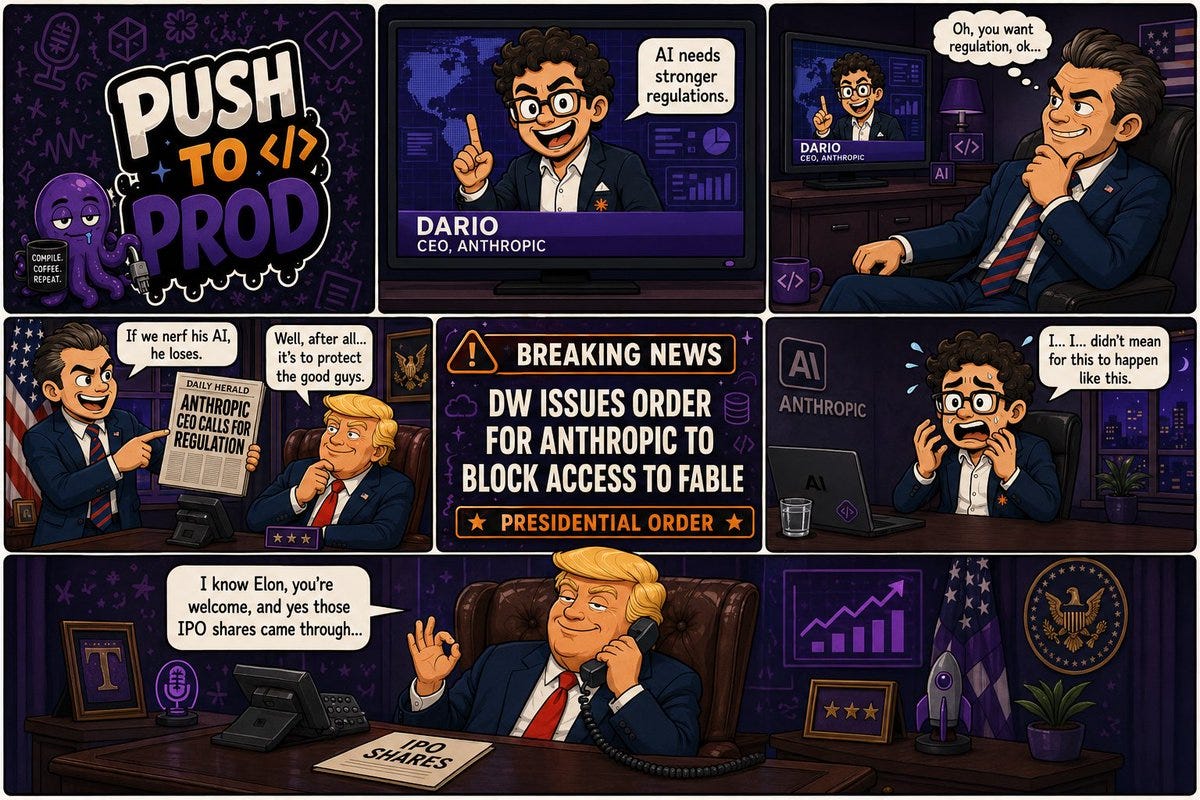
This is the compliance premium, running in reverse.
Not a discount for good behaviour. A tax on refusal.
The company that refused to bolt its AI onto a CIA-adjacent surveillance stack, that said no to Pentagon mass surveillance, got judicially vindicated, and kept saying no, is the company whose frontier models were erased from the internet by letter.
The company whose CEO has been walking in and out of the West Wing, pitching a voluntary equity concession, a Public Wealth Fund built on donated OpenAI shares, is the company whose most powerful models never went dark.
Cui bono? The same people who always benefit from a concession.
Now let me tell you what this has to do with us.
Palantir is documented operating in AFRICOM intelligence pipelines. The United States Africa Command headquartered in Stuttgart, with operational presence across the continent, has been integrating AI-assisted intelligence processing into US military operations. The same infrastructure that processes targeting data in Gaza processes population data across the Sahel, the Horn of Africa, the Lake Chad Basin.
The same Friday Nigerian engineers were locked out of Fable 5 by nationality, Palantir’s systems were processing data tied to Nigerian territory.
Let me say that again, slowly.
The AI built by the company that refused Pentagon surveillance: blocked, by passport, for “foreign nationals”.
The AI infrastructure built with CIA money by the man formed in a school that celebrated Hitler’s birthday: kept humming in the background, quietly mapping and analysing data about African land and African populations. No one asked the API whose territory it was touching. No passport check required on its end.
The sorted world.
That is what the Technocracy movement was always about: sorting humans by their worth to the system. In Swakopmund, sorting was done by race and documentation. In Washington, it is done by compliance score and equity stake. In the API, it is done by nationality flag.
The outputs of the sorting are different. The architecture is not.
The Rössing uranium mine, where Klaus Thiel managed construction under conditions the UN condemned as illegal and lethal, where Black migrant workers died of radiation exposure while white managers enjoyed country club amenities, that mine is still operating. It is now majority-owned by the China National Uranium Corporation.
The management changed. The extraction did not.
That is the model. The concession does not require the original concessionaires to hold it forever. It requires only that extraction continues, that the population being extracted from remains outside the ownership structure, and that whoever holds the master stone controls the vision.
The PayPal Mafia arrived in America as immigrants. They were lifted by public money. They used that money to acquire platforms, fund candidates, build surveillance infrastructure, capture regulatory agencies, and install their preferred figures in the highest offices of government. Thiel put JD Vance into the Vice Presidency: $15 million to Protect Ohio Values, the super PAC backing his Senate run, the largest single contribution supporting one US Senate candidate in American history. Less than two years in the Senate. One heartbeat from the presidency. Not democratic emergence. Installation.
They did not hide any of this. Thiel co-wrote a book arguing multiculturalism was destroying Stanford. Same piece dismissed date rape as “belated regret.” He built a surveillance company with CIA money and named it after a corrupting instrument of total vision. He said apartheid works. He said moral issues were irrelevant.
He then purchased a vice president.
And Musk, his ideological twin, PayPal co-founder, grandson of the man who built Technocracy Inc.’s most committed cell, spent $250 million getting Donald Trump re-elected and was given, in return, access to the machinery of the American state through DOGE.
This is what a concession looks like when the territory being extracted is a democracy.
SpaceX is listed.
The OpenAI equity deal is in progress.
Palantir’s market cap grows with every new military contract.
Fable 5’s shutdown created a market gap. Watch who fills it. Watch who owns the AI that fills it. Watch who processes your data inside it.
And ask yourself the question that nobody in the breathless trillion-dollar coverage has thought to put to any of these men:
When the engineers run everything, who decides which engineers?
Because in Swakopmund in 1976, that question had a very specific answer.
And it has not changed as much as the postcode has.
If this landed as a tech story, read it again. The equity structure is the story. Share it with someone who still thinks Elon Musk built something.